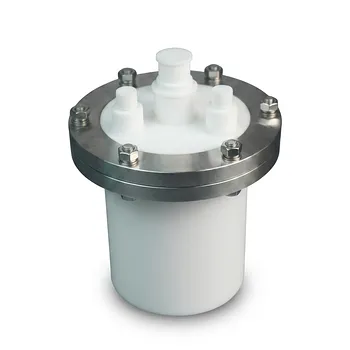
Hydrothermal synthesis reactors require high-performance fluoropolymer liners for xylose carbonization primarily to withstand the corrosive, acidic environment produced during the reaction and to prevent metal ion contamination. At temperatures reaching 220 °C and high spontaneous pressures, these liners act as an inert barrier that protects the stainless steel reactor body from chemical attack while ensuring the resulting biomass-derived carbon maintains a high degree of purity.
Core Takeaway: A PTFE or PFA liner is a non-negotiable safety and quality component that isolates harsh acidic reactants from the metal reactor shell, preventing structural corrosion and the leaching of performance-degrading metal impurities into the carbon skeleton.
Protecting the Structural Integrity of the Reactor
Mitigation of Acidic Corrosion
Hydrothermal carbonization (HTC) of biomass like xylose creates a highly acidic environment as the organic material breaks down. Without a liner, these acids would directly attack the stainless steel walls of the autoclave, leading to pitting and structural weakening over time.
Isolation of the Metal Shell
The fluoropolymer liner serves as a critical reaction carrier, providing a sealed space that effectively isolates the liquid medium. This isolation ensures that the external metal vessel, which provides the necessary mechanical strength to hold pressure, is never compromised by corrosive chemical reactants.
Ensuring Chemical Purity and Product Performance
Prevention of Metal Ion Leaching
High temperatures and pressures can cause metal ions to leach from the reactor walls into the reaction solution. A PTFE liner prevents these ions from entering the carbon skeleton, which is essential for producing high-purity biomass-derived materials.
Maintaining Surface Functional Groups
The chemical inertness of the liner ensures that the surface functional groups of the synthesized carbon remain consistent and uncontaminated. This is particularly vital for applications like carbon quantum dots, where metal impurities can cause fluorescence quenching and reduce sensing sensitivity.
Providing a Non-Stick Interface
Fluoropolymers like PTFE possess unique anti-adhesion properties that provide a pure reaction interface. This prevents the carbonized products from sticking to the walls, ensuring a higher yield and making the reactor much easier to clean without using abrasive methods that could damage the vessel.
Withstanding the Hydrothermal Environment
Thermal and Pressure Stability
High-performance PTFE liners are designed to remain stable at temperatures up to 220 °C. This thermal resistance is necessary to facilitate the spontaneous pressures generated during the hydrothermal synthesis process without the liner deforming or degrading.
Handling Complex Solvent Systems
Xylose carbonization often involves complex solvent systems and organic intermediates that can be chemically aggressive. The exceptional chemical inertness of fluoropolymers allows them to remain unreactive even when exposed to a wide variety of organic solvents and metal salts at high heat.
Understanding the Trade-offs and Limitations
Temperature Thresholds
While PTFE is highly resilient, it has a strict upper thermal limit, typically around 220 °C. Exceeding this temperature can cause the liner to soften or release toxic fumes, meaning it is not suitable for ultra-high-temperature synthesis.
Thermal Expansion Disparity
Fluoropolymers and stainless steel have different thermal expansion coefficients. Rapid heating or cooling can cause the liner to deform or "creep" if the reactor is not designed with the proper tolerances to accommodate these physical changes.
Making the Right Choice for Your Project
Application-Specific Recommendations
- If your primary focus is maximum chemical purity: Always use a virgin PTFE liner to ensure no trace metal contaminants interfere with the carbon skeleton or optical properties.
- If your primary focus is temperatures above 220 °C: You must move away from fluoropolymer liners and consider specialty alloys or glass-carbon inserts, though these offer different chemical resistance profiles.
- If your primary focus is high-throughput cleaning: Utilize PFA liners if available, as they offer similar inertness to PTFE but often provide a smoother surface for even easier product recovery.
The use of a high-performance fluoropolymer liner is the industry standard for ensuring that hydrothermal carbonization remains a controlled, pure, and safe chemical process.
Summary Table:
| Feature | Benefit for Xylose Carbonization | Impact on Results |
|---|---|---|
| Acid Resistance | Protects reactor from organic acids | Prevents vessel pitting & failure |
| Metal Isolation | Blocks leaching of Fe/Ni/Cr ions | Ensures high-purity carbon skeleton |
| Non-Stick Surface | Prevents carbon sticking to walls | Maximizes yield & simplifies cleaning |
| Thermal Stability | Maintains integrity up to 220°C | Enables safe hydrothermal pressure |
| Chemical Inertness | Prevents fluorescence quenching | Vital for carbon quantum dot quality |
Elevate Your Research with Precision Fluoropolymer Engineering
At KINTEK, we specialize in the absolute focus of high-performance fluoropolymer materials, ensuring your hydrothermal synthesis and chemical reactions achieve unparalleled purity. Whether you are performing complex biomass carbonization or sensitive trace analysis, our components provide the inert environment your science demands.
Our Comprehensive Product Range Includes:
- Essential Labware: PTFE/PFA beakers, crucibles, reagent bottles, and digestion tubes.
- Fluid Management: High-purity tubing, fittings, valves, and manifold components.
- Sample Prep Tools: Filters, separatory funnels, and precision tweezers.
- Advanced Apparatus: Standard and custom electrochemical cells, battery testing fixtures, and microwave digestion vessels.
Why Choose KINTEK? Backed by end-to-end custom CNC fabrication, we deliver everything from bespoke, non-standard machined parts to high-volume orders tailored to your specific laboratory setup. Don't compromise your results with metal contamination or equipment corrosion.
Contact KINTEK Today for Custom Laboratory Solutions
References
- Lorenzo Mazzoli, Jesús Barrio. Inducing porosity in xylose-derived FeNC electrocatalysts for alkaline oxygen reduction. DOI: 10.1039/d3gc04645a
This article is also based on technical information from Kintek Knowledge Base .
Related Products
- High Temperature Corrosion Resistant Hydrothermal Synthesis Reactor with TFM Inner Liner and Straight Cylinder Design
- High Pressure Custom TFM Reactor Stainless Steel Outer Vessel PTFE Inner Cup for Corrosive Synthesis
- PTFE Lined High Pressure Digestion Vessel 50ml High Temperature Hydrothermal Synthesis Tank
- Custom TFM Reaction Vessel with Stainless Steel Jacket and PTFE Inner Cup for High Corrosion Resistance
- Custom PTFE Reaction System with Hose Barb Fittings Corrosion Resistant High Sealing 2L 4L Lab Reactor with Separatory Funnel
People Also Ask
- What is the role of a corrosion-resistant reactor in the synthesis of lignin-based carbon dots? Ensure Maximum Purity
- What are the technical advantages of using hydrothermal synthesis reactors for advanced electronic & optical nanomaterials?
- How does a hydrothermal synthesis reactor facilitate the production of crystalline materials with tailored morphologies? Precision Crystal Growth
- Why is the sealing reliability of a hydrothermal synthesis reactor critical for 24-hour cycles? Ensure Nano-Precision
- What role do hydrothermal synthesis reactors play in CQD preparation? Achieve High-Purity Nanomaterial Synthesis