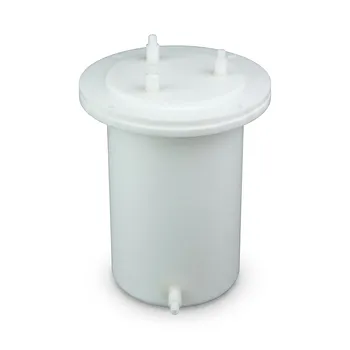
The integrity of MCM-48 mesoporous silica relies on a high-quality PTFE liner. This liner provides the chemical inertness and thermal stability required to withstand strong alkaline environments, such as sodium hydroxide, at constant temperatures of 120°C for up to three days. Without this barrier, the reaction would fail to achieve the high degree of structural order and purity that defines mesoporous materials.
High-quality PTFE liners act as a critical chemical and thermal shield that prevents metal ion contamination and withstands corrosive alkaline media, ensuring the successful synthesis of highly ordered MCM-48 structures.
The Chemical Challenge of MCM-48 Synthesis
Resistance to Strong Alkaline Media
The hydrothermal synthesis of MCM-48 typically involves strong alkaline media, often utilizing sodium hydroxide (NaOH) to facilitate the reaction. PTFE (Polytetrafluoroethylene) is uniquely suited for this role because it is exceptionally resistant to chemical attack by bases. This resistance ensures the liner does not degrade or react with the precursor solution during the synthesis process.
Thermal Stability for Extended Reactions
MCM-48 requires a consistent temperature of 120°C maintained for three days. High-quality PTFE can handle these hydrothermal conditions without losing its physical shape or structural integrity. This stability allows the reaction to proceed undisturbed, which is essential for the controlled growth of the mesoporous framework.
Protection of the Reaction Vessel
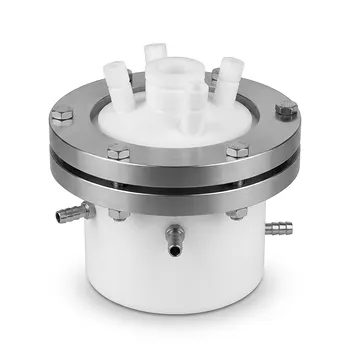
The liner serves as a vital barrier between the corrosive reaction mixture and the stainless steel outer shell of the autoclave. By isolating the alkaline solution, the PTFE liner prevents the metal equipment from corroding. This protection significantly extends the service life of the expensive pressure vessels used in the laboratory.
Protecting the Purity of Mesoporous Structures
Elimination of Metal Ion Leaching
One of the primary risks in hydrothermal synthesis is the leaching of metal ions from the autoclave walls into the reaction mixture. Even trace amounts of iron, chromium, or nickel can disrupt the delicate self-assembly of the silica structure. A high-purity PTFE liner creates a completely inert environment, guaranteeing that no external impurities enter the system.
Ensuring Structural Order
MCM-48 is valued for its specific cubic pore structure and high surface area. Any chemical interference from the reaction vessel can lead to structural defects or a loss of porosity. The use of a high-quality liner ensures the chemical purity of the environment, which is the foundation for achieving a high degree of crystalline order.
Product Recovery and Yield
The excellent mold-release properties and smooth internal surface of PTFE prevent the synthesized nanopowders from adhering to the walls. This makes it significantly easier to collect the final product without mechanical loss or contamination during the scraping process. This non-stick nature directly improves the overall synthesis yield and consistency.
Understanding the Trade-offs and Limitations
Temperature and Pressure Boundaries
While PTFE is highly durable, it has a functional limit, usually around 200°C–250°C, above which it may begin to deform or undergo "creep." For MCM-48 synthesis at 120°C, this is well within safe margins, but users must ensure the autoclave is not overheated. Exceeding these limits can cause the liner to lose its seal, risking vessel failure and sample loss.
Porosity and Vapor Permeability
Low-quality or reused PTFE liners can develop micro-porosity over time, allowing small amounts of alkaline vapor to reach the metal shell. This can lead to "hidden" corrosion behind the liner that might go unnoticed until the autoclave is damaged. It is critical to inspect liners for discoloration or deformation before every long synthesis cycle.
How to Apply This to Your Project
Recommendations for Synthesis Success
When preparing to synthesize MCM-48 or similar mesoporous materials, your choice of liner and maintenance routine will dictate the quality of your results.
- If your primary focus is Maximum Structural Purity: Always use high-purity virgin PTFE liners to eliminate any risk of trace metal contamination from previous experiments.
- If your primary focus is Equipment Longevity: Regularly inspect the seal and the exterior of the PTFE liner for signs of alkaline "seeping" to protect your stainless steel autoclaves from corrosion.
- If your primary focus is High Material Yield: Ensure the internal surface of the liner remains smooth and unscratched, as scratches provide anchor points for material adhesion and reduce recovery rates.
Choosing the right PTFE liner transforms a risky chemical process into a controlled, repeatable method for creating advanced nanomaterials.
Summary Table:
| Feature | Benefit for MCM-48 Synthesis | Technical Requirement |
|---|---|---|
| Chemical Inertness | Resists strong NaOH alkaline media | Virgin PTFE material |
| Thermal Stability | Maintains integrity at 120°C for 3 days | High-purity fluoropolymer |
| Inert Barrier | Prevents metal ion leaching from autoclave | 100% contamination-free |
| Surface Quality | High product recovery (non-stick) | Smooth, CNC-machined finish |
Elevate Your Synthesis Precision with KINTEK
Ensure the integrity of your mesoporous structures with high-performance laboratory supplies from KINTEK. Whether you require standard hydrothermal synthesis liners, microwave digestion vessels, or complex custom electrochemical cells, we provide the chemical resistance and thermal stability your research demands.
From everyday labware (beakers, crucibles, and reagent bottles) and fluid transfer components (tubing, valves, and fittings) to precision sample prep tools and consumables like stirring bars and O-rings, KINTEK manufactures virtually every fluoropolymer solution imaginable. Backed by end-to-end custom CNC fabrication, we deliver everything from bespoke, non-standard machined parts to high-volume orders with an absolute focus on PTFE and PFA excellence.
Ready to optimize your lab's performance? Contact us today to discuss your custom requirements and secure the high-purity environment your experiments deserve.
References
- Adife Şeyda Yargıç, M. Emre Sener. Mesoporous Silica-Polyethyleneimine Composites as High-Capacity Adsorbents for CO2 Adsorption: Isotherm and Thermodynamic Analysis. DOI: 10.1007/s11270-025-07782-w
This article is also based on technical information from Kintek Knowledge Base .
Related Products
- PTFE Lined High Pressure Digestion Vessel 50ml High Temperature Hydrothermal Synthesis Tank
- High Pressure Custom TFM Reactor Stainless Steel Outer Vessel PTFE Inner Cup for Corrosive Synthesis
- Custom TFM Reaction Vessel with Stainless Steel Jacket and PTFE Inner Cup for High Corrosion Resistance
- High Purity PTFE Microwave Digestion Vessel for Soil and Food Analysis Acid Resistant Fluoropolymer Sample Preparation Liners
- High Purity TFM Microwave Digestion Vessels PTFE Acid Evaporation Liners Domestic GT-400 Equivalent Laboratory Reaction Containers
People Also Ask
- What are the benefits of using a PTFE-lined vessel for carbon-sulfur cathode treatment? Maximize Purity & Performance
- Why are PTFE-lined pressure digestion vessels required for the preparation of Ag/CeO2 catalysts? Purity & Performance
- What safety features are typically incorporated into high-pressure PTFE digestion vessel designs? Ensure Lab Safety
- What is the function of PTFE lined high-pressure vessels in g-C3N4 synthesis? Achieve High-Purity Material Growth
- Role of High-Pressure Digestion Tanks in Perovskite Synthesis: Achieve Superior Stability and Latent Heat