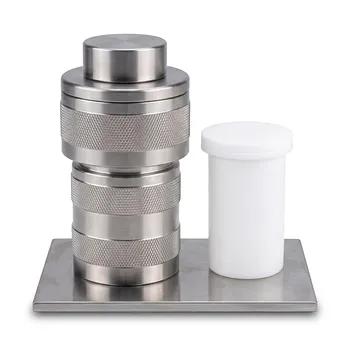
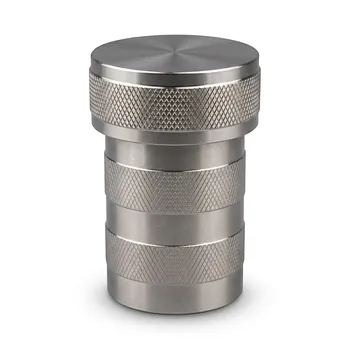
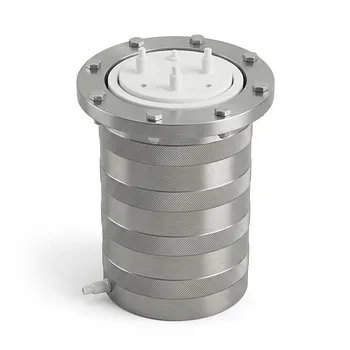
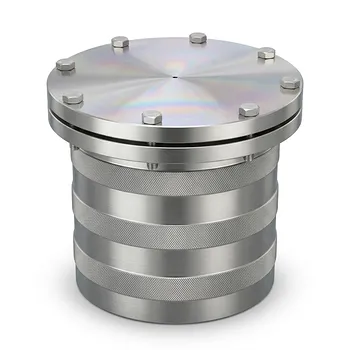
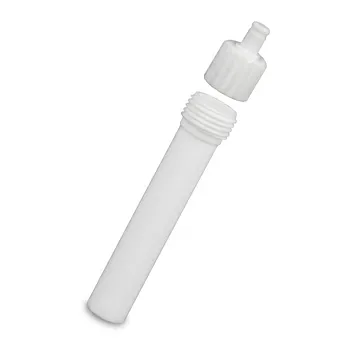
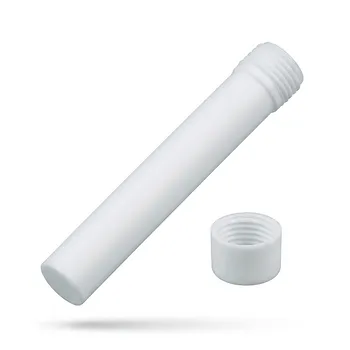
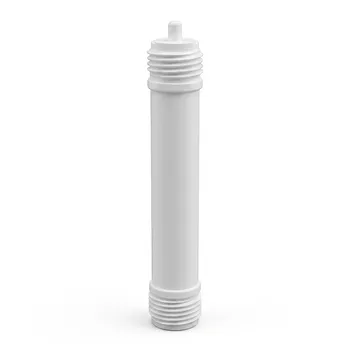
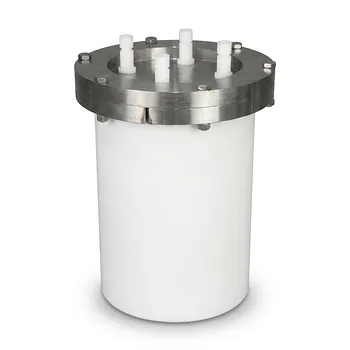
PTFE liners are the essential barrier that maintains chemical purity and structural integrity. During the hydrothermal synthesis of $Ru_xTi_yO_z$ catalysts, high-purity PTFE liners protect the reaction from metallic contamination while withstanding the corrosive effects of acidic ruthenium precursors at high temperatures and pressures. This setup ensures that the resulting catalyst has clean active sites, a uniform morphology, and reproducible experimental results.
A high-purity PTFE liner acts as a chemically inert shield that prevents acidic corrosion of the reactor vessel and blocks the leaching of metal impurities. This dual-purpose protection is critical for ensuring the catalyst’s purity, the reactor's longevity, and the researcher's safety.
The Role of Chemical Inertness in Acidic Environments
Resistance to Corrosive Precursors
The synthesis of $Ru_xTi_yO_z$ often involves acidic precursors such as ruthenium(III) chloride ($RuCl_3$) solutions. At the high temperatures required for hydrothermal synthesis, these chemicals become highly aggressive and would rapidly corrode standard metallic reactor walls.
Protecting the Structural Vessel
Hydrothermal reactors are typically constructed from high-strength stainless steel to withstand extreme internal pressures. A PTFE liner serves as a sacrificial and protective barrier, preventing the acidic medium from compromising the structural integrity of the outer pressure vessel.
Maintenance of a Clean Reaction Environment
By resisting chemical attacks, the PTFE liner ensures that the chemical stoichiometry of the $Ru_xTi_yO_z$ catalyst remains exactly as intended. Any degradation of the container would introduce unintended side reactions, potentially altering the oxidation states of the ruthenium or titanium ions.
Preventing Metallic Leaching and Contamination
Blocking Metal Impurity Ions
High-purity PTFE prevents metal ions from the reactor body—such as iron, nickel, or chromium—from leaching into the catalyst system. Even trace amounts of these foreign metals can incorporate into the $Ru_xTi_yO_z$ crystal lattice, significantly altering its catalytic properties.
Preserving Active Catalyst Sites
For catalysts to function effectively, their active sites must remain free of contaminants. Ensuring high purity via a PTFE liner allows for the precise transfer of electrons during reactions, such as the CO2 reduction reaction (CO2RR), by maintaining the intended d-orbital configurations.
Ensuring Experimental Repeatability
Using high-purity fluoropolymers guarantees that the catalyst surface remains "clean" across different batches. This consistency is vital for researchers who need to verify that their results are a product of the catalyst design rather than random metallic impurities.
Mechanical Benefits and Product Recovery
Non-Stick Properties for Yield
The non-stick nature of PTFE is a significant advantage when synthesizing powders or 3D-printed catalyst supports. It ensures that the reaction products can be easily removed from the liner without loss of material or cross-contamination between experiments.
Thermal Stability and Pressure Resistance
High-purity PTFE is designed to remain stable under the high-pressure conditions of an autoclave. This stability ensures that the liner does not deform or fail, maintaining a sealed and enclosed environment necessary for effective hydrothermal growth.
Facilitating Effective Cleaning
The ease of cleaning a PTFE liner preserves the accuracy of experimental data over time. Because the material does not easily absorb precursors or products, researchers can ensure that no "memory effect" from previous experiments influences the current synthesis.
Understanding the Trade-offs
Temperature Limitations
While PTFE is highly inert, it has a strict thermal ceiling, generally recommended for use below 200°C to 230°C. Exceeding these temperatures can cause the liner to soften, deform, or release toxic fluorinated vapors, which risks both the experiment and the safety of the lab.
Porosity and Absorption
Although PTFE is chemically resistant, it is slightly porous at a microscopic level. Over many cycles, it may absorb trace amounts of certain reagents, which is why high-purity grades and rigorous cleaning protocols are necessary to prevent long-term cross-contamination.
Physical Wear and Deformation
PTFE is a relatively soft material compared to the metal autoclave shell. Frequent high-pressure cycles can lead to "cold flow" or permanent deformation of the liner, requiring periodic replacement to ensure a proper seal and prevent leaks to the metal wall.
How to Apply This to Your Project
When synthesizing $Ru_xTi_yO_z$ or similar metal-oxide catalysts, your choice of liner material directly dictates the quality of your results.
- If your primary focus is Maximum Purity: Always opt for high-purity PTFE or PFA liners to eliminate the risk of metallic leaching into your crystal growth system.
- If your primary focus is High-Temperature Synthesis (>250°C): Consider alternative liner materials like PPL (Polyphenylene polymers) or specialized alloy reactors, though you must account for potential loss of chemical inertness.
- If your primary focus is Scalability and Yield: Leverage the non-stick properties of PTFE to ensure total recovery of your synthesized powders or nanostructures.
Choosing the right high-purity liner is not just a secondary detail; it is a fundamental requirement for the precise and safe synthesis of high-performance catalysts.
Summary Table:
| Key Feature | Functional Benefit | Impact on Catalyst Synthesis |
|---|---|---|
| Chemical Inertness | Resists acidic precursors like $RuCl_3$ | Maintains stoichiometric purity and prevents side reactions |
| Metal-Free Barrier | Blocks leaching of Fe, Ni, and Cr ions | Preserves active sites and d-orbital electronic configurations |
| Non-Stick Surface | Facilitates easy product removal | Maximizes yield and prevents batch-to-batch cross-contamination |
| Thermal Protection | Shields stainless steel vessel walls | Prevents structural corrosion and extends autoclave lifespan |
Elevate Your Research with KINTEK’s High-Performance Fluoropolymers
At KINTEK, we understand that in catalyst synthesis, even trace impurities can compromise years of research. That is why we maintain an exclusive focus on high-performance fluoropolymers, manufacturing virtually every laboratory supply you need from high-purity PTFE and PFA.
Whether you require everyday basic labware (beakers, crucibles, reagent bottles, and digestion tubes), comprehensive fluid transfer components (tubing, fittings, valves), or specialized sample prep tools (filters, pipettes, spatulas), KINTEK delivers unmatched material purity. For advanced applications, we provide precision-engineered hydrothermal synthesis liners, microwave digestion vessels, and custom electrochemical cells designed to withstand the most demanding chemical environments.
Why choose KINTEK?
- End-to-End Customization: Our advanced CNC fabrication capabilities allow us to deliver complex non-standard machined parts and bespoke laboratory setups tailored to your specific project.
- Scale and Precision: From individual custom components to high-volume orders, we maintain rigorous quality standards.
- Expertise: Our absolute focus on fluoropolymers ensures your $Ru_xTi_yO_z$ catalysts—and all your sensitive materials—remain free from metallic contamination.
Don’t let material degradation compromise your results. Contact us today to discuss your custom requirements!
References
- Hyojin Kim, Hiromi Yamashita. Layered Na2Ti3O7-supported Ru catalyst for ambient CO2 methanation. DOI: 10.1038/s41467-025-57954-9
This article is also based on technical information from Kintek Knowledge Base .
Related Products
- PTFE Lined High Pressure Digestion Vessel 50ml High Temperature Hydrothermal Synthesis Tank
- High Temperature Corrosion Resistant Hydrothermal Synthesis Reactor with TFM Inner Liner and Straight Cylinder Design
- High Pressure Custom TFM Reactor Stainless Steel Outer Vessel PTFE Inner Cup for Corrosive Synthesis
- Custom TFM Reaction Vessel with Stainless Steel Jacket and PTFE Inner Cup for High Corrosion Resistance
- High Purity PTFE Microwave Digestion Vessel Replacement Liner for Acid Sample Preparation and Trace Analysis
People Also Ask
- What are the benefits of using a PTFE-lined vessel for carbon-sulfur cathode treatment? Maximize Purity & Performance
- Why are PTFE-lined pressure digestion vessels required for the preparation of Ag/CeO2 catalysts? Purity & Performance
- What safety features are typically incorporated into high-pressure PTFE digestion vessel designs? Ensure Lab Safety
- What is the function of PTFE lined high-pressure vessels in g-C3N4 synthesis? Achieve High-Purity Material Growth
- Role of High-Pressure Digestion Tanks in Perovskite Synthesis: Achieve Superior Stability and Latent Heat