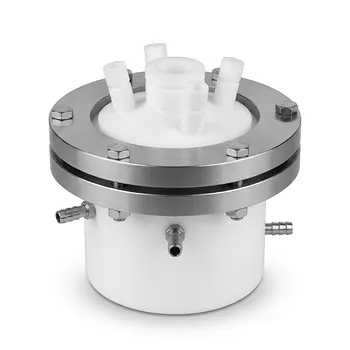
A high-purity PTFE liner is the critical barrier that ensures the chemical integrity of ZnO@MnO2 composites by preventing metallic contamination. In the extreme environment of hydrothermal synthesis, this liner isolates aggressive precursors from the reactor’s steel walls, ensuring the resulting nanomaterials achieve the precise stoichiometry and high photocatalytic activity required for advanced applications.
Core Takeaway: High-purity PTFE liners provide the necessary chemical inertness to prevent metal ion leaching and withstand corrosive precursors, which is fundamental to maintaining the crystalline purity and structural uniformity of ZnO@MnO2 nanocomposites.
The Role of Chemical Inertness in Nanocomposite Purity
Eliminating Metal Ion Contamination
Hydrothermal synthesis occurs under high temperature and high pressure, conditions that would otherwise cause metal ions to leach from a stainless steel reactor. The PTFE liner acts as a total physical barrier, ensuring that no iron, nickel, or chromium impurities enter the reaction solution to degrade the composite’s properties.
Resisting Harsh Precursor Media
The synthesis of ZnO often involves strong bases like Sodium Hydroxide (NaOH) or other highly polar solvents that are corrosive to metallic surfaces. High-purity PTFE is exceptionally resistant to these alkaline environments, allowing the reaction to proceed without compromising the vessel or the sample.
Ensuring High Photocatalytic Activity
For ZnO@MnO2 composites, the surface chemistry is vital for their performance as photocatalysts. By preventing stray ions from entering the system, the PTFE liner ensures the precise stoichiometry of the manganese and zinc phases, which is essential for efficient electron-hole separation.
Impact on Crystal Growth and Microstructure
Maintaining Specific Growth Orientations
The presence of unintended impurities can act as "dopants" that disrupt the natural crystal growth orientation of ZnO nanorods or MnO2 layers. A clean environment provided by the liner allows for controlled growth, resulting in the desired morphology and high crystallinity.
Facilitating Material Recovery
PTFE possesses excellent mold-release properties, which means the synthesized nanopowders do not adhere strongly to the container walls. This allows researchers to collect the maximum yield of the synthesized material without mechanical loss or cross-contamination from previous experiments.
Thermal Stability and Pressure Safety
While PTFE is chosen for its chemistry, it also provides a reliable chemical protection barrier that protects the structural integrity of the outer autoclave. By preventing corrosion of the load-bearing metal shell, the liner ensures the safety of the high-pressure process over many cycles.
Understanding the Trade-offs
Temperature Limitations
While PTFE is chemically robust, it has a functional temperature ceiling, typically around 220°C to 250°C. Exceeding these temperatures can lead to the "creeping" or deformation of the liner, which may cause the seal to fail or contaminate the sample with polymer degradation products.
Thermal Expansion Mismatch
PTFE has a higher coefficient of thermal expansion than the stainless steel outer shell. If the liner is not properly sized or if the cooling process is too rapid, the resulting mechanical stress can lead to cracking or permanent warping of the liner.
Porosity and Absorption
At the molecular level, PTFE can be slightly porous to certain gases or small molecules at high pressures. Over time, high-purity liners can absorb trace amounts of precursors, necessitating thorough cleaning or replacement to avoid "memory effects" in subsequent synthesis batches.
Maximizing Results in Hydrothermal Synthesis
How to Apply This to Your Project
To ensure the highest quality ZnO@MnO2 composites, your choice of liner and handling procedures should align with your specific research objectives.
- If your primary focus is photocatalytic efficiency: Use only high-purity, virgin PTFE liners to eliminate even trace-level metallic impurities that act as recombination centers for charge carriers.
- If your primary focus is morphological control: Ensure the liner is free of surface scratches or residue, as surface imperfections can serve as unintended nucleation sites for crystal growth.
- If your primary focus is equipment longevity: Implement a slow cooling protocol after the hydrothermal reaction to account for the different expansion rates of the PTFE and the steel autoclave.
The strategic use of a high-purity PTFE liner is not merely a preference but a technical necessity for achieving the phase purity and performance benchmarks required in modern nanomaterial synthesis.
Summary Table:
| Key Feature | Benefit for ZnO@MnO2 Synthesis |
|---|---|
| Chemical Inertness | Prevents metallic leaching and ensures precise stoichiometry |
| Corrosion Resistance | Withstands aggressive precursors like Sodium Hydroxide (NaOH) |
| Non-stick Surface | Facilitates easy material recovery and prevents cross-contamination |
| Phase Purity | Eliminates stray ions to maintain high photocatalytic activity |
| Thermal Stability | Provides a reliable barrier for high-pressure hydrothermal cycles |
Elevate Your Synthesis with KINTEK’s High-Performance Fluoropolymers
Precision in nanomaterial synthesis demands the ultimate chemical barrier. KINTEK specializes in manufacturing high-purity PTFE and PFA laboratory solutions, ranging from standard liners and hydrothermal synthesis vessels to custom-machined CNC components tailored to your exact research specifications.
Whether you require basic labware like beakers, crucibles, and digestion tubes, or advanced reaction apparatus such as microchannel reactors and electrochemical cells, our end-to-end fabrication ensures every part meets the rigorous standards of trace analysis. Don't let metallic contamination compromise your ZnO@MnO2 composites—rely on our absolute focus on high-performance materials to deliver the purity your work deserves.
Ready to optimize your lab setup? Contact us today to discuss your custom project or high-volume orders.
References
- Edilane Bezerra, Ramón Raudel Peña Garcia. Hydrothermal Synthesis of ZnO@MnO<sub>2</sub>-Montmorillonite Nanocomposites: Influence of Molarity on Structural, Optical, and Photocatalytic Performance toward Ciprofloxacin Degradation under Variable Conditions. DOI: 10.1021/acsomega.5c06454
This article is also based on technical information from Kintek Knowledge Base .
Related Products
- PTFE Lined High Pressure Digestion Vessel 50ml High Temperature Hydrothermal Synthesis Tank
- High Pressure Custom TFM Reactor Stainless Steel Outer Vessel PTFE Inner Cup for Corrosive Synthesis
- Custom TFM Reaction Vessel with Stainless Steel Jacket and PTFE Inner Cup for High Corrosion Resistance
- High Purity PTFE Microwave Digestion Vessel for Soil and Food Analysis Acid Resistant Fluoropolymer Sample Preparation Liners
- High Purity TFM Microwave Digestion Vessels PTFE Acid Evaporation Liners Domestic GT-400 Equivalent Laboratory Reaction Containers
People Also Ask
- What are the benefits of using a PTFE-lined vessel for carbon-sulfur cathode treatment? Maximize Purity & Performance
- Why are PTFE-lined pressure digestion vessels required for the preparation of Ag/CeO2 catalysts? Purity & Performance
- What is the function of high-pressure PTFE digestion vessels in mineral analysis? Optimize Sample Mineralization
- What safety features are typically incorporated into high-pressure PTFE digestion vessel designs? Ensure Lab Safety
- What is the function of PTFE lined high-pressure vessels in g-C3N4 synthesis? Achieve High-Purity Material Growth