Fluorine can replace hydrogen without substantially enlarging the polymer structure. Fluorine is only slightly larger than hydrogen, and the C–F bond is exceptionally short, second only to the C–H bond. As a result, replacing hydrogen atoms throughout an organic polymer backbone causes relatively little additional steric crowding or geometric disruption, allowing fully perfluorinated polymers to retain a stable, workable chain structure.
The key is fluorine’s unusual size-to-bond-length combination: it provides extensive chemical protection around the carbon backbone without creating the steric distortion that would typically result from substituting larger atoms.
Why Full Fluorination Preserves Polymer Structure
Fluorine adds little steric bulk
Larger halogens such as chlorine and bromine occupy substantially more space than hydrogen. Replacing hydrogen with those atoms can force neighboring groups apart, alter bond angles, and introduce strain into the polymer chain.
Fluorine is different. Its atomic size is only slightly greater than hydrogen’s, so extensive hydrogen-to-fluorine substitution adds relatively little total steric bulk.
C–F bonds are exceptionally compact
The short length of the carbon–fluorine bond helps keep fluorine atoms close to the carbon backbone. The resulting structure does not require major rearrangement simply to accommodate the substituents.
This compact bonding arrangement is why a polymer can become almost completely fluorinated while maintaining a regular and structurally coherent carbon framework.
The backbone becomes chemically shielded
In a perfluorinated polymer, fluorine atoms largely encase the carbon backbone. This creates a protective outer layer that makes the underlying carbon structure difficult for chemical reagents to attack.
The same structural arrangement supports the extreme chemical inertness associated with materials such as PTFE and PFA.
How This Produces High-Performance Fluoropolymers
Chemical inertness without major dimensional disruption
Because fluorination does not significantly increase steric strain, the polymer can preserve its overall chain architecture while gaining strong resistance to aggressive chemicals.
That combination is particularly valuable in trace-analysis labware, digestion vessels, and chemical transfer lines, where both chemical purity and dimensional reliability matter.
Resistance to thermal and oxidative degradation
Fluorinated structures also resist thermal and oxidative attack more effectively than many nonfluorinated organic polymers. Fluorinated moieties, including perfluoroalkyl groups, can improve stability under demanding temperature and chemical conditions.
The exact performance depends on the polymer’s composition, molecular architecture, and processing history, but fluorination provides the fundamental chemical basis for this durability.
Low sorption and reliable fluid handling
High-performance fluoropolymers are used where contact with chemicals must not significantly contaminate the sample or alter the material. Their fluorinated surfaces generally provide low chemical sorption and strong hydrophobic behavior.
These properties help maintain reliable performance in fluid transport, laboratory containment, and high-purity analytical applications.
The Structural Principle Behind Perfluorination
Small substitution, large chemical benefit
The important distinction is that fluorine changes the chemical character of the polymer much more than it changes its physical size. It substantially lowers chemical reactivity and surface energy while adding comparatively little steric expansion.
This is why full fluorination can deliver a major performance improvement without the severe structural distortion expected from substituting larger atoms.
Fluorine acts like a protective shell
A useful analogy is a compact protective coating built directly into the molecular structure. The fluorine atoms shield the carbon backbone, while their small size allows that shielding to occur without forcing the chain into an impractical geometry.
This molecular “shell” explains the combination of chemical inertness, hydrophobicity, and structural integrity found in many fluoropolymers.
Understanding the Trade-offs
Full fluorination does not eliminate all structural effects
Fluorine substitution is not completely neutral. It can influence chain conformation, intermolecular interactions, free volume, surface energy, permeability, and processing behavior.
Therefore, “without significant structural distortion” means that fluorination avoids disruptive steric expansion; it does not mean that fluorine has no effect on polymer properties.
Performance depends on polymer design
PTFE, PFA, and other fluoropolymers do not perform identically. Differences in chain structure, side groups, crystallinity, and processing determine properties such as thermal behavior, permeability, flexibility, and dimensional stability.
The fluorinated chemistry provides the foundation, but the final product performance depends on the complete material design.
Chemical resistance is not universal immunity
Fluoropolymers are exceptionally resistant to many chemicals, but no material is immune to every combination of reagent, temperature, pressure, and exposure time. Application-specific compatibility testing remains necessary for critical systems.
Making the Right Choice for Your Goal
The structural reason for fluorination is consistent, but the best product depends on the operating environment.
- If your primary focus is chemical purity: Choose a high-performance fluoropolymer because its fluorine-shielded backbone supports low sorption and strong resistance to chemical contamination.
- If your primary focus is dimensional stability: Select a fluoropolymer grade and design suited to the expected temperature and mechanical conditions, rather than assuming all fluorinated materials behave identically.
- If your primary focus is extreme chemical exposure: Use the perfluorinated structure as a strong starting point, then verify compatibility against the specific chemicals, temperatures, and exposure durations.
- If your primary focus is fluid transport or barrier performance: Evaluate the complete polymer formulation and geometry, because fluorination improves resistance and hydrophobicity while also influencing permeability and free volume.
Fluorine’s small steric footprint allows polymers to gain exceptional chemical protection without sacrificing the coherent backbone structure required for high-performance applications.
Summary Table:
| Aspect | Impact of Fluorination |
|---|---|
| Steric bulk | Fluorine adds minimal steric bulk due to size close to hydrogen. |
| Bond length | C–F bond length is short (second only to C–H), keeping structure compact. |
| Structural distortion | Avoids significant distortion, maintaining chain architecture. |
| Chemical inertness | The fluorine shell shields the carbon backbone, providing high chemical resistance. |
| Thermal stability | Perfluorination improves resistance to thermal and oxidative degradation. |
| Hydrophobicity | Fluorinated surfaces provide low sorption and hydrophobic behavior. |
| Dimensional reliability | Retains dimensional stability, crucial for labware and flow components. |
Ready to leverage the performance benefits of perfluorinated polymers for your lab? Contact us today to discuss how KINTEK's high-quality PTFE and PFA products, including custom machined parts and labware, can meet your precise needs.
Related Products
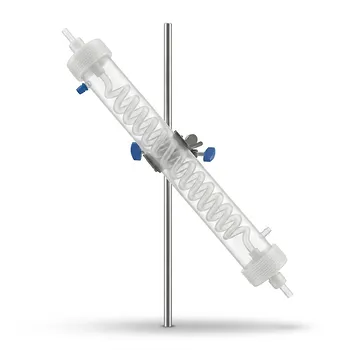
- High Purity PFA Chromatography Column with Collection Bottle Corrosion Resistant Fluoropolymer Filtration System for Trace Analysis
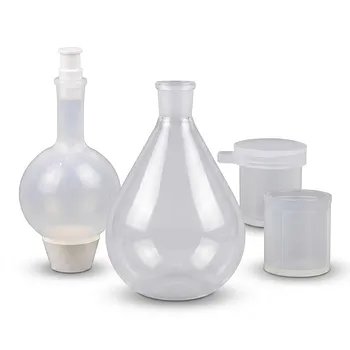
- Custom PTFE Flask 250ml High Purity Fluoropolymer Laboratory Vessel for Chemical Research
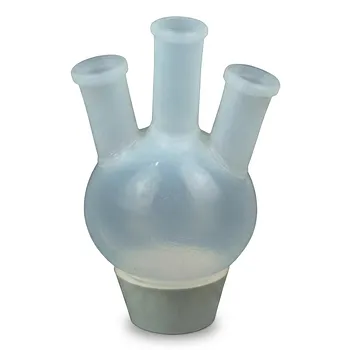
- High Purity PTFE Single Neck Reaction Flask Acid Resistant Customizable Fluoropolymer Laboratory Reactor
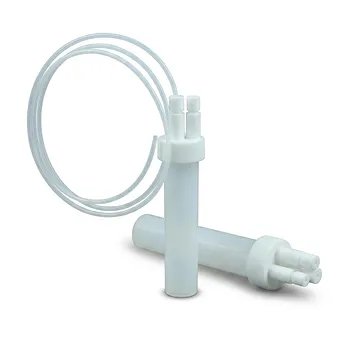
- Custom PFA Tubing 1/4 Inch High Purity Corrosion Resistant Fluoropolymer Tube with Welding and Machining Services
- High Purity PFA Chromatography Column Double Layer Constant Pressure Filter Column with Sieve Plate Acid Resistant Fluoropolymer Filtration System
People Also Ask
- What are the primary functional and temperature differences between PFA and FEP when selecting melt-processible fluoropolymers for custom laboratory apparatus?
- Why is the chemical stability of polymer endgroups critical when selecting melt-processible fluoropolymers like PFA for high-purity laboratory apparatus? Choose Stable Endgroups for Reliable Performance
- What are the characteristics of PFA material? A Guide to Its High-Performance Balance
- Why is Perfluoroalkoxy alkane (PFA) preferred over glass or stainless steel in pharmaceutical process development? Pure Yield
- Why is PFA superior for cleaning and preventing cross-contamination? The Gold Standard for Ultra-Trace Lab Hygiene