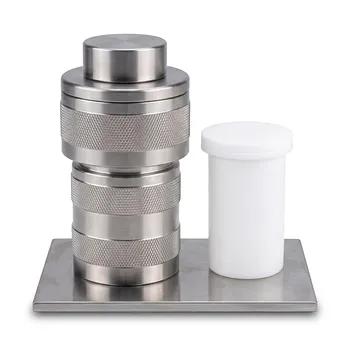
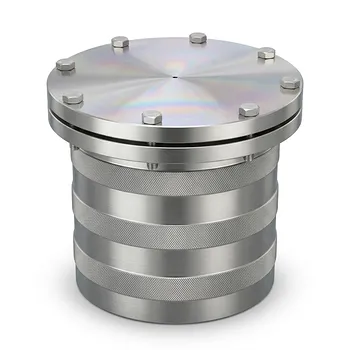
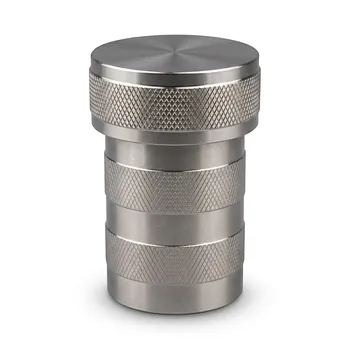
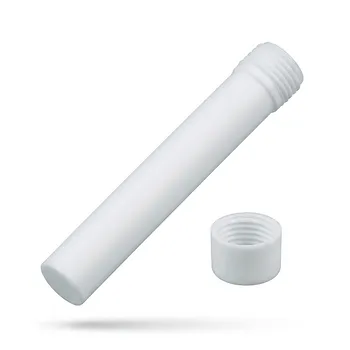
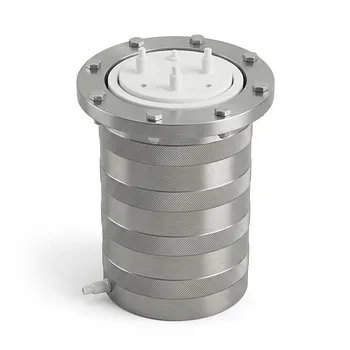
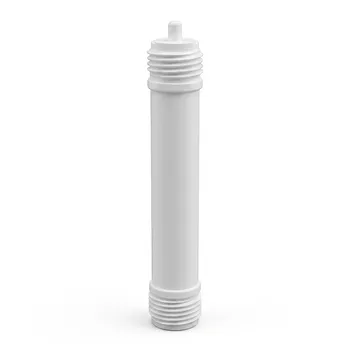
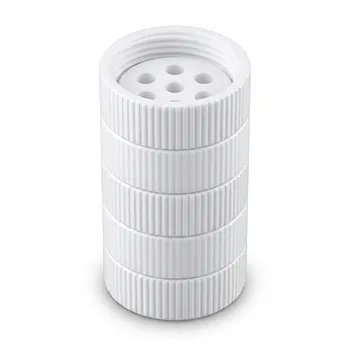
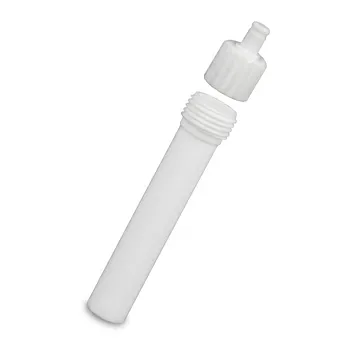
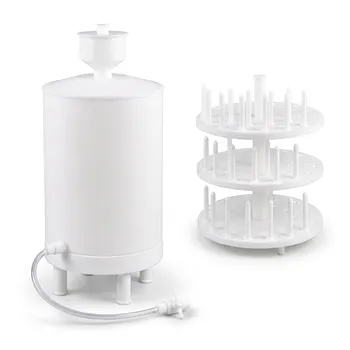
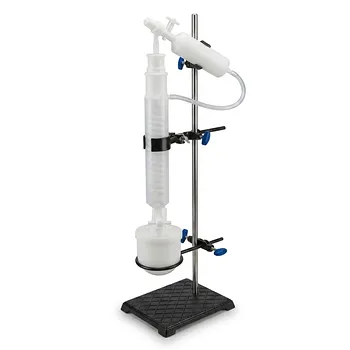
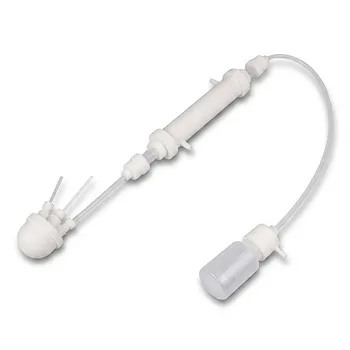
PTFE-lined hydrothermal autoclaves are the industry standard for synthesizing titanium-doped iron oxide (TFO) nanorods because they create a chemically inert, high-pressure environment essential for crystal growth. This setup prevents metallic impurities from the autoclave shell from leaching into the solution while allowing the high temperatures and pressures required for the oriented growth of nanorods on conductive substrates.
Core Takeaway: The PTFE liner acts as a critical barrier that ensures the chemical purity of TFO nanorods by resisting corrosive solvents and providing a stable, non-reactive interface for high-pressure crystallization.
Maintaining Chemical Purity and Material Integrity
Preventing Metallic Contamination
Hydrothermal synthesis often involves high heat and aggressive reagents that can cause the stainless steel body of an autoclave to leach metal ions. PTFE (polytetrafluoroethylene) is exceptionally inert, ensuring that no iron, chromium, or nickel from the outer shell enters the reaction.
This purity is vital for the photoelectric activity of semiconductor materials. Even trace amounts of unplanned metallic impurities can act as recombination centers, significantly degrading the performance of the TFO nanorods in applications like water splitting or solar cells.
Resistance to Corrosive Solvents
The synthesis of titanium-based nanostructures frequently requires strong acids (like HCl) or strong bases (like NaOH) to facilitate the reaction. PTFE maintains its structural integrity in these harsh environments, where other materials would corrode or fail.
By resisting chemical attack, the liner protects the expensive metal autoclave shell from damage. This stability ensures that the chemical concentration of the precursors remains consistent throughout the reaction period.
Facilitating Controlled Nanostructure Growth
Supporting Oriented Crystal Growth
The sealed environment of the autoclave generates the internal pressure necessary for the oriented growth of beta-FeOOH or TFO nanorods. This pressure is essential for depositing nanostructures directly onto substrates like fluorine-doped tin oxide (FTO) glass.
A clean PTFE interface promotes heterogeneous nucleation, where the titanium and iron sources crystallize specifically on the substrate. This results in vertically aligned, single-crystal arrays with controllable aspect ratios rather than random, bulk precipitation.
Enhancing Crystallinity and Phase Transformation
High-pressure hydrothermal treatment encourages the transformation of unstable amorphous clusters into highly crystalline phases. The PTFE liner provides a "non-stick" and non-reactive surface that allows precursors to react fully without sticking to the vessel walls.
This environment is particularly effective for achieving the highly crystalline anatase or hematite phases required for TFO nanorods. The consistent thermal distribution within the liner ensures uniform growth across the entire substrate surface.
Understanding the Trade-offs
Temperature and Pressure Limitations
While PTFE is highly resistant to chemicals, it has a lower thermal threshold than the metal autoclave shell. Most PTFE liners are limited to a maximum continuous operating temperature of 220°C to 250°C.
Exceeding these temperatures can cause the PTFE to soften or deform, leading to seal failure or "creep." Furthermore, the thermal expansion of PTFE is different from that of stainless steel, necessitating careful cooling protocols to prevent the liner from warping or cracking over time.
Potential for Diffusion and Memory Effects
Although inert, PTFE is slightly porous at a microscopic level under extreme pressure. If not cleaned rigorously between uses, trace amounts of precursors from previous experiments can remain trapped in the liner, leading to cross-contamination.
How to Apply This to Your Synthesis Project
Making the Right Choice for Your Goal
- If your primary focus is High Photoelectric Efficiency: Prioritize using a fresh or meticulously cleaned PTFE liner to ensure zero metallic leaching, as purity is the primary driver of electron mobility.
- If your primary focus is Precise Morphological Control: Ensure your autoclave is filled to the correct volume (usually 60-80%) to generate the specific internal pressure required for vertically aligned nanorod growth.
- If your primary focus is High-Temperature Phase Transitions: Evaluate if your reaction exceeds 220°C; if so, you may need to transition to a PPL (polyparaphenylene) liner, which offers higher thermal stability than PTFE.
Utilizing a PTFE-lined autoclave is the most effective way to balance the need for aggressive chemical environments with the requirement for high-purity, crystalline nanostructure development.
Summary Table:
| Key Feature | Benefit for TFO Nanorod Synthesis | Operational Requirement |
|---|---|---|
| Chemical Inertness | Prevents metallic leaching; ensures high photoelectric activity | Use high-purity PTFE to avoid contamination |
| Corrosion Resistance | Withstands aggressive precursors like HCl or NaOH | Regular cleaning to prevent "memory effects" |
| Pressure Stability | Facilitates oriented crystal growth on FTO glass substrates | Maintain 60-80% fill volume for internal pressure |
| Thermal Control | Promotes transition to highly crystalline anatase/hematite phases | Limit continuous operation to 220°C-250°C |
Elevate Your Nanomaterial Synthesis with KINTEK Precision
High-performance research demands high-performance materials. At KINTEK, we maintain an exclusive focus on high-performance fluoropolymers to ensure your laboratory results are never compromised. From everyday basic labware like PTFE beakers, crucibles, and reagent bottles to advanced hydrothermal synthesis liners and microwave digestion vessels, we provide the inert environment essential for TFO nanorod growth.
Whether you require standard consumables—such as high-purity stirring bars, O-rings, and filtration tools—or complex, bespoke laboratory setups via our end-to-end custom CNC fabrication, KINTEK delivers absolute chemical resistance and purity. We support your entire workflow with everything from fluid transfer components (tubing, fittings, valves) to specialized electrochemical cells and battery testing fixtures.
Ready to eliminate metallic contamination and optimize your crystal growth? Contact our experts today for custom fluoropolymer solutions!
References
- Shenghe Si, Yujie Xiong. Selective photoelectrochemical synthesis of adipic acid using single-atom Ir decorated α-Fe2O3 photoanode. DOI: 10.1038/s41467-025-60506-w
This article is also based on technical information from Kintek Knowledge Base .
Related Products
- PTFE Lined High Pressure Digestion Vessel 50ml High Temperature Hydrothermal Synthesis Tank
- Custom TFM Reaction Vessel with Stainless Steel Jacket and PTFE Inner Cup for High Corrosion Resistance
- High Temperature Corrosion Resistant Hydrothermal Synthesis Reactor with TFM Inner Liner and Straight Cylinder Design
- PTFE Acid Steam Cleaning System HF Resistant Trace Analysis Beaker Digestion Tank Customizable
- High Purity TFM Microwave Digestion Vessels PTFE Acid Evaporation Liners Domestic GT-400 Equivalent Laboratory Reaction Containers
People Also Ask
- What are the benefits of using a PTFE-lined vessel for carbon-sulfur cathode treatment? Maximize Purity & Performance
- Why are PTFE-lined pressure digestion vessels required for the preparation of Ag/CeO2 catalysts? Purity & Performance
- What safety features are typically incorporated into high-pressure PTFE digestion vessel designs? Ensure Lab Safety
- What is the function of PTFE lined high-pressure vessels in g-C3N4 synthesis? Achieve High-Purity Material Growth
- Role of High-Pressure Digestion Tanks in Perovskite Synthesis: Achieve Superior Stability and Latent Heat