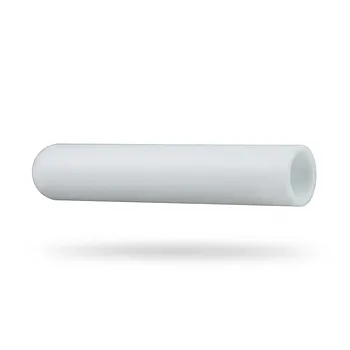
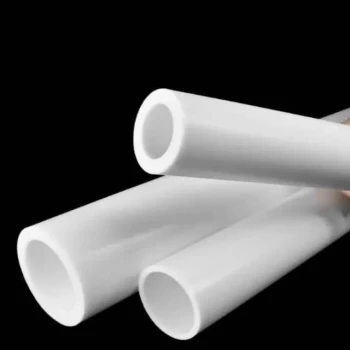
Presintered PTFE resins are preferred because they feed more reliably and produce stronger, more uniform extrudates. The resin is first melted or sintered, cooled, and then disintegrated into free-flowing granules. This treatment lowers the effective melting point from approximately 342°C to 327°C, while improving flowability and bulk density—characteristics that are especially important when ram-extruding thin-walled tubing and small-diameter rods.
The main advantage is processing reliability: presintered granules feed into the ram extruder without bridging, compact more uniformly, and reduce internal voids and charge-mark fractures. The result is tubing and rods with more consistent dimensions, fewer defects, and higher structural integrity.
Why Ram Extrusion Needs Specialized PTFE Resin
Ram extrusion is sensitive to powder feeding
Ram extrusion is a semicontinuous process in which PTFE resin is repeatedly charged into an extrusion cylinder and compacted by a ram. The resin must move consistently through the feed section and consolidate uniformly under pressure.
Fine-cut powders can have poor flow behavior. They may form bridges above the feed opening or leave unfilled spaces during charging, interrupting the otherwise continuous material column.
Thin profiles magnify small defects
A void or weak interface is particularly damaging in thin-walled tubing and small-diameter rods because there is less material available to carry mechanical loads.
Defects can lead to leakage, reduced pressure resistance, or fracture during handling, machining, or service in high-purity fluid-transfer systems.
How Presintering Improves Resin Behavior
The particles flow more freely
Presintering changes the resin from a fine-cut powder into larger, controlled granules, commonly several hundred microns in size. These particles have substantially better flow characteristics than conventional fine-cut powders.
The improved flow helps the resin enter the cylinder steadily instead of accumulating around the feed opening.
Higher bulk density supports consistent charging
Ram-extrusion grades are typically designed with relatively large particle sizes and high bulk density. More material can be delivered consistently into each charge, reducing variation in the amount of resin entering the cylinder.
This supports more uniform compaction and helps maintain consistent dimensions along the extruded profile.
The lower melting point supports processing
Thermal conditioning reduces the PTFE melting point from approximately 342°C to 327°C, according to the supplied references. This difference can provide a more favorable processing response during the heating and sintering stages of ram extrusion.
The melting-point change is not the sole reason for selecting presintered resin, however. Flowability and resistance to charging defects are the primary practical advantages.
How Presintered Resin Improves the Finished Product
It reduces bridging and void formation
Free-flowing granules are less likely to bridge in the feed section. They also fill the extrusion cylinder more completely during successive charges.
That reduces the risk of internal voids, which can otherwise become weak points in tubing walls or rod cross-sections.
It reduces charge-mark fracture
Ram extrusion builds the extrudate from successive resin charges. The interface between charges can become a structural weakness if the material does not compact and fuse uniformly.
Presintered grades are better suited to withstand the pressures required for small rods and thin-wall tubes, reducing fracture at these interfaces. This failure mode is often referred to as “poker chipping” or inter-dose fracturing.
It improves structural integrity
Consistent feeding and compaction produce a more continuous, homogeneous extrudate. That improves resistance to fracture and supports reliable performance in fluid-transfer applications.
The benefit is especially important where tubing must remain leak-tight or where rods will later be machined into precision components.
Why These Benefits Matter for Tubing and Thin Rods
Thin-walled tubing
Tubing must maintain a continuous wall with no hidden voids or weak longitudinal regions. Presintered resin helps the extruder maintain stable material delivery and uniform consolidation, supporting consistent wall thickness and structural integrity.
Small-diameter solid rods
Rods below approximately 1 cm in diameter are more vulnerable to defects associated with charging and compaction. A small internal flaw can occupy a significant portion of the cross-section or initiate fracture during subsequent machining.
Presintered grades are therefore commonly favored for these dimensions.
Fluid-transfer components
Extruded PTFE tubing and rods are often used as raw stock for high-purity fluid-handling equipment. Defect reduction matters not only for mechanical strength but also for dimensional control, cleanability, and leak prevention.
Understanding the Trade-offs
Presintered resin is not ideal for every profile
The preferred resin depends on the product geometry and extrusion conditions. General-purpose free-flow granular powders may be appropriate for larger solid rods—particularly profiles greater than roughly 2 cm in diameter—and thick-walled shapes.
Presintered grades are most valuable where feeding stability, pressure tolerance, and resistance to inter-charge defects are critical.
Extruded PTFE requires shrinkage allowances
Ram-extruded parts can exhibit shrinkage rates of approximately 7.5–10.5%, depending on the material and process. Tooling and machining plans must account for this post-processing dimensional change.
A resin that feeds well does not eliminate the need for process-specific dimensional compensation.
Mechanical properties can vary
Ram-extruded parts may show a relatively broad tensile-strength range, cited in the references as approximately 17–32 MPa. Resin selection, compaction, extrusion pressure, thermal history, geometry, and sintering conditions all influence the final result.
Presintering reduces important defect risks, but it cannot compensate for poorly controlled extrusion or sintering parameters.
“Free-flowing” does not mean defect-proof
Presintered resin improves feeding behavior; it does not guarantee flawless parts under every operating condition. Incorrect charge size, inadequate compaction, unsuitable pressure, or improper heating can still create dimensional or structural problems.
The resin and the process must be selected as a complete system.
How to Apply This to Your Project
The correct choice depends primarily on profile size, wall thickness, pressure requirements, and the level of dimensional and structural reliability required.
- If your primary focus is thin-walled PTFE tubing: Choose a presintered ram-extrusion grade to improve feeding consistency, reduce void formation, and support continuous, mechanically sound tube walls.
- If your primary focus is small-diameter solid rods: Favor presintered resin because its pressure tolerance and uniform compaction reduce inter-charge fracture and “poker chipping.”
- If your primary focus is high-purity fluid transfer: Prioritize resin and processing conditions that minimize internal defects, since structural discontinuities can compromise reliability and leak resistance.
- If your primary focus is large solid rods or thick profiles: Compare presintered grades with general-purpose free-flow granular resins, since the latter may be adequate and potentially more economical for less demanding geometries.
- If your primary focus is dimensional accuracy after extrusion: Include the expected ram-extrusion shrinkage in tooling and machining calculations rather than relying on resin selection alone.
Presintered PTFE is preferred for demanding ram-extruded tubing and thin rods because it turns reliable powder handling into more uniform compaction, fewer defects, and stronger finished profiles.
Summary Table:
| Aspect | Presintered Resin Benefits |
|---|---|
| Feeding | Free-flowing granules prevent bridging, ensuring consistent material delivery. |
| Compaction | Higher bulk density supports uniform charging and compaction, reducing voids. |
| Melting Point | Lower melting point (~327°C) improves processing response. |
| Defect Reduction | Minimizes charge-mark fractures and internal voids, enhancing structural integrity. |
| Applications | Ideal for thin-walled tubing and small-diameter rods where defects are critical. |
Upgrade your PTFE extrusion with KINTEK's high-performance presintered resins. Our materials ensure reliable feeding, fewer defects, and superior mechanical strength for demanding tubing and rod applications. Contact us today for expert guidance and custom solutions tailored to your needs. Get in touch now!
Related Products
- Custom High Purity PTFE Digestion Tubes and Centrifuge Tubes for Trace Metal Analysis
- High Purity PTFE Digestion Tubes and Custom Centrifuge Tubes 100ml for Trace Analysis and Chemical Digestion
- Custom PTFE Digestion Tube Double Sided Openable High Temperature Corrosion Resistant Low Background
- Corrosion Resistant PTFE Digestion Tubes for Graphite Block Systems with Acid Reflux Caps Custom Dimensions
- Custom PTFE Condenser Tube 100ml Serpentine and Straight Fluoropolymer Laboratory Heat Exchanger with Flask Adapters
People Also Ask
- What are the common capacities and physical configurations available for PTFE digestion tubes? Expert Selection Guide
- What is the primary function of PTFE digestion tubes in a laboratory setting? Essential for Pure Sample Mineralization
- How do PTFE digestion tubes assist in pharmaceutical and biological sample preparation? Ensure High Recovery & Purity
- How do PTFE digestion tubes minimize contamination during ultra-trace elemental analysis? Achieve high-purity results.
- How does the synergy of pressure and temperature within a PTFE digestion tube improve digestion efficiency? Accelerate Sample Prep