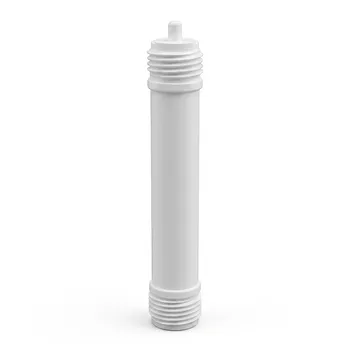
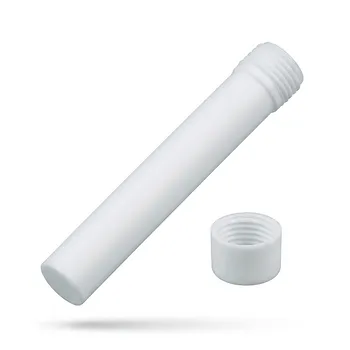
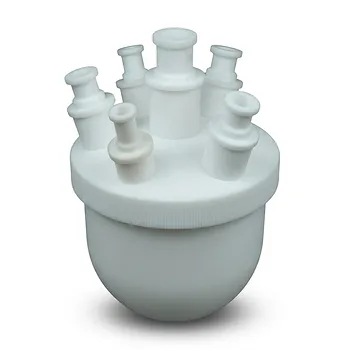
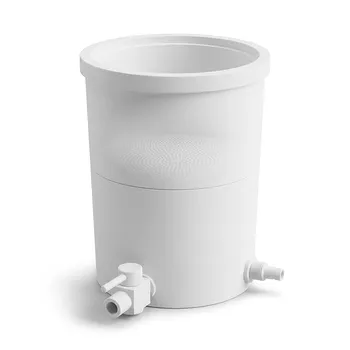
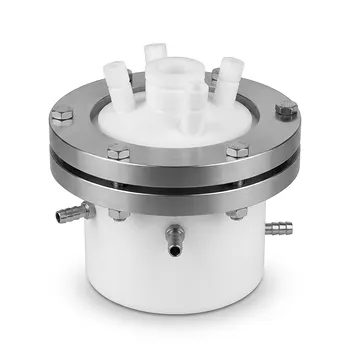
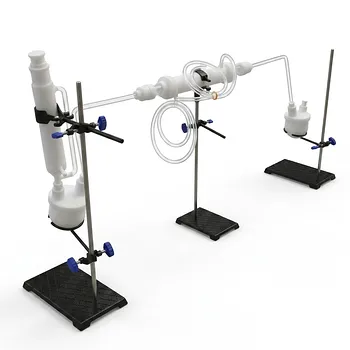
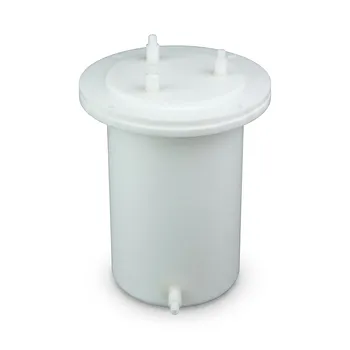
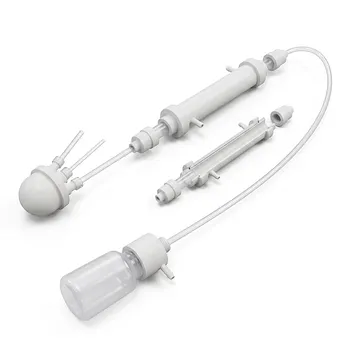
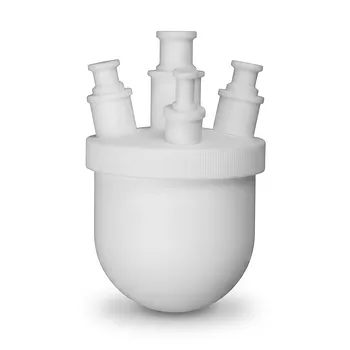
Polytetrafluoroethylene (PTFE) liners are indispensable in the hydrothermal synthesis of strontium titanate ($SrTiO_3$) because they provide an inert, corrosion-resistant barrier against highly alkaline reaction media. These liners prevent the caustic precursors from attacking the stainless steel autoclave walls, which simultaneously protects the equipment and ensures the high purity of the synthesized nanostructures by preventing metal ion leaching.
Core Takeaway: The PTFE liner acts as both a chemical shield and a purity guarantor, allowing $SrTiO_3$ synthesis to occur in aggressive alkaline environments at temperatures up to 200°C without compromising the structural integrity of the reactor or the quality of the nanomaterial.
The Chemical Necessity of PTFE in Titanate Synthesis
Resisting Highly Alkaline Reaction Media
The synthesis of strontium titanate nanostructures typically requires a strongly alkaline environment, often utilizing sodium hydroxide ($NaOH$) as a mineralizer. PTFE is one of the few materials capable of withstanding these caustic conditions without undergoing chemical degradation.
Without this liner, the alkaline solution would directly attack the metal reactor, leading to premature equipment failure and uncontrolled reaction conditions.
Thermal Stability Under Pressure
Hydrothermal synthesis relies on autogenous pressure generated at elevated temperatures to drive the growth of specific nanostructure morphologies. PTFE liners maintain their chemical stability and seal integrity at temperatures up to 200°C, which is the standard range for $SrTiO_3$ crystallization.
This thermal resilience allows researchers to exploit subcritical water properties to induce the formation of complex structures like nanotubes, nanosheets, or nanocrystals.
Protecting the Structural Integrity of the Reactor
Preventing Vessel Corrosion and Leaching
Stainless steel, while physically strong, is susceptible to corrosion when exposed to the high-temperature salts and bases used in $SrTiO_3$ synthesis. The PTFE liner provides a sealed reaction interface that completely isolates the chemical precursors from the external metal shell.
By preventing this contact, the liner ensures that the expensive stainless steel autoclave remains structurally sound over hundreds of reaction cycles.
Eliminating Metal Ion Contamination
In semiconductor and electronic applications, the purity of $SrTiO_3$ is critical; even trace amounts of iron or chromium from the reactor walls can alter the material's properties. The liner ensures that no metal ions leach into the reaction mixture, maintaining the pristine chemical composition of the nanostructures.
This isolation is essential for achieving the high-quality single-crystal growth required for advanced material performance.
Optimizing Product Quality and Collection
Non-Stick Surface for High Recovery Rates
PTFE is renowned for its exceptional mold-release properties, which prevent synthesized nanopowders from adhering to the container walls. This non-stick characteristic allows for the easy and near-complete collection of the final product after the synthesis is finished.
Facilitating easy recovery is vital when working with small yields of specialized nanomaterials where every milligram is valuable.
Ensuring Simplified Maintenance
The chemical inertness of PTFE makes the liners significantly easier to clean than a bare metal surface. Because the precursors do not bond with the PTFE, the risk of cross-contamination between different synthesis batches is drastically reduced.
This ease of cleaning ensures a "neutral" environment for every new experiment, which is a cornerstone of reproducible scientific results.
Understanding the Trade-offs and Limitations
Temperature Ceilings
The primary limitation of PTFE is its maximum operating temperature, which generally should not exceed 200°C to 250°C. Beyond this point, the material can begin to soften or undergo thermal decomposition, potentially releasing toxic fumes or losing its seal.
For synthesis requiring temperatures above this range, researchers must pivot to more expensive PEEK or metallic alloy liners.
Pressure and Deformation
Under extreme pressure, PTFE can exhibit "cold flow" or permanent deformation, especially if the liner is not perfectly fitted to the autoclave. This deformation can lead to leaks or difficulty removing the liner after a reaction.
Regularly inspecting liners for thinning or warping is necessary to maintain the safety of the high-pressure hydrothermal process.
How to Apply This to Your Project
Recommendations for Material Synthesis
- If your primary focus is maximum material purity: Always use a new or high-purity PTFE liner to ensure zero cross-contamination from previous reactions.
- If your primary focus is high-yield collection: Leverage the non-stick properties of PTFE by using ultrasonic baths to dislodge nanostructures from the liner walls after the reaction.
- If your primary focus is reactor longevity: Ensure the PTFE liner is properly seated with an appropriate gasket to prevent any alkaline "blow-by" from reaching the stainless steel threads.
Choosing the correct PTFE liner is not merely a matter of convenience, but a fundamental requirement for the safe and successful engineering of high-performance strontium titanate nanostructures.
Summary Table:
| Key Feature | Benefit for SrTiO3 Synthesis |
|---|---|
| Chemical Inertness | Resists highly alkaline NaOH precursors without degradation. |
| Thermal Stability | Operates safely under autogenous pressure up to 200°C. |
| Purity Guarantee | Eliminates metal ion leaching from stainless steel walls. |
| Non-Stick Surface | Facilitates easy collection of synthesized nanopowders. |
| Equipment Protection | Prevents corrosive attack on the stainless steel autoclave. |
Elevate Your Material Synthesis with KINTEK’s Fluoropolymer Expertise
From high-purity trace analysis instruments and cleaning tanks to custom-engineered hydrothermal synthesis liners, KINTEK is your premier partner for high-performance labware. Whether you need standard lab basics like beakers, reagent bottles, and digestion tubes, or complex, non-standard machined parts crafted via our end-to-end custom CNC fabrication, we deliver solutions tailored to your exact specifications.
Our exclusive focus on PTFE and PFA ensures your $SrTiO_3$ nanostructures remain pure and your reactors stay protected. From fluid transfer components (tubing, valves) to advanced electrochemical cells and microwave digestion vessels, we provide absolutely everything your lab needs to maintain peak performance.
Ready to optimize your synthesis process? Contact KINTEK today for bespoke laboratory setups and high-volume orders!
References
- Anderson Thesing, Jacqueline Santos. Engineering SrTiO<sub>3</sub> Nanostructures for Enhanced Photocatalytic Performance: Unveiling the Influence of Titanium Precursors and Synthesis Temperature. DOI: 10.1021/acsomega.5c04899
This article is also based on technical information from Kintek Knowledge Base .
Related Products
- PTFE Lined High Pressure Digestion Vessel 50ml High Temperature Hydrothermal Synthesis Tank
- High Pressure Custom TFM Reactor Stainless Steel Outer Vessel PTFE Inner Cup for Corrosive Synthesis
- Custom TFM Reaction Vessel with Stainless Steel Jacket and PTFE Inner Cup for High Corrosion Resistance
- High Purity PTFE Microwave Digestion Vessel for Soil and Food Analysis Acid Resistant Fluoropolymer Sample Preparation Liners
- High Purity TFM Microwave Digestion Vessels PTFE Acid Evaporation Liners Domestic GT-400 Equivalent Laboratory Reaction Containers
People Also Ask
- What are the benefits of using a PTFE-lined vessel for carbon-sulfur cathode treatment? Maximize Purity & Performance
- Why are PTFE-lined pressure digestion vessels required for the preparation of Ag/CeO2 catalysts? Purity & Performance
- What safety features are typically incorporated into high-pressure PTFE digestion vessel designs? Ensure Lab Safety
- What is the function of PTFE lined high-pressure vessels in g-C3N4 synthesis? Achieve High-Purity Material Growth
- Role of High-Pressure Digestion Tanks in Perovskite Synthesis: Achieve Superior Stability and Latent Heat