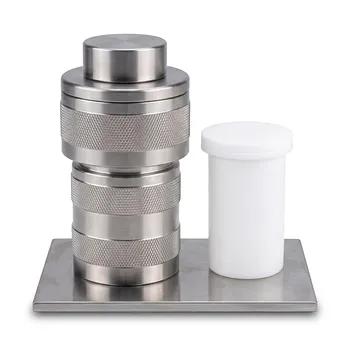
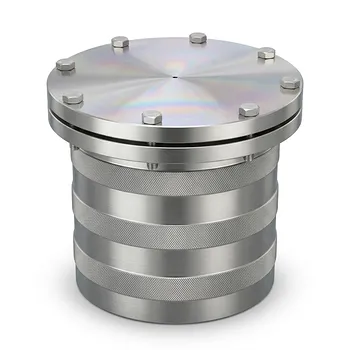
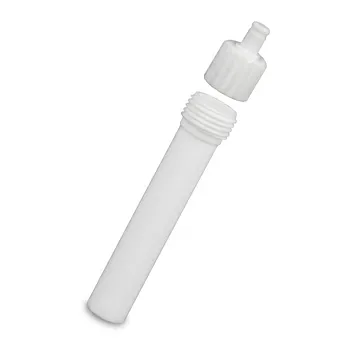
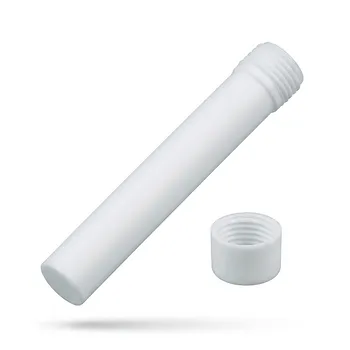
High-quality PTFE-lined autoclaves are essential for cerium dioxide nanorod synthesis because they provide the necessary chemical inertness to withstand highly concentrated alkaline solutions at high temperatures and pressures. Without this liner, the caustic environment would corrode the reaction vessel, introducing metallic impurities that disrupt nanorod crystallization and compromise the structural integrity of the autoclave itself.
Core Takeaway: A PTFE (polytetrafluoroethylene) liner acts as a critical barrier that prevents strong alkaline reagents from reacting with the vessel walls, ensuring both the purity of the cerium dioxide nanorods and the safety of the high-pressure equipment.
Resilience Against Harsh Alkaline Environments
Resistance to Concentrated Sodium Hydroxide
The synthesis of cerium dioxide nanorods frequently utilizes highly concentrated sodium hydroxide (NaOH) solutions, often reaching amounts as high as 60 grams per reaction. PTFE is uniquely capable of resisting this strong alkaline corrosion, which would otherwise aggressively attack most metallic surfaces.
Stability Under Thermal Stress
Hydrothermal reactions for $CeO_2$ nanorods typically operate at temperatures reaching 110 °C. High-quality PTFE maintains its thermal stability and mechanical properties at these temperatures, preventing the liner from warping or degrading during the long hours required for crystal growth.
Maintaining a Sealed Pressure Environment
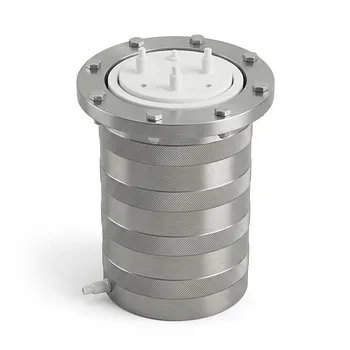
The PTFE liner, when properly fitted within a stainless steel shell, creates a sealed, high-pressure environment. This pressure is vital for the precursors to fully react and transform into the desired structured nanorod morphology.
Ensuring Chemical Purity and Crystal Integrity
Prevention of Metal Ion Leaching
One of the most critical roles of the liner is preventing the reaction liquid from contacting the outer stainless steel autoclave body. This barrier ensures that metal ion impurities from the steel do not leach into the mixture, which would contaminate the $CeO_2$ nanoparticles and skew experimental results.
Non-Stick Surface for Uniform Growth
PTFE provides a non-stick surface that ensures cerium precursors are not lost to the vessel walls. This surface allows the particles to remain in the solution, promoting heterogeneous nucleation and the orderly development of single-crystal nanorods.
Facilitating Experimental Accuracy
By providing a chemically inert environment, the PTFE liner ensures that the chemical reaction is driven solely by the intended reagents. This level of control is necessary for producing nanorods with controllable aspect ratios and high crystalline phases.
Understanding the Trade-offs and Limitations
Temperature Constraints
While PTFE is excellent for many reactions, it has a functional upper limit, typically around 200°C to 240°C. Exceeding these temperatures can lead to the deformation of the liner or the release of toxic vapors, meaning researchers must carefully monitor their thermal profiles.
Thermal Expansion Mismatch
PTFE has a different coefficient of thermal expansion than the stainless steel shell surrounding it. If a liner is not high-quality or correctly sized, rapid cooling or heating can cause the liner to crack or "collapse," potentially allowing corrosive fluids to reach the metal shell.
Memory Effect and Contamination
Even though PTFE is non-stick, it can be slightly porous at a microscopic level. If not cleaned rigorously between experiments, cross-contamination from previous synthesis runs can occur, which is why high-purity, high-density PTFE is preferred for sensitive nanomaterial work.
How to Apply This to Your Project
When selecting or using an autoclave for $CeO_2$ nanorod synthesis, your choice should be guided by your specific chemical environment and purity requirements.
- If your primary focus is product purity: Always opt for high-purity, virgin PTFE liners to eliminate the risk of trace metal contamination from the autoclave walls.
- If your primary focus is equipment longevity: Ensure the PTFE liner is inspected for cracks or thinning after every high-alkaline run to prevent the $NaOH$ from eventually "pinholing" through to the stainless steel.
- If your primary focus is morphology control: Maintain strict temperature control within the PTFE's stable range (below 200°C) to ensure consistent pressure and uniform nanorod crystallization.
The high-quality PTFE liner is the silent guardian of the hydrothermal process, turning a potentially destructive chemical reaction into a controlled environment for precision engineering.
Summary Table:
| Feature | Benefit for $CeO_2$ Synthesis | Technical Consideration |
|---|---|---|
| Chemical Inertness | Resists highly concentrated NaOH (alkaline corrosion) | Prevents vessel damage and contamination |
| Metallic Isolation | Prevents leaching of metal ions from steel shell | Ensures pure crystal formation and morphology |
| Non-Stick Surface | Promotes heterogeneous nucleation in solution | Minimizes precursor loss on vessel walls |
| Thermal Stability | Maintains integrity at 110°C+ synthesis temps | Operating limit typically 200°C - 240°C |
| Pressure Sealing | Enables the high-pressure environment for growth | Requires precise fit with stainless steel shell |
Elevate Your Research with KINTEK’s High-Performance Fluoropolymer Solutions
Don't let impurities or equipment failure compromise your hydrothermal synthesis. KINTEK specializes in high-performance laboratory supplies crafted exclusively from PTFE and PFA, ensuring absolute chemical inertness for your most sensitive experiments.
Whether you require everyday basic labware (beakers, measuring cylinders, crucibles, reagent bottles) or advanced reaction apparatus like hydrothermal synthesis liners, microwave digestion vessels, and custom electrochemical cells, we have you covered. Our expertise extends to comprehensive fluid transfer components (tubing, fittings, valves), sample prep tools (filters, pipettes, spatulas), and high-volume consumables.
Why choose KINTEK?
- End-to-End Customization: Precision CNC fabrication for complex, non-standard machined parts.
- Absolute Purity: Specialized in trace analysis instruments and cleaning tanks to eliminate contamination.
- Material Focus: An exclusive commitment to high-performance fluoropolymers for extreme resilience.
Ready to optimize your laboratory setup? Contact KINTEK today to discuss your bespoke requirements and experience the precision of expert-led fabrication.
References
- Rui Zhiyan, Jianguo Liu. Ceria nanorods as highly stable free radical scavengers for highly durable proton exchange membranes. DOI: 10.1039/d1ra05026e
This article is also based on technical information from Kintek Knowledge Base .
Related Products
- PTFE Lined High Pressure Digestion Vessel 50ml High Temperature Hydrothermal Synthesis Tank
- Custom TFM Reaction Vessel with Stainless Steel Jacket and PTFE Inner Cup for High Corrosion Resistance
- High Purity PTFE Microwave Digestion Vessel Replacement Liner for Acid Sample Preparation and Trace Analysis
- High Purity TFM Microwave Digestion Vessels PTFE Acid Evaporation Liners Domestic GT-400 Equivalent Laboratory Reaction Containers
- High Pressure Custom TFM Reactor Stainless Steel Outer Vessel PTFE Inner Cup for Corrosive Synthesis
People Also Ask
- What are the benefits of using a PTFE-lined vessel for carbon-sulfur cathode treatment? Maximize Purity & Performance
- Why are PTFE-lined pressure digestion vessels required for the preparation of Ag/CeO2 catalysts? Purity & Performance
- What is the function of high-pressure PTFE digestion vessels in mineral analysis? Optimize Sample Mineralization
- What safety features are typically incorporated into high-pressure PTFE digestion vessel designs? Ensure Lab Safety
- What is the function of PTFE lined high-pressure vessels in g-C3N4 synthesis? Achieve High-Purity Material Growth