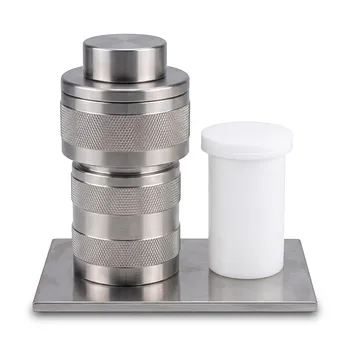
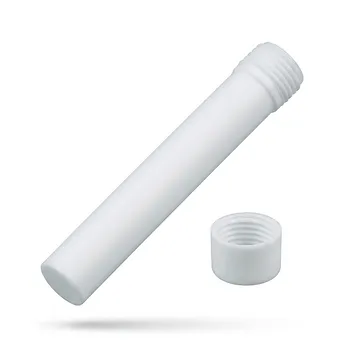
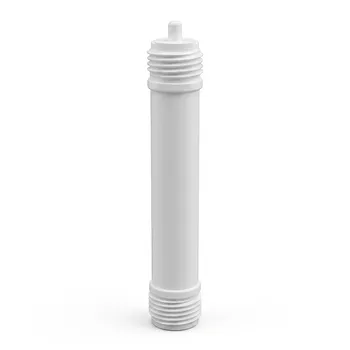
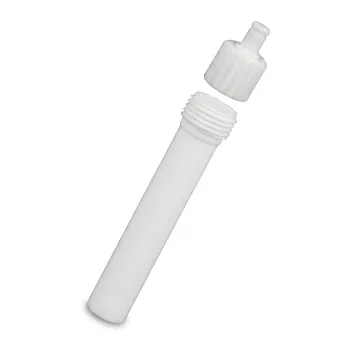
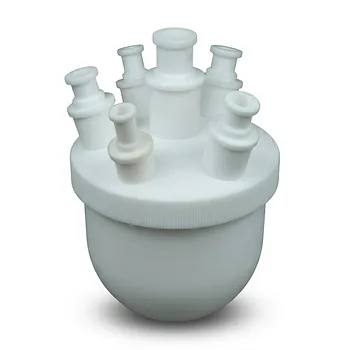
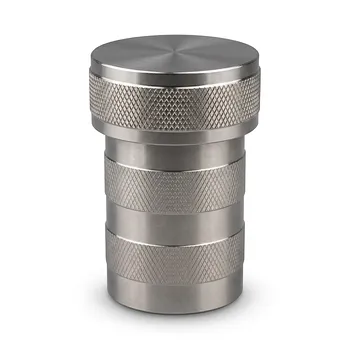
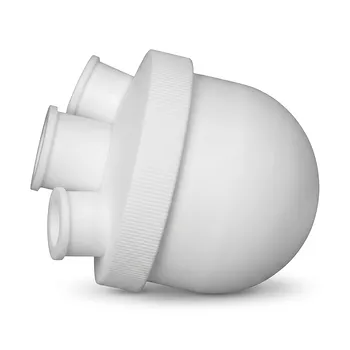
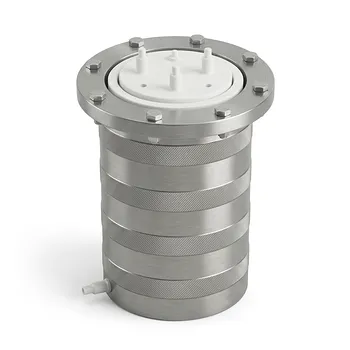
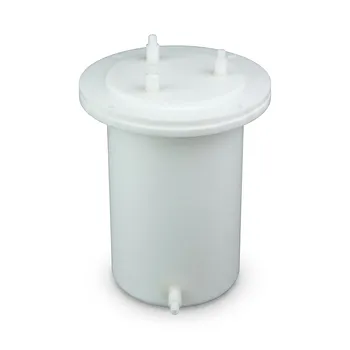
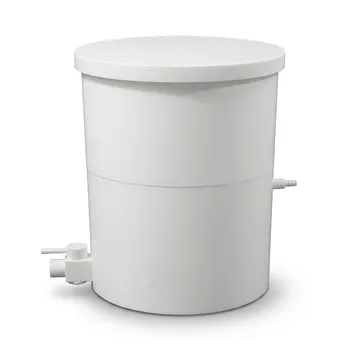
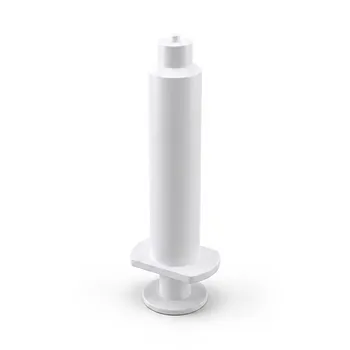
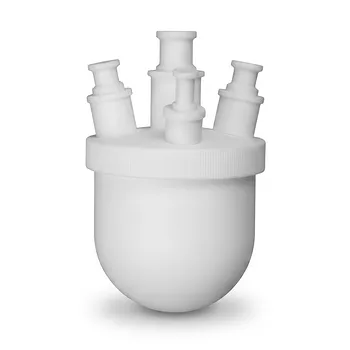
High-purity PTFE liners are the industry standard for hydrothermal synthesis because they provide a chemically inert and thermally stable environment essential for the formation of complex nanocomposites. These liners isolate the reaction precursors from the metal autoclave, preventing contamination from leaching ions while allowing the system to reach the temperatures (up to 200°C) and autogenous pressures required for high crystallinity.
Core Takeaway: PTFE liners function as a critical chemical and thermal barrier that ensures the phase purity and structural integrity of $Fe_3O_4:Ce@NaYF_4$ nanocomposites by preventing vessel corrosion and trace metal contamination.
Maintaining Phase Purity and Crystallinity
Preventing Trace Metal Contamination
During the synthesis of cerium-doped magnetite cores and rare-earth upconversion shells, the presence of foreign metal ions can disrupt the crystal lattice. PTFE liners effectively isolate the reaction from the stainless steel walls of the autoclave, ensuring that no iron, nickel, or chromium ions leach into the solution.
Enabling High-Temperature Stability
The synthesis of $NaYF_4$ shells requires stable temperatures, often reaching 200°C. High-purity PTFE maintains its structural integrity at these temperatures, providing a consistent environment that allows for the growth of uniform morphologies and high-quality crystals.
Facilitating Controlled Autogenous Pressure
PTFE liners create a sealed environment that facilitates the build-up of autogenous pressure. This pressure is vital for forcing the precursors into the desired crystalline phases, ensuring the magnetite and upconversion layers bond correctly.
Chemical Protection and Reaction Safety
Resistance to Corrosive Media
Hydrothermal synthesis often involves strong acidic or alkaline media (with pH levels reaching up to 10) to control particle size and shape. PTFE is exceptionally resistant to chemical attack, protecting the outer metal vessel from corrosion that could lead to structural failure of the autoclave.
Surface Inertness and Sample Recovery
The low surface energy and non-stick properties of PTFE are critical for the recovery of synthesized nanopowders. These properties prevent the $Fe_3O_4:Ce@NaYF_4$ particles from adhering to the container walls, maximizing yield and simplifying the cleaning process.
Ensuring Uniform Morphology
Because PTFE does not react with the precursors, the nucleation and growth kinetics remain undisturbed. This leads to the production of nanocomposites with highly consistent sizes and shapes, which is essential for their performance in downstream applications.
Understanding the Trade-offs and Limitations
Temperature Thresholds
While PTFE is highly resilient, it has a functional limit typically around 220°C to 250°C. Exceeding these temperatures can cause the liner to soften or deform, potentially compromising the seal and leading to a dangerous loss of pressure.
Thermal Expansion Mismatch
PTFE has a different coefficient of thermal expansion than the stainless steel outer shell of the autoclave. If the liner is not sized correctly or cooled too rapidly, it can warp or crack, which may lead to "creep" and eventual leakage of the reaction mixture.
Porosity and Absorption
Although largely inert, PTFE can be slightly porous to certain gases or small molecules over long reaction times. In extremely sensitive syntheses, trace amounts of previous reaction residues trapped in the pores could act as contaminants if the liner is not meticulously cleaned.
How to Optimize Your Synthesis Results
To achieve the best results when synthesizing $Fe_3O_4:Ce@NaYF_4$ nanocomposites, consider your specific experimental constraints.
- If your primary focus is maximum phase purity: Always use high-purity, virgin PTFE liners and implement a rigorous "leaching" cleaning cycle with dilute acid between runs.
- If your primary focus is high-yield sample recovery: Utilize the non-stick nature of the liner by avoiding mechanical scraping; instead, use ultrasonic baths to gently displace the nanomaterials from the walls.
- If your primary focus is safety at high temperatures: Monitor the integrity of the PTFE gaskets and ensure the liner is never filled beyond 80% capacity to allow for safe thermal expansion.
By meticulously managing the reaction environment through high-purity PTFE liners, researchers can ensure the reliable and repeatable production of high-performance nanocomposites.
Summary Table:
| Feature | Benefit for Nanocomposite Synthesis | Technical Detail |
|---|---|---|
| Chemical Inertness | Prevents trace metal contamination (Fe, Ni, Cr) | Isolates precursors from autoclave walls |
| Thermal Stability | Ensures uniform growth and high crystallinity | Stable operation up to 200°C - 250°C |
| Surface Energy | Facilitates maximum sample recovery | Non-stick surface prevents wall adhesion |
| Corrosion Resistance | Protects vessel from acidic/alkaline media | Withstands pH levels up to 10+ |
| Pressure Seal | Enables autogenous pressure build-up | Facilitates phase transformation kinetics |
Elevate Your Synthesis Precision with KINTEK’s Fluoropolymer Expertise
High-performance research requires uncompromising material purity. KINTEK specializes in manufacturing virtually all imaginable laboratory supplies crafted from high-purity PTFE and PFA. From everyday basic labware (beakers, crucibles, and reagent bottles) to advanced hydrothermal synthesis liners, microwave digestion vessels, and custom electrochemical cells, we provide the chemically inert environment your nanocomposites demand.
Whether you need standard consumables like stirring bars and O-rings or complex non-standard machined parts via our end-to-end custom CNC fabrication, KINTEK is your dedicated partner for high-performance fluoropolymers. Ensure your $Fe_3O_4:Ce@NaYF_4$ research is backed by the industry's most reliable thermal and chemical barriers.
Ready to optimize your lab setup? Contact us today for bespoke solutions and high-volume orders!
References
- V. Ponni, C. Rakkappan. Fe3O4:Ce@NaYF4 Core-Shell Nanocomposites: Hydrothermal Synthesis for Enhanced Magnetic, Photocatalytic and Supercapacitor Applications. DOI: 10.14233/ajchem.2025.34339
This article is also based on technical information from Kintek Knowledge Base .
Related Products
- PTFE Lined High Pressure Digestion Vessel 50ml High Temperature Hydrothermal Synthesis Tank
- High Purity TFM Microwave Digestion Vessels PTFE Acid Evaporation Liners Domestic GT-400 Equivalent Laboratory Reaction Containers
- High Purity PTFE Microwave Digestion Vessel for Soil and Food Analysis Acid Resistant Fluoropolymer Sample Preparation Liners
- High Purity PTFE Microwave Digestion Vessel Replacement Liner for Acid Sample Preparation and Trace Analysis
- Custom Multi Neck PTFE Flask 18L Laboratory Chemical Reactor Vessel for High Purity Synthesis and Stirring Applications
People Also Ask
- What are the benefits of using a PTFE-lined vessel for carbon-sulfur cathode treatment? Maximize Purity & Performance
- Why are PTFE-lined pressure digestion vessels required for the preparation of Ag/CeO2 catalysts? Purity & Performance
- What safety features are typically incorporated into high-pressure PTFE digestion vessel designs? Ensure Lab Safety
- What is the function of high-pressure PTFE digestion vessels in mineral analysis? Optimize Sample Mineralization
- What is the function of PTFE lined high-pressure vessels in g-C3N4 synthesis? Achieve High-Purity Material Growth