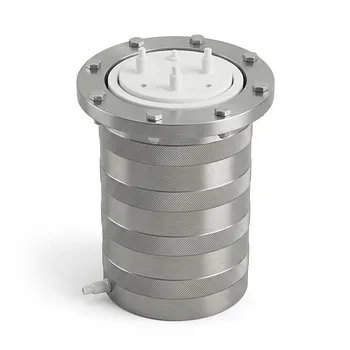
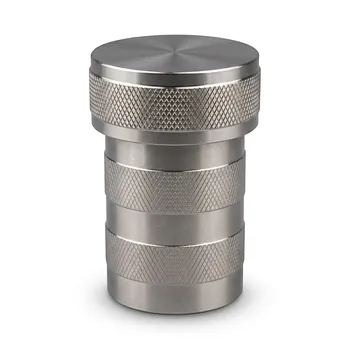
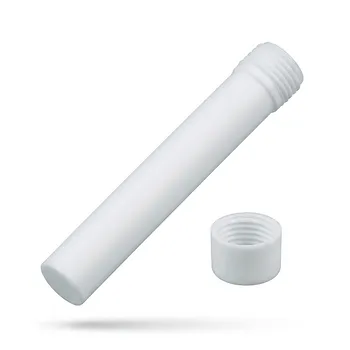
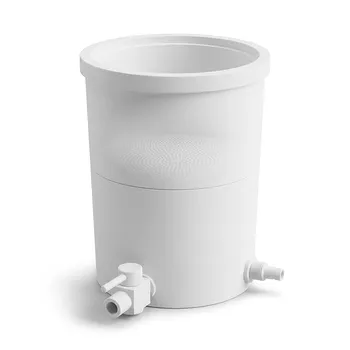
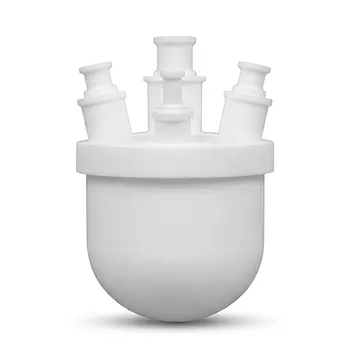
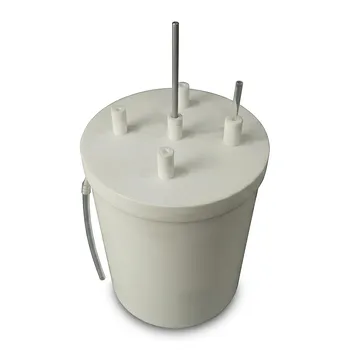
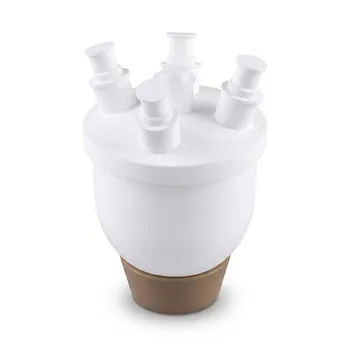
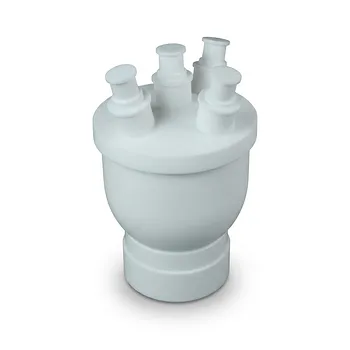
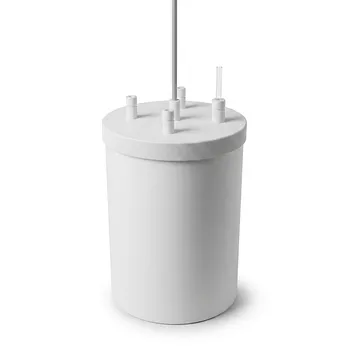
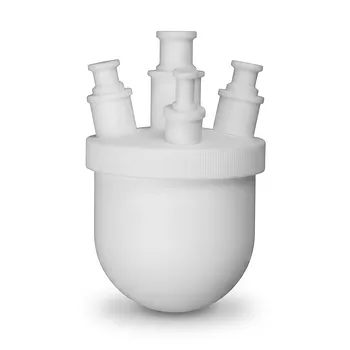
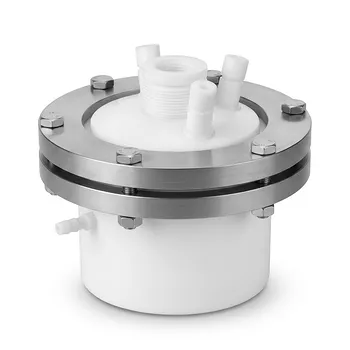
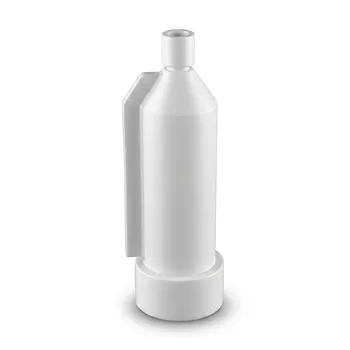
The PTFE (polytetrafluoroethylene) liner is the indispensable internal barrier that enables the hydrothermal synthesis of vanadium pentoxide ($V_2O_5$) by providing a chemically inert, high-pressure environment. It specifically protects the external stainless steel autoclave from the highly acidic precursor solutions (often with a pH as low as 2) required to precipitate $V_2O_5$ nanostructures.
The PTFE liner serves as a critical reaction carrier that isolates corrosive media from the reactor's metal walls, ensuring both the structural integrity of the equipment and the chemical purity of the resulting nanomaterials. By maintaining a sealed environment under autogenous pressure, it facilitates the precise morphological transformation of precursors into specific $V_2O_5$ nanosheets or frameworks.
Protecting the Structural Integrity of the Reactor
Corrosion Resistance Against Acidic Precursors
The synthesis of $V_2O_5$ often requires precursor solutions with a pH of approximately 2. PTFE is virtually immune to chemical attack from these strong acids, whereas the stainless steel outer shell would suffer immediate and severe erosion.
Safeguarding the Stainless Steel Shell
The liner acts as a sacrificial yet durable sleeve that prevents the acidic media from reaching the load-bearing metal vessel. This isolation ensures the high-pressure safety of the autoclave remains intact over hundreds of reaction cycles.
Enhancing Equipment Longevity
Because PTFE has excellent non-stick properties, it is easy to clean and maintain after a synthesis run. This reduces the mechanical wear and tear associated with removing stubborn chemical residues, further extending the life of the reactor system.
Enabling High-Purity Synthesis
Preventing Metal Ion Contamination
If precursors were in direct contact with the stainless steel walls, iron, chromium, and nickel ions would leach into the solution. The PTFE liner provides a sealed reaction interface that keeps the $V_2O_5$ nanostructures free from these metallic impurities.
Providing a Chemically Inert Interface
PTFE does not participate in the chemical reaction, acting only as a container. This chemical neutrality allows researchers to control the reaction kinetics precisely without worrying about side reactions triggered by the vessel material.
Ensuring High Crystallinity
By maintaining a stable, uncontaminated environment, the PTFE liner supports the growth of high-purity nanocrystals. This is essential for applications where $V_2O_5$ is used in quantum dots or advanced battery materials.
Controlling Nanostructure Development
Managing Autogenous Pressure and Heat
Within the liner, the reaction proceeds at temperatures typically ranging from 200°C to 205°C. The sealed environment generates autogenous pressure, which is the driving force behind the full reaction of the precursors.
Facilitating Specific Morphologies
The high-pressure environment inside the PTFE chamber promotes the transformation of chemicals into complex structures like nanosheets or microporous frameworks. These specific shapes are critical for the surface area and reactivity of the $V_2O_5$ material.
Providing a Stable Growth Environment
The liner ensures that temperature and pressure are distributed evenly throughout the solution. This stability is what allows the $V_2O_5$ to develop with uniform morphology and consistent particle sizes.
Understanding the Trade-offs and Limitations
Temperature Thresholds
While PTFE is highly resilient, it has a functional limit typically around 220°C. Exceeding this temperature can cause the liner to soften or deform, potentially compromising the seal and leading to a dangerous pressure release.
Thermal Expansion Disparity
PTFE expands at a different rate than the stainless steel shell during heating. If the liner is not properly sized or if the cooling process is too rapid, it can lead to leaking or permanent warping of the liner.
Pressure Limitations
The liner itself does not provide mechanical strength; it relies on the stainless steel shell to hold the pressure. If the liner develops a micro-crack, the corrosive acidic solution can seep through and damage the load-bearing shell without the user immediately realizing it.
How to Apply This to Your Project
When selecting or operating a hydrothermal reactor for $V_2O_5$ synthesis, consider your specific experimental parameters to ensure safety and product quality.
- If your primary focus is high-purity nanostructures: Ensure the PTFE liner is thoroughly cleaned with dilute acid between runs to prevent cross-contamination of $V_2O_5$ crystal seeds.
- If your primary focus is extreme temperature synthesis (above 220°C): Replace the PTFE liner with a PPL (polyphenylene polymers) liner, which offers higher thermal stability while maintaining chemical resistance.
- If your primary focus is equipment longevity: Always inspect the liner for "creeping" or deformation after every run at 200°C to ensure the seal remains airtight for the next experiment.
The PTFE liner is the silent enabler of hydrothermal chemistry, turning a standard pressure vessel into a precision laboratory for advanced nanomaterial engineering.
Summary Table:
| Feature | Role in V2O5 Synthesis | Key Benefit |
|---|---|---|
| Corrosion Resistance | Resists acidic precursors (pH ~2) | Protects stainless steel reactor shell |
| Chemical Inertness | Prevents metal ion leaching (Fe, Cr, Ni) | Ensures high-purity nanostructures |
| Temperature Limit | Operates safely up to 220°C | Enables stable 200-205°C reactions |
| Pressure Handling | Maintains sealed autogenous environment | Facilitates nanosheet & framework growth |
| Surface Property | Non-stick, easy-to-clean interface | Simplifies maintenance & prevents seeding |
Elevate Your Synthesis with KINTEK’s Precision Fluoropolymer Solutions
Achieving consistent results in hydrothermal synthesis requires equipment that never compromises on purity or safety. KINTEK specializes in high-performance fluoropolymer materials, manufacturing everything from essential PTFE and PFA labware—including beakers, crucibles, and reagent bottles—to advanced hydrothermal synthesis liners, microwave digestion vessels, and custom electrochemical cells.
Whether you need standard consumables like stirring bars and O-rings or bespoke, CNC-machined components tailored to your specific reactor dimensions, our end-to-end fabrication ensures absolute precision. We help researchers and engineers maintain a contamination-free environment for even the most sensitive nanomaterial applications.
Ready to upgrade your lab setup? Contact us today to discover how our high-performance PTFE/PFA solutions and custom engineering can optimize your research outcomes.
References
- Bhalchandra K. Mandlekar, Anamika V. Kadam. Vacancy-defect assisted electrochromic applications in V2O5 nanomaterials. DOI: 10.1007/s44373-025-00050-w
This article is also based on technical information from Kintek Knowledge Base .
Related Products
- PTFE Lined High Pressure Digestion Vessel 50ml High Temperature Hydrothermal Synthesis Tank
- High Pressure Custom TFM Reactor Stainless Steel Outer Vessel PTFE Inner Cup for Corrosive Synthesis
- High Temperature Corrosion Resistant Hydrothermal Synthesis Reactor with TFM Inner Liner and Straight Cylinder Design
- Custom TFM Reaction Vessel with Stainless Steel Jacket and PTFE Inner Cup for High Corrosion Resistance
- High Purity TFM Microwave Digestion Vessels PTFE Acid Evaporation Liners Domestic GT-400 Equivalent Laboratory Reaction Containers
People Also Ask
- What are the benefits of using a PTFE-lined vessel for carbon-sulfur cathode treatment? Maximize Purity & Performance
- Why are PTFE-lined pressure digestion vessels required for the preparation of Ag/CeO2 catalysts? Purity & Performance
- What safety features are typically incorporated into high-pressure PTFE digestion vessel designs? Ensure Lab Safety
- What is the function of PTFE lined high-pressure vessels in g-C3N4 synthesis? Achieve High-Purity Material Growth
- Role of High-Pressure Digestion Tanks in Perovskite Synthesis: Achieve Superior Stability and Latent Heat