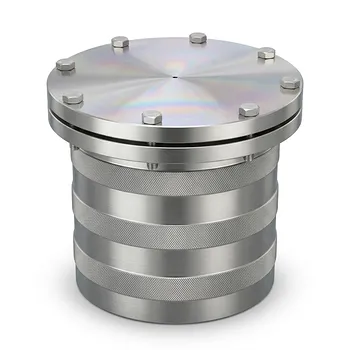
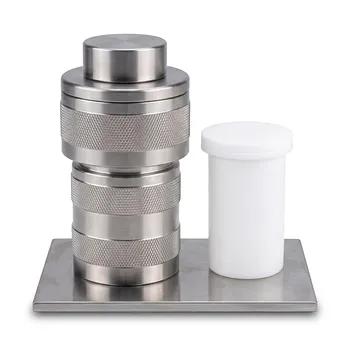
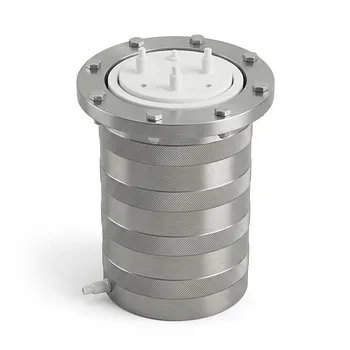
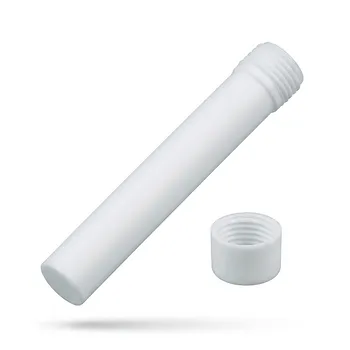
In the synthesis of Tin Ferrite ($SnFe_2O_4$), the PTFE-lined stainless steel autoclave acts as a specialized reaction vessel that creates a high-purity, high-pressure environment. This setup allows precursors, such as metal chlorides and sodium hydroxide, to react at temperatures well above the boiling point of the solvent. The resulting autogenous pressure within the sealed chamber is the driving force behind the nucleation and crystallization of the $SnFe_2O_4$ nanostructures.
The autoclave provides a dual-function environment where the stainless steel shell offers mechanical strength to contain high pressure, while the PTFE liner ensures chemical inertness. This combination allows for the controlled growth of high-purity nanocrystals by preventing contamination and resisting corrosive reagents.
The Synergistic Role of the Autoclave Components
Mechanical Support from the Stainless Steel Shell
The stainless steel outer shell provides the structural integrity required to withstand the high internal pressures generated during the heating process. Without this rigid exterior, the vessel would be unable to maintain the autogenous pressure necessary for hydrothermal synthesis at temperatures reaching 200°C. This pressure is fundamental to forcing the precursors into a state that promotes the formation of a single-phase spinel structure.
Chemical Isolation via the PTFE Liner
The Polytetrafluoroethylene (PTFE) liner serves as a protective barrier that prevents the reaction solution from contacting the metallic walls of the autoclave. In $SnFe_2O_4$ synthesis, aggressive reagents like sodium hydroxide (NaOH) and acidic metal chlorides are commonly used. The PTFE liner is exceptionally stable and resists corrosion from these chemicals, ensuring the stainless steel shell remains undamaged.
Prevention of Metallic Contamination
By isolating the reaction mixture, the PTFE liner eliminates the risk of introducing iron or chromium ions from the stainless steel into the sample. This ensures the chemical purity of the Tin Ferrite nanomaterials, which is critical for maintaining their specific magnetic and catalytic properties. High purity is essential for achieving a precise tetragonal or spinel crystal structure without unwanted dopants.
Mechanisms of Hydrothermal Synthesis for $SnFe_2O_4$
Creation of Autogenous Pressure
As the autoclave is heated, the liquid precursors within the sealed PTFE chamber expand and partially vaporize, creating autogenous pressure. This high-pressure environment increases the solubility of the precursors, allowing them to mix more thoroughly at the molecular level. This state is required to overcome the energy barriers associated with the formation of complex ferrites.
Promotion of Nucleation and Growth
The combination of high temperature and pressure within the autoclave accelerates the nucleation and growth of $SnFe_2O_4$ crystals. Under these conditions, the reaction kinetics are significantly enhanced compared to open-air methods. This allows for the production of nanomaterials with high crystallinity and consistent morphology, such as uniform spheres or octahedrons.
Precise Control Over Nanostructures
The sealed nature of the autoclave allows researchers to maintain a constant volume and environment throughout the reaction. By adjusting the filling ratio of the PTFE liner or the heating duration, one can precisely control the particle size and shape of the Tin Ferrite. This level of control is vital for tailoring the material for applications in gas sensing or energy storage.
Understanding the Trade-offs
Temperature Limitations of PTFE
While PTFE is highly inert, it has a functional temperature limit, typically around 250°C. Exceeding this temperature can cause the liner to soften or deform, potentially leading to a seal failure or the release of toxic fumes. For reactions requiring higher temperatures, more expensive liners like PPL (Polyphenylene polymers) or gold-plated vessels must be considered.
Thermal Expansion Mismatch
Stainless steel and PTFE have different rates of thermal expansion, which can put stress on the liner during rapid heating or cooling cycles. If the autoclave is cooled too quickly, the liner may contract at a different rate than the steel shell, leading to cracks or leaks. Gradual cooling is usually required to maintain the longevity of the equipment and the quality of the crystals.
Pressure Safety Risks
The very pressure that enables synthesis also presents a significant safety risk if the vessel is overfilled. A common pitfall is exceeding the 80% filling capacity of the PTFE liner, which can lead to excessive pressure buildup and potential explosion. Proper calculation of the expansion of the solvent at target temperatures is mandatory for safe operation.
How to Apply This to Your Project
Recommendations for Successful Synthesis
The choice of autoclave parameters directly influences the final characteristics of your $SnFe_2O_4$ nanomaterials.
- If your primary focus is High Chemical Purity: Ensure the PTFE liner is thoroughly cleaned with dilute acid between runs to remove any residual metal ions that could act as nucleation seeds.
- If your primary focus is Small Particle Size: Utilize a lower filling ratio (around 50-60%) and shorter reaction times to limit the growth phase of the crystals after the initial nucleation.
- If your primary focus is High Crystallinity: Operate at the upper safe limit of the PTFE liner (approx. 200°C–220°C) and allow for a slow, controlled cooling process to let the crystal lattice stabilize.
The PTFE-lined stainless steel autoclave is an indispensable tool that bridges the gap between liquid precursors and high-performance $SnFe_2O_4$ nanostructures through the precise application of heat and pressure.
Summary Table:
| Component | Primary Function | Advantage for SnFe2O4 Synthesis |
|---|---|---|
| Stainless Steel Shell | Mechanical Strength | Withstands high autogenous pressure at 200°C+ |
| PTFE Liner | Chemical Inertness | Prevents metallic contamination and resists NaOH/acids |
| Sealed Chamber | Pressure Generation | Facilitates single-phase spinel structure crystallization |
Elevate Your Research with High-Performance Fluoropolymer Solutions
Unlock the full potential of your hydrothermal synthesis with KINTEK. We specialize in high-performance laboratory supplies crafted exclusively from PTFE and PFA, ensuring your nanomaterials remain free from metallic contamination.
From everyday essentials like beakers, crucibles, and reagent bottles to advanced components like hydrothermal synthesis liners, microwave digestion vessels, and custom-machined microchannel reactors, KINTEK provides the chemical inertness your lab demands. Our end-to-end custom CNC fabrication allows us to deliver everything from complex non-standard parts to high-volume orders of tubing, fittings, and reaction apparatus.
Ready to optimize your SnFe2O4 production? Contact KINTEK today to discuss your custom laboratory needs and discover how our absolute focus on fluoropolymer excellence can improve your experimental precision.
References
- Trần Thị Việt Nga, Vuong Minh Hieu. Hydrothermal Synthesis and Gas Sensing Performance of Spinel-type SnFe2O4 Nanomaterials: Influence of Synthesis Condition. DOI: 10.25073/2588-1124/vnumap.5059
This article is also based on technical information from Kintek Knowledge Base .
Related Products
- Custom TFM Reaction Vessel with Stainless Steel Jacket and PTFE Inner Cup for High Corrosion Resistance
- PTFE Lined High Pressure Digestion Vessel 50ml High Temperature Hydrothermal Synthesis Tank
- High Pressure Custom TFM Reactor Stainless Steel Outer Vessel PTFE Inner Cup for Corrosive Synthesis
- High Purity TFM Microwave Digestion Vessels PTFE Acid Evaporation Liners Domestic GT-400 Equivalent Laboratory Reaction Containers
- High Purity PTFE Microwave Digestion Vessel Replacement Liner for Acid Sample Preparation and Trace Analysis
People Also Ask
- Why are high-performance pressure-resistant reaction vessels required for oxygen-assisted hydrothermal conversion at 150 °C?
- Why are high-quality fluoropolymer-lined reaction vessels required for alk-Ti3C2Tx MXene? Ensure Purity & HF Resistance
- How do magnetic stirring and reaction vessels impact MOF-derived carbon quality? Optimize Your Composite Performance
- Why are PTFE-lined reaction vessels necessary for forced degradation studies? Ensure high-purity results and accuracy.
- Why is a high-purity PTFE lined reaction vessel required for the acidic etching of MXenes? Ensure Material Purity.