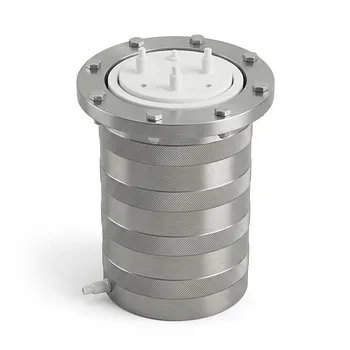
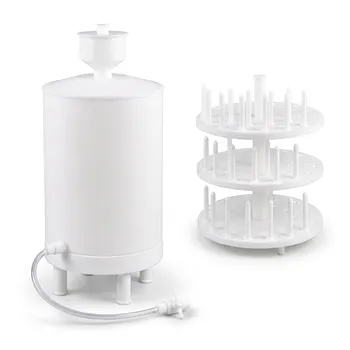
A PTFE-lined stainless steel autoclave acts as a specialized pressure vessel that creates the extreme thermal and chemical conditions necessary for LSFO crystallization. It provides a sealed environment where temperatures can exceed the boiling point of the solvent, generating the autogenous pressure required to transform liquid precursors into solid, high-purity $La_{0.9}Sr_{0.1}FeO_3$ nanopowder.
The autoclave serves two critical functions: the stainless steel shell provides the structural integrity to withstand high internal pressures, while the PTFE liner ensures chemical purity by shielding the reaction from metallic contamination in highly alkaline conditions.
The Dual-Component Design Architecture
The Stainless Steel Outer Shell
The primary role of the stainless steel exterior is to provide mechanical strength. During the hydrothermal process, internal pressure rises significantly as the temperature reaches levels such as 220°C, and the steel shell prevents the vessel from deforming or failing.
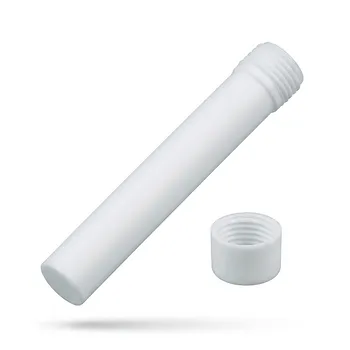
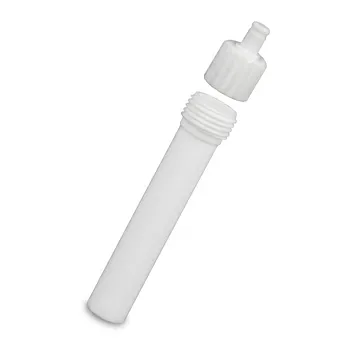
The PTFE (Polytetrafluoroethylene) Liner
The internal PTFE liner, often called a Teflon liner, is chosen for its exceptional chemical inertness. In the synthesis of LSFO, the precursor solutions are often highly alkaline (e.g., pH 12), which would otherwise corrode the metal walls and introduce unwanted iron or nickel ions into the powder.
Anti-Adhesive Properties
The smooth surface of the PTFE liner prevents the synthesized LSFO nanoparticles from sticking to the vessel walls. This characteristic is vital for the efficient recovery and collection of the solid precipitates once the reaction is complete.
Creating the Hydrothermal Reaction Environment
Generation of Autogenous Pressure
By providing an airtight seal, the autoclave allows the liquid precursors to reach temperatures far above their atmospheric boiling point. This creates autogenous pressure, which provides the physical energy necessary to drive the nucleation and growth of the perovskite crystal structure.
Facilitating Dissolution and Recrystallization
The high-pressure environment promotes the dissolution of poorly soluble metal salts and their subsequent recrystallization. This controlled process is what allows the formation of single-phase LSFO crystals with uniform morphologies, such as nanorods or nanoparticles.
Maintaining Thermal Stability
The autoclave design ensures that the reaction proceeds at a constant temperature over long durations. This stability is essential for achieving high-crystallinity products that are free from amorphous impurities or secondary phases.
Understanding the Trade-offs
Temperature Limitations
While PTFE is highly resistant to chemicals, it has a physical limit; it begins to soften or degrade at temperatures exceeding 250°C. For LSFO synthesis requiring higher thermal energy, alternative liners like PEEK or gold-plated vessels must be considered.
Pressure Safety Risks
The transition to high-pressure states introduces safety risks if the vessel is overfilled or if the heating rate is not controlled. A 70-80% fill level is typically the maximum allowed to provide enough headspace for safe vapor expansion.
Scaling and Batch Consistency
Hydrothermal synthesis in autoclaves is often limited to small-batch production in laboratory settings. Scaling this process to industrial levels requires significantly more complex engineering to maintain the same uniformity of heat and pressure across a larger volume.
Applying This to Your Synthesis Goals
How to Apply This to Your Project
To ensure the successful synthesis of high-purity LSFO nanopowder, you must align your equipment parameters with your specific material requirements.
- If your primary focus is Phase Purity: Ensure the PTFE liner is pristine and free of scratches to prevent alkaline precursors from reaching the stainless steel and leaching metal impurities.
- If your primary focus is High Crystallinity: Maximize the reaction duration at 220°C within the autoclave to allow for the complete reorganization of atoms into the perovskite lattice.
- If your primary focus is Particle Uniformity: Control the cooling rate of the autoclave after the reaction to prevent secondary growth or agglomeration of the LSFO nanoparticles.
The PTFE-lined autoclave is the indispensable foundation for LSFO synthesis, bridging the gap between liquid chemistry and solid-state perovskite physics.
Summary Table:
| Component/Feature | Primary Function | Benefit for LSFO Synthesis |
|---|---|---|
| Stainless Steel Shell | Structural Integrity | Withstands high internal autogenous pressure at 220°C. |
| PTFE (Teflon) Liner | Chemical Inertness | Prevents metallic contamination in high pH (alkaline) environments. |
| Pressure Generation | Phase Transformation | Facilitates dissolution and recrystallization of metal salts. |
| Anti-Adhesive Surface | Material Recovery | Ensures easy collection of nanoparticles without vessel sticking. |
Elevate Your Hydrothermal Synthesis with KINTEK’s Fluoropolymer Expertise
Achieving high-purity perovskite structures like LSFO requires equipment that guarantees zero contamination and superior thermal stability. KINTEK specializes in high-performance PTFE and PFA laboratory supplies designed to meet the most rigorous research standards.
From our precision PTFE-lined hydrothermal synthesis autoclaves, microwave digestion vessels, and custom reaction apparatus to everyday basics like beakers, crucibles, and reagent bottles, we offer a comprehensive range of fluoropolymer solutions. Whether you require standard labware, fluid transfer components (tubing, fittings, valves), or bespoke CNC-fabricated parts for unique experimental setups, KINTEK provides end-to-end manufacturing tailored to your needs.
Ensure absolute purity and performance in your next project.
Contact KINTEK today for custom fluoropolymer lab solutions
References
- Farnaz Eslami, Haman Tavakkoli. Hydrothermal Synthesis, Comprehensive Characterization, and Adsorption Behavior of Perovskite Nanoparticles for Wastewater Treatment. DOI: 10.30492/ijcce.2025.2056310.7057
This article is also based on technical information from Kintek Knowledge Base .
Related Products
- Custom TFM Reaction Vessel with Stainless Steel Jacket and PTFE Inner Cup for High Corrosion Resistance
- PTFE Lined High Pressure Digestion Vessel 50ml High Temperature Hydrothermal Synthesis Tank
- High Pressure Custom TFM Reactor Stainless Steel Outer Vessel PTFE Inner Cup for Corrosive Synthesis
- High Purity TFM Microwave Digestion Vessels PTFE Acid Evaporation Liners Domestic GT-400 Equivalent Laboratory Reaction Containers
- High Purity PTFE Microwave Digestion Vessel Replacement Liner for Acid Sample Preparation and Trace Analysis
People Also Ask
- Why are high-performance pressure-resistant reaction vessels required for oxygen-assisted hydrothermal conversion at 150 °C?
- Why are PTFE-lined reaction vessels necessary for forced degradation studies? Ensure high-purity results and accuracy.
- Why are high-quality fluoropolymer-lined reaction vessels required for alk-Ti3C2Tx MXene? Ensure Purity & HF Resistance
- How do magnetic stirring and reaction vessels impact MOF-derived carbon quality? Optimize Your Composite Performance
- Why is a high-purity PTFE lined reaction vessel required for the acidic etching of MXenes? Ensure Material Purity.