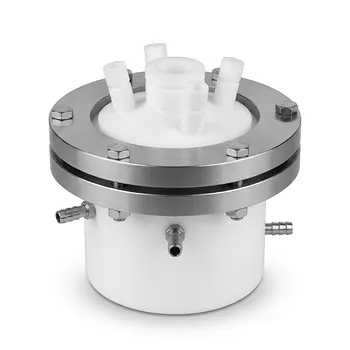
The PTFE-lined hydrothermal synthesis autoclave acts as a precision reactor that enables the controlled hydrolysis and crystallization of ruthenium dioxide. Specifically, it creates a sealed, high-pressure environment at 120 °C that allows ruthenium precursors to transform into stable crystals within the pores of a carrier material.
Core Takeaway: The PTFE-lined autoclave provides the essential combination of high-pressure containment and chemical inertness, ensuring that $RuO_2$ nanoparticles grow uniformly on substrates without suffering from metallic contamination or structural irregularities.
Creating the Ideal Reaction Environment
Facilitating High-Pressure Hydrolysis
The primary role of the autoclave is to maintain a sealed environment where temperatures can exceed the boiling point of the solvent. This elevated temperature (120 °C) triggers the slow hydrolysis of ruthenium precursors, a critical step for the initial formation of $RuO_2$ nuclei.
Driving Initial Crystallization
Under the autogenous pressure generated inside the vessel, the chemical energy is sufficient to drive the crystallization process. This pressure ensures that the precursors infiltrate the carrier pores deeply, allowing for the in-situ growth of nanoparticles directly where they are needed.
Ensuring Uniform Thermal Stability
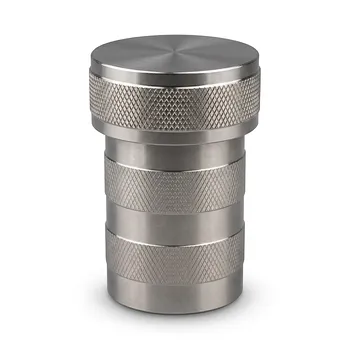
The stainless steel outer shell of the autoclave provides the structural integrity to withstand high pressures, while the internal environment remains thermally stable. This stability is vital for achieving a consistent size and distribution of $RuO_2$ nanoparticles across the substrate.
The Critical Role of the PTFE Liner
Absolute Chemical Inertness
Polytetrafluoroethylene (PTFE) is exceptionally resistant to chemical attack, even when dealing with the acidic or oxidative precursors often used in ruthenium synthesis. This inertness ensures that the reaction solution does not react with the container, maintaining the purity of the final catalyst.
Preventing Metal Ion Contamination
By acting as a barrier between the reaction medium and the stainless steel walls, the PTFE liner prevents iron or chromium ions from leaching into the solution. For $RuO_2$ synthesis, even trace amounts of metallic impurities can significantly degrade the electrochemical performance of the nanoparticles.
Non-Stick Properties and Sample Recovery
The anti-adhesive nature of PTFE ensures that the synthesized $RuO_2$ does not stick to the walls of the liner. This facilitates the easy recovery of the synthesized samples and ensures that the yield is not lost during the collection process.
Understanding the Trade-offs
Temperature Limitations
While PTFE is highly inert, it has a strict thermal ceiling, typically around 220–250 °C, above which it may deform or release toxic fumes. For reactions requiring higher temperatures, researchers must transition to more expensive materials like PPL (Polyphenylene polymers) or quartz.
Pressure Safety and Filling Ratios
The effectiveness of the autoclave depends on the filling ratio of the liquid precursors, usually recommended at 60–80%. Exceeding these limits can lead to dangerous pressure spikes that threaten the integrity of both the PTFE liner and the stainless steel housing.
How to Apply This to Your Project
Selecting the Right Approach for Your Goal
- If your primary focus is High Purity: Always use a pristine PTFE liner and ensure it is cleaned with aqua regia between runs to prevent cross-contamination of ruthenium species.
- If your primary focus is Uniform Pore Loading: Maintain a constant temperature of 120 °C for the full duration of the reaction to allow the precursors sufficient time for deep infiltration and crystallization.
- If your primary focus is Scalability: Monitor the filling ratio strictly to ensure that the autogenous pressure remains within the safety specifications of your specific autoclave model.
By leveraging the unique properties of PTFE-lined autoclaves, researchers can achieve the high-purity, in-situ growth necessary for high-performance ruthenium dioxide applications.
Summary Table:
| Feature | Role in $RuO_2$ Synthesis | Benefit to Researcher |
|---|---|---|
| High-Pressure Seal | Maintains solvent above boiling point | Triggers slow precursor hydrolysis |
| Chemical Inertness | Resists acidic/oxidative precursors | Maintains absolute sample purity |
| Ion Barrier | Blocks Fe/Cr leaching from SS shell | Optimized electrochemical performance |
| Non-Stick Surface | Prevents wall adhesion | Facilitates easy sample recovery and yield |
| Thermal Stability | Ensures uniform temperature at 120°C | Consistent nanoparticle size distribution |
Elevate Your Material Synthesis with KINTEK’s High-Performance Fluoropolymers
Precision research like in-situ $RuO_2$ growth demands equipment that guarantees zero contamination and extreme chemical resistance. KINTEK specializes in the engineering and manufacture of high-performance PTFE and PFA laboratory supplies, designed to meet the rigorous standards of modern material science.
From everyday essentials like beakers, reagent bottles, and centrifuge tubes to advanced components like hydrothermal synthesis liners, microwave digestion vessels, and custom electrochemical cells, we provide the full spectrum of fluoropolymer solutions. Our capabilities extend to end-to-end custom CNC fabrication, allowing us to deliver everything from complex non-standard machined parts to high-volume orders of standard labware.
Why partner with KINTEK?
- Unmatched Purity: Our PTFE/PFA materials are ideal for trace analysis and sensitive catalyst synthesis.
- Custom Engineering: We manufacture bespoke laboratory setups and fluid transfer components (tubing, valves, fittings) tailored to your specific reactor needs.
- Comprehensive Catalog: We supply everything from filtration tools and stir bars to specialized battery testing fixtures.
Ensure the integrity of your next breakthrough. Contact KINTEK today to discuss your custom labware requirements!
References
- W. Zheng, Tong‐Bu Lu. Boosting the durability of RuO2 via confinement effect for proton exchange membrane water electrolyzer. DOI: 10.1038/s41467-024-55747-0
This article is also based on technical information from Kintek Knowledge Base .
Related Products
- PTFE Lined High Pressure Digestion Vessel 50ml High Temperature Hydrothermal Synthesis Tank
- High Temperature Corrosion Resistant Hydrothermal Synthesis Reactor with TFM Inner Liner and Straight Cylinder Design
- Custom TFM Reaction Vessel with Stainless Steel Jacket and PTFE Inner Cup for High Corrosion Resistance
- High Pressure Custom TFM Reactor Stainless Steel Outer Vessel PTFE Inner Cup for Corrosive Synthesis
- High Purity TFM Microwave Digestion Vessels PTFE Acid Evaporation Liners Domestic GT-400 Equivalent Laboratory Reaction Containers
People Also Ask
- What are the benefits of using a PTFE-lined vessel for carbon-sulfur cathode treatment? Maximize Purity & Performance
- Why are PTFE-lined pressure digestion vessels required for the preparation of Ag/CeO2 catalysts? Purity & Performance
- What safety features are typically incorporated into high-pressure PTFE digestion vessel designs? Ensure Lab Safety
- What is the function of high-pressure PTFE digestion vessels in mineral analysis? Optimize Sample Mineralization
- What is the function of PTFE lined high-pressure vessels in g-C3N4 synthesis? Achieve High-Purity Material Growth