In the solvothermal synthesis of Tungsten Disulfide (WS2) superstructures, the Polytetrafluoroethylene (PTFE) lined autoclave acts as a chemically inert, high-pressure reaction vessel. It provides the critical sealed environment necessary to withstand temperatures up to 200°C and resist corrosion from aggressive precursors like tungsten hexachloride and organic amines. This stability ensures the ordered growth of WS2 nanosheets into complex superstructures under constant, controlled conditions.
Core Takeaway: The PTFE-lined autoclave is the fundamental enabler of solvothermal WS2 synthesis because it provides a "non-reactive stage" that facilitates high-pressure morphological evolution while protecting the equipment and the purity of the resulting nanomaterial.
Providing a Corrosion-Resistant Reaction Space
Neutralizing Aggressive Precursors
The synthesis of WS2 superstructures often involves highly reactive precursors such as tungsten hexachloride (WCl6) and organic amines like octylamine. PTFE is exceptionally resistant to these chemicals, preventing the reaction medium from attacking the vessel walls during the synthesis process.
Protecting the Structural Integrity of the Vessel
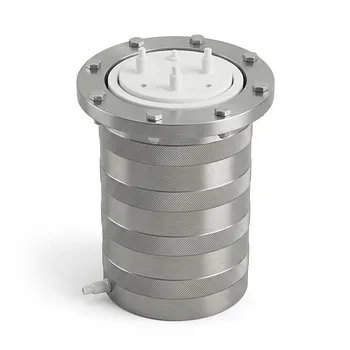
While the internal PTFE liner handles the chemical environment, it relies on an external stainless steel shell for mechanical support. The liner prevents acidic or corrosive solvents from eroding the steel, ensuring the equipment remains safe and functional over multiple high-temperature cycles.
Enabling High-Pressure Phase Engineering
Managing Autogenous Pressure
As the solvothermal reaction reaches temperatures between 150°C and 200°C, the solvents generate significant autogenous pressure. The sealed PTFE-lined system contains this pressure, which is a driving force for the phase engineering and morphological evolution of the WS2 nanosheets.
Facilitating Ordered Superstructure Growth
By maintaining a closed and constant environment, the autoclave allows for the slow, controlled crystallization of WS2. This stability is vital for the individual nanosheets to self-assemble into complex, three-dimensional superstructures rather than forming disordered aggregates.
Maintaining High Material Purity
Eliminating Metal Ion Contamination
At high temperatures, solvents can leach metal ions from standard stainless steel reactors. The PTFE lining acts as a total chemical barrier, ensuring that no iron, chromium, or nickel impurities enter the WS2 system, which would otherwise degrade the material's electronic or catalytic properties.
Preventing Side Reactions
The chemical inertness of PTFE ensures that the vessel walls do not participate in the redox reactions occurring within the solution. This ensures that the precursors, such as sulfur sources and tungsten salts, react only with each other to form the intended WS2 phase without forming unintended byproducts.
Optimizing Product Recovery
The extremely smooth surface of the PTFE material prevents the synthesized WS2 powder from adhering strongly to the walls. This facilitates the easy recovery and collection of the solid precipitates once the reaction is complete, maximizing the yield of the synthesis.
Understanding the Trade-offs
Thermal Limitations
The primary limitation of PTFE is its thermal ceiling; it generally cannot exceed 200°C to 210°C without risking deformation or the release of toxic vapors. For synthesis requiring higher temperatures, researchers must transition to more expensive materials like PEEK or specialized metallic alloys.
Mechanical Fragility
While chemically robust, PTFE is physically soft and susceptible to scratches or "cold flow" (deformation under pressure). If the liner is scratched or improperly seated, corrosive precursors can leak behind the liner, leading to catastrophic "crevice corrosion" of the stainless steel shell.
Heating and Cooling Rates
PTFE is a poor thermal conductor compared to metal. This creates a thermal lag between the laboratory oven temperature and the actual reaction temperature inside the liner, requiring careful calibration of heating programs to ensure consistent crystallization.
How to Apply This to Your Project
Recommendations for Synthesis
- If your primary focus is high material purity: Always inspect the PTFE liner for any discoloration or scratches before use to ensure no metal ions can leach into your WS2 sample.
- If your primary focus is complex morphology: Ensure the autoclave is filled to the manufacturer-recommended volume (typically 60-80%) to optimize the autogenous pressure required for superstructure formation.
- If your primary focus is equipment longevity: Never exceed 200°C when using standard PTFE liners, and allow the vessel to cool naturally to room temperature to prevent the liner from warping or cracking.
By strictly controlling the internal chemical environment and pressure, the PTFE-lined autoclave transforms volatile precursors into the precise, high-performance WS2 superstructures required for modern technical applications.
Summary Table:
| Feature | Role in WS2 Synthesis | Key Benefit |
|---|---|---|
| Chemical Inertness | Resists WCl6 & organic amines | Prevents metal ion contamination |
| Pressure Containment | Manages autogenous pressure | Drives morphological evolution |
| Surface Properties | Non-stick smooth surface | Maximizes powder product recovery |
| Thermal Barrier | Operates up to 200°C | Facilitates controlled crystallization |
Elevate Your Research with KINTEK’s High-Performance Fluoropolymers
Ensure the integrity of your solvothermal synthesis with KINTEK’s premium PTFE and PFA laboratory solutions. From everyday essentials like beakers, crucibles, and digestion tubes to advanced hydrothermal synthesis liners and microwave digestion vessels, we provide the chemically inert environment your experiments demand.
Our expertise extends to comprehensive fluid transfer components (tubing, valves) and bespoke CNC-fabricated parts, allowing us to deliver everything from high-volume consumables to complex, non-standard machined apparatus. Don’t let contamination or equipment failure compromise your results—leverage our absolute focus on high-performance fluoropolymers to protect your material purity.
Contact KINTEK Today to discuss your custom laboratory needs and optimize your synthesis workflow!
References
- Lingbin Xie, Qiang Zhao. Flexible tungsten disulfide superstructure engineering for efficient alkaline hydrogen evolution in anion exchange membrane water electrolysers. DOI: 10.1038/s41467-024-50117-2
This article is also based on technical information from Kintek Knowledge Base .
Related Products
- PTFE Lined High Pressure Digestion Vessel 50ml High Temperature Hydrothermal Synthesis Tank
- Custom TFM Reaction Vessel with Stainless Steel Jacket and PTFE Inner Cup for High Corrosion Resistance
- High Purity PTFE Microwave Digestion Vessel Replacement Liner for Acid Sample Preparation and Trace Analysis
- High Purity TFM Microwave Digestion Vessels PTFE Acid Evaporation Liners Domestic GT-400 Equivalent Laboratory Reaction Containers
- High Pressure Custom TFM Reactor Stainless Steel Outer Vessel PTFE Inner Cup for Corrosive Synthesis
People Also Ask
- What are the benefits of using a PTFE-lined vessel for carbon-sulfur cathode treatment? Maximize Purity & Performance
- Why are PTFE-lined pressure digestion vessels required for the preparation of Ag/CeO2 catalysts? Purity & Performance
- What safety features are typically incorporated into high-pressure PTFE digestion vessel designs? Ensure Lab Safety
- What is the function of PTFE lined high-pressure vessels in g-C3N4 synthesis? Achieve High-Purity Material Growth
- Role of High-Pressure Digestion Tanks in Perovskite Synthesis: Achieve Superior Stability and Latent Heat