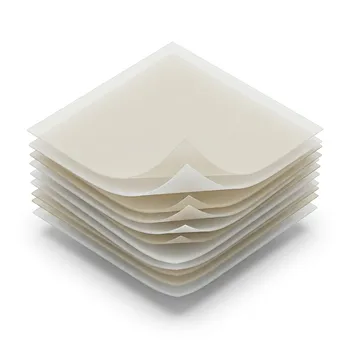
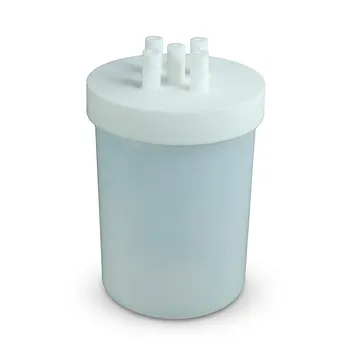
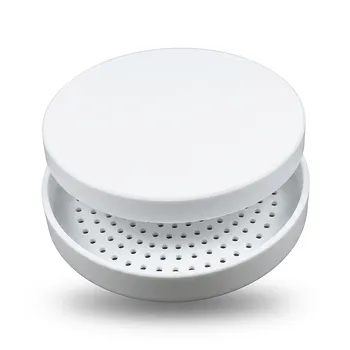
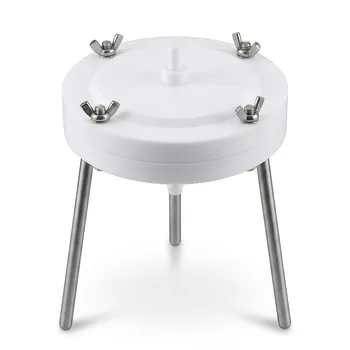
Non-stick fluoropolymer substrates serve as thermally stable release surfaces during PVDF membrane casting and heat treatment. They support the film while solvent evaporates and the polymer develops its final morphology, then allow the finished membrane to detach with minimal force. This prevents tearing, warping, surface distortion, and thickness nonuniformity that could reduce the mechanical and piezoelectric performance of electroactive PVDF.
The substrate does not replace control of the thermal process, but it protects the membrane while that process takes place. PTFE or PFA casting surfaces combine low adhesion with high temperature resistance, enabling clean release after solvent evaporation and heat treatment.
Why PVDF Processing Requires a Controlled Substrate
PVDF morphology depends on processing conditions
PVDF can crystallize into different polymorphs, including the nonpolar alpha-phase and the polar, electroactive beta-phase. Solvent evaporation temperature, stretching, heat treatment, and filler addition influence which structure develops.
For example, casting or processing above approximately 120°C favors alpha-phase formation in the referenced process, while conditions below approximately 70°C can favor beta-phase formation. The substrate must therefore remain stable and nonreactive across the selected thermal cycle.
The membrane is vulnerable during drying and heating
As solvent leaves the cast solution, the film contracts and gains mechanical strength. During subsequent heat treatment, additional shrinkage, crystallization, or internal stress can develop.
If the membrane adheres strongly to the casting surface, these dimensional changes can create tearing, delamination defects, wrinkles, or residual stress. These defects are especially important in thin films intended for sensors and actuators.
How Fluoropolymer Substrates Support Film Casting
They provide low-adhesion release
PTFE and PFA have highly non-stick surfaces that reduce adhesion between the substrate and the PVDF membrane. After solvent evaporation and thermal processing, the film can be lifted or peeled away with substantially less mechanical force.
This clean release helps preserve the membrane's surface continuity, edges, and thickness profile. It also reduces the risk that removal will introduce scratches, tears, or localized deformation.
They preserve mechanical integrity
A membrane that releases unevenly can experience concentrated stresses at stuck regions. Those stresses may produce microscopic damage even when the film appears intact.
A non-stick substrate distributes the release process more uniformly. That is important for maintaining the membrane's mechanical integrity and avoiding defects that could interfere with electrical or piezoelectric operation.
They support uniform film thickness
Casting plates, evaporating dishes, and machined surface molds provide a stable geometry for holding the PVDF solution during drying. Their smooth, consistent surfaces help the solution form a more uniform layer.
Uniform thickness improves repeatability in membrane fabrication and supports more predictable mechanical behavior, capacitance, and actuator or sensor response.
Their Role During Thermal Processing
They tolerate elevated processing temperatures
High-purity PTFE substrates offer thermal endurance suitable for PVDF casting and heat-treatment workflows, including processes conducted at elevated temperatures. PFA can provide a comparable fluoropolymer release surface where the selected form factor and thermal requirements make it appropriate.
The substrate therefore remains functional while the PVDF undergoes solvent evaporation, crystallization, and heat treatment. It does not need to be removed or replaced between the casting and thermal-processing stages.
They reduce damage during phase-forming treatments
The thermal profile is what primarily determines the PVDF phase outcome in the referenced process. The fluoropolymer substrate contributes by holding the film without imposing strong adhesive forces while that phase development occurs.
This distinction matters: the substrate enables the thermal treatment to be completed without damaging the film, but it is not itself the principal mechanism that creates the beta-phase. Temperature, solvent removal, stretching, and formulation remain the key process variables.
They maintain a clean processing interface
High-purity PTFE evaporating dishes, plates, and molds provide a chemically resistant contact surface for the casting solution. A clean interface reduces the likelihood that substrate contamination or surface irregularities will be transferred to the membrane.
Surface cleanliness is particularly important for thin electroactive films, where small defects can affect electrode contact, mechanical reliability, and electrical response.
Why Clean Detachment Matters for Electroactive Performance
Defects can weaken thin membranes
PVDF membranes are often thin enough that small tears, pinholes, edge damage, or wrinkles become significant relative to the overall film dimensions. These defects can create stress concentrations and reduce handling durability.
Non-stick release surfaces lower the mechanical load required to separate the membrane, helping preserve the structure created during casting and heat treatment.
Surface distortion can affect device behavior
A distorted surface can interfere with electrode deposition, bonding, lamination, or contact uniformity. It can also change the local thickness and mechanical stiffness of the membrane.
Because piezoelectric and actuator performance depend on the film's electrical and mechanical uniformity, controlled release is part of achieving a reproducible device rather than merely a convenience during demolding.
Consistent release improves manufacturing repeatability
A process that produces a membrane only when removal is carefully improvised is difficult to scale. Standardized PTFE or PFA casting fixtures make release behavior more predictable across batches.
That repeatability supports the fabrication of sensors and actuators with more consistent dimensions, morphology, and performance.
Understanding the Trade-offs
A non-stick surface does not control phase selection by itself
Using PTFE or PFA does not guarantee formation of the electroactive beta-phase. The final polymorph still depends on the selected solvent, evaporation temperature, stretching conditions, heat treatment, and any filler or copolymer formulation.
The substrate should therefore be treated as a release and processing-support component, while phase control must be established through the thermal and materials process.
Thermal stability must match the complete process
Although PTFE and PFA provide high thermal endurance, the substrate must still be selected for the actual temperature, duration, mechanical loading, and equipment configuration. The usable limit is determined by the full processing environment, not only by whether the material is generally described as heat resistant.
The casting surface should also remain dimensionally appropriate for the required film geometry and thickness.
Surface condition still affects film quality
Non-stick chemistry cannot compensate for contamination, scratches, machining marks, or poor leveling. Surface defects may be reproduced in the membrane or create local differences in drying and release behavior.
Cleaning and inspection of the substrate remain necessary, particularly when producing thin films for electrical characterization or device integration.
Excessively aggressive removal can still damage the film
A low-adhesion substrate reduces release stress but does not eliminate it. Thin or partially cured membranes can still tear if peeled too quickly, handled at an unsuitable temperature, or removed from damaged tooling.
Release conditions should therefore be controlled along with casting temperature, drying time, and film thickness.
Applying This to PVDF Membrane Manufacturing
The substrate should be selected as part of the complete morphology-control and handling process.
- If your primary focus is beta-phase electroactivity: Control solvent evaporation, temperature, stretching, and heat treatment first, then use a PTFE or PFA surface to prevent release damage from compromising the resulting polar film.
- If your primary focus is alpha-phase thermal processing: Choose a fluoropolymer substrate that remains stable through the higher-temperature cycle and allows the thermally treated film to detach without distortion.
- If your primary focus is uniform membrane thickness: Use a clean, smooth, level casting plate or machined mold with consistent geometry and reliable non-stick behavior.
- If your primary focus is manufacturing yield: Standardize the substrate material, surface condition, thermal history, and release procedure so that each membrane experiences similar handling stresses.
- If your primary focus is sensor or actuator reliability: Minimize tearing, wrinkles, scratches, and residual deformation during detachment because these defects can affect both mechanical integrity and electroactive performance.
Non-stick fluoropolymer substrates protect the PVDF membrane during the critical transition from liquid cast solution to thermally processed electroactive film, making controlled release a practical part of reliable device fabrication.
Summary Table:
| Role | Key Benefit | Impact on PVDF Membrane |
|---|---|---|
| Low-adhesion release | Minimal force to detach film | Prevents tearing and surface distortion |
| Thermal stability | Withstands heat-treatment cycles | Protects film during phase-forming steps |
| Clean interface | Chemically resistant and smooth | Reduces contamination and defects |
| Uniform geometry | Stable casting surface | Encourages consistent membrane thickness |
| Consistent removal | Predictable release across batches | Enhances manufacturing repeatability |
Enhance your PVDF membrane fabrication with KINTEK's high-purity PTFE/PFA labware and custom machining. Our non-stick evaporation dishes, casting plates, and tailored components ensure clean release and thermal stability, helping you achieve reliable electroactive performance. Whether you need standard labware or bespoke fixtures, our end-to-end CNC capabilities deliver precision for every batch. Contact us today to discuss your specific requirements and optimize your process!
Related Products
- PVDF Sample Support Body for Corrosion Testing and Electrochemical Analysis
- High Purity PTFE Square Membrane Cutter and Filter Aliquot Device for Trace Analysis and Cleanroom Laboratory Applications
- High-Performance Anion Exchange Membrane for Green Hydrogen Production
- High Purity 4L PFA Reaction Tank for Proton Exchange Membrane Electrolysis Water Oxygen Separation Systems
- PTFE Membrane Filter Holder for Aerosol Environmental Monitoring and Low Concentration Particulate Matter Sampling Chemical Resistant Air Quality Analysis Component
People Also Ask
- How do PVDF, PTFE, and PFA compare for chemical process and filtration applications?
- What is the function of β-phase fluoropolymer interfaces in lithium dendrite suppression, and how does this guide the selection of fluoropolymer electrochemical testing apparatus?
- How to Balance Ionic Conductivity and Water Barrier in Amphiphilic Polymer Electrolyte Membranes? Optimize with Fluoropolymer Testing Supplies
- What are the primary operational challenges with gaseous fluorinated monomers like VDF? Discover how specialized PTFE/PFA apparatus enables safe, low-pressure photopolymerization.
- How does VA content affect PVDF ferroelectric properties? Boost breakdown strength with crosslinking