High-pressure synthesis reactors facilitate ZIF-67 growth by providing a sealed, superheated environment. These reactors maintain aqueous or organic solvents in a liquid state well above their atmospheric boiling points, generating what is known as autogenous pressure. This physical state dramatically accelerates the solubility and diffusion rates of cobalt salts and 2-methylimidazole (MeIM) ligands, which are the fundamental building blocks of the framework.
The core advantage of a high-pressure reactor lies in its ability to maintain a superheated liquid phase that prevents solvent evaporation while boosting reaction kinetics. This environment provides the necessary energy to overcome activation barriers, ensuring rapid nucleation and the controlled growth of complex, hierarchical ZIF-67 geometries.
The Role of Superheated Liquid Environments
Maintaining Liquid State Above Boiling Point
High-pressure reactors, often referred to as hydrothermal or solvothermal autoclaves, create a sealed system that prevents the escape of vapor. By containing the pressure generated during heating, the reactor keeps the solvent in a condensed liquid phase even at temperatures like 140°C, which would normally cause rapid boiling.
Enhancing Solubility and Diffusion
Under these high-pressure conditions, the solvent’s ability to dissolve metal salts and organic ligands increases significantly. The elevated thermal energy decreases the viscosity of the fluid, allowing cobalt ions and MeIM ligands to diffuse more rapidly through the solution to reach growth sites.
Driving Crystal Nucleation and Growth
Kinetic Conditions for Rapid Nucleation
The combination of high temperature and autogenous pressure provides the kinetic energy required for the initial formation of crystal nuclei. This "kickstart" is essential for producing a high density of seeds, which eventually leads to the formation of hierarchical ZIF-67 crystals.
Morphological Control and Stability
The reactor maintains a constant temperature and pressure, which is vital for the stability of the growth process. This steady environment allows the reaction to be tuned to produce specific geometric morphologies, such as nanocubes, flakes, or rod-like structures, depending on the precise temperature settings.
Understanding the Trade-offs
Equipment Limitations and Safety
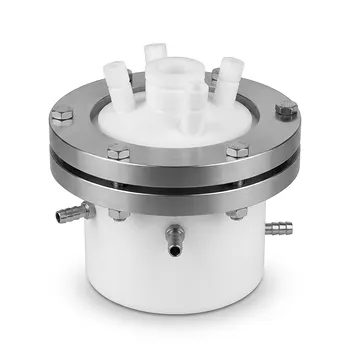
While high-pressure environments accelerate synthesis, they require specialized stainless steel autoclaves with Teflon liners to resist corrosion and handle internal stress. Operating at these limits introduces safety risks related to pressure vessel failure if temperature limits are exceeded.
Lack of Real-Time Monitoring
The sealed nature of these reactors makes it difficult to perform in-situ observations of the crystal growth. Unlike open-beak synthesis, researchers cannot easily sample the mixture or adjust concentrations mid-reaction, requiring a "black box" approach where parameters must be perfectly set before sealing the vessel.
How to Apply These Conditions to Your Project
Making the Right Choice for Your Goal
- If your primary focus is rapid production: Utilize temperatures significantly above the solvent's boiling point to maximize nucleation rates and reduce total synthesis time.
- If your primary focus is morphological precision: Maintain a strictly constant temperature (e.g., 90°C to 140°C) to ensure the kinetic stability necessary for uniform nanocubes or flake structures.
- If your primary focus is structural hierarchy: Focus on balancing the concentration of MeIM ligands with the autogenous pressure to promote oriented growth on existing seed layers.
By mastering the pressure-temperature relationship within these reactors, you can precisely dictate the structural properties of ZIF-67 to meet the needs of your specific application.
Summary Table:
| Physical Condition | Mechanism of Action | Impact on ZIF-67 Growth |
|---|---|---|
| Superheated Liquid Phase | Maintains solvent above boiling point via sealed vessel | Prevents evaporation; boosts reaction kinetics and energy. |
| Autogenous Pressure | Internal pressure generated during heating | Increases solubility of cobalt salts and MeIM ligands. |
| High Diffusion Rates | Reduced solvent viscosity at high temperatures | Accelerates transport of building blocks to growth sites. |
| Kinetic Energy | Elevated thermal environment | Drives rapid nucleation and overcomes activation barriers. |
| Thermal Stability | Constant temperature control | Enables precise morphological control (cubes, flakes, rods). |
Elevate Your ZIF-67 Synthesis with KINTEK’s Precision Engineering
Achieving the perfect hierarchical structure in ZIF-67 requires more than just high pressure—it requires equipment that can withstand extreme chemical environments without contamination. KINTEK specializes in high-performance fluoropolymer solutions tailored for advanced material science.
From hydrothermal synthesis liners and microwave digestion vessels essential for solvothermal reactions to high-purity trace analysis instruments, we provide the tools you need for reliable results. Our expertise spans a massive range of PTFE and PFA products, including:
- Core Labware: Beakers, measuring cylinders, crucibles, and reagent/wash bottles.
- Sample Prep: Separatory funnels, filters, pipettes, and digestion tubes.
- Fluid Components: Tubing, fittings, valves, and high-performance O-rings/gaskets.
- Advanced Apparatus: Custom electrochemical cells, microchannel reactors, and condensation devices.
Backed by end-to-end custom CNC fabrication, KINTEK can deliver everything from complex, non-standard machined parts to high-volume orders. Ensure your high-pressure synthesis is backed by the durability and purity of fluoropolymer experts.
Ready to optimize your laboratory setup? Contact us today to discuss your custom requirements and discover how KINTEK’s high-performance materials can drive your research forward.
References
- Paula S. Pacheco, Daniel Eiras. Controlling the Hierarchical Morphology of ZIF-67 via Hydrothermal Synthesis: Insights into the Stability for Gas Separation. DOI: 10.1021/acs.langmuir.5c01142
This article is also based on technical information from Kintek Knowledge Base .
Related Products
- High Temperature Corrosion Resistant Hydrothermal Synthesis Reactor with TFM Inner Liner and Straight Cylinder Design
- High Pressure Custom TFM Reactor Stainless Steel Outer Vessel PTFE Inner Cup for Corrosive Synthesis
- PTFE Lined High Pressure Digestion Vessel 50ml High Temperature Hydrothermal Synthesis Tank
- High Purity PFA Reaction Vessel for Biopharmaceutical Synthesis and Corrosive Chemical Fluid Handling with Customizable Tube Fittings
- Custom Multi Neck PTFE Flask 18L Laboratory Chemical Reactor Vessel for High Purity Synthesis and Stirring Applications
People Also Ask
- What is the role of a corrosion-resistant reactor in the synthesis of lignin-based carbon dots? Ensure Maximum Purity
- What are the technical advantages of using hydrothermal synthesis reactors for advanced electronic & optical nanomaterials?
- How does a hydrothermal synthesis reactor facilitate the production of crystalline materials with tailored morphologies? Precision Crystal Growth
- Why is the sealing reliability of a hydrothermal synthesis reactor critical for 24-hour cycles? Ensure Nano-Precision
- What role do hydrothermal synthesis reactors play in CQD preparation? Achieve High-Purity Nanomaterial Synthesis