Fluoroalkyl end-capped oligomers self-assemble because their terminal perfluoroalkyl groups strongly avoid both water and organic liquids. This hydrophobic and lipophobic segregation drives the oligomers into nanometer-scale micellar aggregates, while the fluorinated groups concentrate at low-energy interfaces. In high-purity PFA and PTFE apparatus, related fluorinated surface chemistry produces chemical inertness, low wetting, and low contamination risk; stabilized polymer end-groups further reduce decomposition and ionic leaching during demanding reactions.
Core takeaway: Fluorinated segments create a low-energy, chemically resistant interface. That same combination supports nanoscale self-assembly in oligomers and delivers non-wetting, low-adsorption, high-purity performance in fluoropolymer reaction vessels and fluid-handling components.
How Fluoroalkyl Oligomers Self-Assemble
Fluorinated groups minimize unfavorable contact
Terminal fluoroalkyl groups are both strongly hydrophobic and lipophobic. They tend to avoid contact with water as well as many nonpolar organic substances, producing a powerful driving force for the fluorinated segments to associate with one another and move away from the surrounding medium.
This is more than ordinary water repellency. The simultaneous resistance to aqueous and oily phases gives fluorinated surfaces unusually low surface energy and broad liquid-repellent behavior.
Molecular segregation creates organized aggregates
In a suitable solvent or formulation, the oligomer separates into regions with different affinities for the surrounding medium. The fluoroalkyl ends cluster together, while the nonfluorinated portions remain more compatible with the continuous phase.
This segregation produces micellar or micelle-like aggregates with nanometer-scale dimensions. Their size and organization depend on factors such as oligomer structure, concentration, solvent compatibility, and the balance between fluorinated and nonfluorinated segments.
Aggregates can carry inorganic particles
The self-assembled structures can encapsulate or associate with inorganic particles while remaining sufficiently soluble and surface-active. This combination is useful because the oligomer is not merely precipitating; it is forming an organized interfacial structure that can stabilize dispersed material.
The result is a nanoscale platform with both particle-association capability and surface activity.
Surface-active groups help maintain dispersion
The nonfluorinated portion of the oligomer can interact more favorably with the surrounding medium or with particle surfaces. Meanwhile, the fluorinated portions provide the low-energy, liquid-repellent character.
This division of roles helps explain how fluorinated oligomers can remain processable while still forming strongly segregated surface structures.
Why These Features Matter in Laboratory Apparatus
Low surface energy reduces wetting
In PFA, PTFE, and related fluoropolymer components, fluorinated surfaces resist spreading by aqueous solutions and many organic liquids. Droplets are less likely to adhere strongly, and fluids are less likely to remain as persistent films on vessel walls or tubing.
This supports improved draining and more reproducible sample transfer, particularly when handling small volumes.
Chemical inertness protects the reaction environment
The carbon–fluorine-rich structure of fluoropolymers provides strong resistance to many aggressive chemicals, including harsh solvents and acids. Properly selected PFA or PTFE components therefore introduce less chemical reactivity into the reaction than many conventional materials.
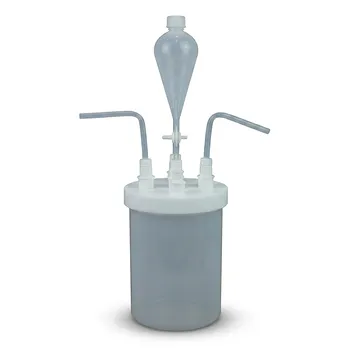
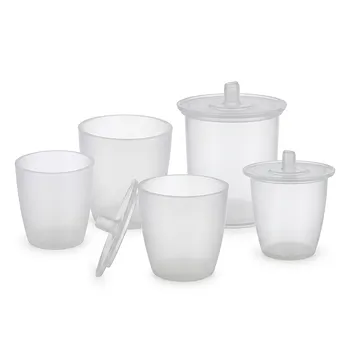
This is especially important for digestion vessels, cleaning tanks, electrochemical cells, reagent bottles, and trace-analysis fluid paths.
Reduced adsorption limits cross-contamination
A low-energy, non-wetting surface gives contaminants fewer opportunities to adhere strongly. This helps reduce carryover between samples and limits the retention of analytes, reagents, or reaction by-products.
It does not mean that contamination is impossible. Cleaning protocol, surface condition, chemical compatibility, and fluid properties still determine actual recovery and carryover performance.
Non-wetting behavior improves sample recovery
When a liquid does not spread extensively across a vessel or tubing surface, less material can remain trapped as a residual film. This is valuable in micro-volume trace analysis, where even small retained quantities can distort the next measurement.
The practical benefit is more consistent transfer and better recovery, rather than a guarantee of literally zero retention under every condition.
Why End-Group Stabilization Is Important
As-synthesized PFA can contain reactive terminal groups
PFA produced by conventional synthesis may contain unstable end-groups, including –CF₂CH₂OH, –CF₂COF, –CF₂COOH, and –CF₂COOCH₃. These groups are more chemically and thermally reactive than fully fluorinated terminal structures.
In high-temperature or strongly acidic applications, they can contribute to decomposition, gas evolution, or release of trace ionic species.
Fluorination converts reactive ends into stable structures
A multi-step treatment using diluted fluorine gas and steam at elevated temperature converts these unstable end-groups into more stable perfluorinated structures. The cited treatment reduces unstable end-group counts from more than 200 per 10⁶ carbon atoms to zero.
This is a material-stabilization mechanism, distinct from oligomeric micelle formation. The first controls polymer purity and stability; the second describes molecular aggregation and interfacial organization.
Stabilized materials reduce extractables
For microwave digestion vessels, trace-analysis bottles, fittings, and related components, fewer reactive end-groups means less potential for thermal degradation and ionic leaching. That helps preserve the chemical composition of high-purity samples during aggressive processing.
The benefit is particularly important when the apparatus is exposed to elevated temperature, concentrated acid, or long digestion cycles.
Linking Molecular Structure to Apparatus Performance
The common principle is interface control
In oligomers, fluorinated groups organize themselves to minimize unfavorable interactions with the surrounding phase. In fluoropolymer apparatus, fluorinated groups dominate the exposed surface and create a stable, low-energy interface.
In both cases, the key engineering outcome is control over what the material contacts, absorbs, retains, or releases.
Surface inertia supports reproducibility
A chemically inert surface is less likely to participate in the reaction, catalyze unwanted changes, or release impurities. This provides a more consistent reaction environment across repeated runs.
For high-purity work, reproducibility depends not only on the instrument but also on the vessel, fittings, tubing, and cleaning hardware that contact the sample.
Fluorinated structures support broad chemical compatibility
The same fluorinated backbone that lowers surface energy also contributes to resistance against chemical attack. This makes PFA and PTFE suitable for demanding combinations of acids, solvents, cleaning agents, and electrochemical media, subject to application-specific compatibility limits.
Understanding the Trade-offs
Non-wetting does not eliminate all contamination
Fluoropolymer surfaces can still retain particles, viscous materials, precipitates, or strongly interacting species. Surface scratches, residues, electrostatic effects, and inadequate cleaning can also create carryover.
Non-wetting behavior should therefore be treated as a risk-reduction feature, not a substitute for validated cleaning and blank-control procedures.
Chemical resistance is not unlimited
PFA and PTFE resist many aggressive chemicals, but temperature, pressure, exposure time, mechanical stress, and the specific chemical combination matter. Some substances can permeate, swell, degrade, or physically damage fluoropolymer components under unfavorable conditions.
Compatibility should be confirmed for the exact process rather than inferred from the word “fluoropolymer.”
Low surface energy can complicate bonding
The same non-stick chemistry that prevents contamination can make adhesion, coating, printing, and joining difficult. Fluoropolymer components may require specialized fabrication or surface treatment when they must be bonded to other materials.
Fluorination quality affects purity
End-group stabilization is valuable only when the treatment is controlled and the finished component is properly processed and cleaned. Manufacturing residues, machining debris, and assembly materials can still become sources of contamination.
How to Apply This to Your Project
Select materials according to the dominant purity, chemical, thermal, and sample-recovery requirements.
- If your primary focus is trace analysis: Favor low-adsorption PFA or PTFE fluid paths and vessels, then validate blanks, recovery, and carryover with the actual analytes and cleaning procedure.
- If your primary focus is aggressive acid digestion: Use fluoropolymer components with stabilized perfluorinated end-groups to reduce decomposition, gas evolution, and ionic leaching at elevated temperature.
- If your primary focus is reliable fluid transfer: Use low-surface-energy fluoropolymer tubing, fittings, and vessels to reduce droplet adhesion and residual film formation.
- If your primary focus is oligomer formulation or particle dispersion: Control oligomer concentration, solvent compatibility, and fluorinated/nonfluorinated balance so micellar aggregates form without loss of solubility.
- If your primary focus is long-term apparatus durability: Evaluate the complete chemical, temperature, pressure, and mechanical exposure profile rather than relying on fluoropolymer designation alone.
Fluorinated self-assembly and fluoropolymer surface performance are both consequences of carefully controlled interfacial chemistry, which makes them powerful tools for high-purity laboratory work.
Summary Table:
| Mechanism | Key Feature | Benefit in Apparatus |
|---|---|---|
| Hydrophobic/lipophobic segregation | Fluoroalkyl ends avoid water and oil | Low surface energy reduces wetting |
| Nanoscale micellar aggregates | Organized clusters of fluorinated groups | Uniform dispersion, surface activity |
| End-group stabilization | Conversion of reactive ends to –CF₃ | Reduced decomposition and ionic leaching |
| Low adsorption surface | Non-wetting, low adhesion | Minimizes cross-contamination and improves recovery |
| Chemical inertness | Carbon–fluorine backbone | Resists aggressive chemical attack |
Ready to enhance your high-purity lab apparatus? At KINTEK, our PTFE and PFA components are engineered with stabilized end-groups for maximum purity and durability. Contact us today to discuss your custom requirements — from trace-analysis vessels to complex fluid systems. Get in touch now!
Related Products
- High Performance Customizable PTFE Reaction Vessel and Corrosion Resistant Polytetrafluoroethylene Flask for Chemical Laboratory Use
- PFA Reaction Jar Corrosion Resistant Wide Mouth PTFE Lab Bottle High Purity Chemical Vessel
- Corrosion Resistant PTFE Support with PFA Transparent Reaction Tank and High Purity PFA Sampling Tube for Trace Analysis
- Corrosion Resistant PFA Reaction Tank High Purity Laboratory Reaction Bottle Wide Mouth PTFE Jar Multiple Specifications
- Custom PTFE Laboratory Apparatus Corrosion Resistant Low Background Reaction Cells Precision CNC Fabrication
People Also Ask
- What are the key steps for structural integrity in molded PTFE lab reaction vessels? Master fine powder processing.
- Why is a PTFE reaction vessel required for Ti3C2Tx MXene synthesis? Ensure Safe HF Etching & High Purity
- Why are fluoroplastic (PTFE) reaction vessels recommended for Methylene Blue (MB) adsorption kinetic experiments?
- Ion Activation Reaction Vessel Requirements: Why PTFE is Critical for Membrane Performance
- Why is a high-quality PTFE reaction vessel required for the etching preparation of Ti3C2Tx MXene? Ensure Pure Synthesis.