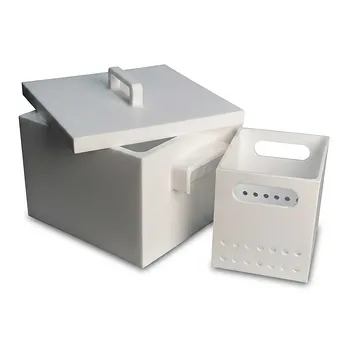
For the synthesis of CuGNT nanostructures, a high-pressure reaction vessel with a Polytetrafluoroethylene (PTFE) liner provides a sealed, high-temperature, and corrosion-resistant environment. This setup facilitates the reduction of copper ions by glucose and enables the directional growth of high-aspect-ratio nanowires by maintaining the reaction system above the normal boiling point of water.
Core Takeaway: The PTFE-lined autoclave creates a pressurized, contaminant-free environment that allows water to reach subcritical states, providing the necessary energy and chemical stability to transform precursors into high-purity, structurally precise CuGNT hybrids.
Creating the Ideal Synthesis Environment
Achieving Subcritical States
The sealed vessel allows the reaction temperature to reach 120°C, which is significantly above the atmospheric boiling point of water. This creates high autogenous pressure, transforming the solvent into a subcritical state where its solubility and reactivity are greatly enhanced.
Superior Chemical Inertness
The PTFE liner is chosen for its exceptional resistance to nearly all strong acids, bases, and organic solvents. This ensures that the reaction solution, which may be highly corrosive at elevated temperatures, does not interact with the autoclave’s metal shell.
Prevention of Ion Contamination
By acting as a physical barrier, the PTFE liner prevents the introduction of extraneous metal ions from the stainless steel vessel into the reaction. This is critical for maintaining the high purity of the resulting CuGNT hybrids and ensuring the catalyst's integrity.
Driving the Chemical Transformation
Energy for Copper Ion Reduction
The high-temperature environment provides the thermal energy required to drive the reduction of copper ions by glucose. Without the pressure-induced ability to exceed 100°C, the reaction kinetics would be insufficient to complete the "one-pot" synthesis efficiently.
Guidance of Nanowire Growth
The specific processing conditions within the vessel guide copper atoms to grow along specific crystal planes. This controlled environment is what enables the formation of high-aspect-ratio nanowires rather than disorganized particles.
Practical Sample Recovery
Beyond chemical protection, the non-stick properties of the PTFE liner simplify the recovery of the synthesized nanostructures. This minimizes material loss and ensures that the cleaning process between batches is thorough and effective.
Understanding the Trade-offs
Temperature Limitations
While PTFE is highly inert, it has a functional thermal limit, typically around 200°C to 220°C. Exceeding these temperatures can lead to the deformation of the liner or the release of toxic vapors, potentially compromising the experiment and safety.
Thermal Expansion Mismatch
PTFE has a different coefficient of thermal expansion than the stainless steel outer shell. Rapid heating or cooling can cause the liner to warp or crack, which may lead to "leaking" where the reaction fluid contacts and corrodes the metal autoclave.
Pressure Safety Risks
Hydrothermal synthesis generates significant internal pressure that is not always easy to monitor in real-time. Operators must strictly adhere to filling degree limits (usually 60-80% of volume) to prevent over-pressurization and potential vessel failure.
How to Apply This to Your Project
Making the Right Choice for Your Goal
- If your primary focus is High-Purity CuGNT: Ensure the PTFE liner is pristine and free of scratches, as even minor surface defects can harbor contaminants from previous reactions.
- If your primary focus is Morphological Precision: Maintain a consistent temperature of 120°C for the full 20-hour duration to allow for the steady, directional growth of the nanowires along specific crystal planes.
- If your primary focus is Equipment Longevity: Avoid rapid quenching of the autoclave after the reaction; allow it to cool naturally to room temperature to prevent the PTFE liner from deforming or cracking.
By leveraging the unique pressurized environment of a PTFE-lined vessel, you can precisely control the chemical reduction and physical growth stages necessary for high-performance nanostructure synthesis.
Summary Table:
| Processing Condition | Function in Synthesis | Key Benefit |
|---|---|---|
| 120°C Temperature | Drives copper ion reduction by glucose | Efficient one-pot chemical transformation |
| Autogenous Pressure | Creates subcritical solvent states | Facilitates high-aspect-ratio nanowire growth |
| PTFE Chemical Inertness | Prevents ion leaching from steel shell | Ensures high-purity, contaminant-free hybrids |
| Non-stick Surface | Simplifies material collection | Maximizes sample recovery and cleaning efficiency |
| Thermal Limit (220°C) | Defines safe operating window | Protects vessel integrity and operator safety |
Elevate Your Synthesis with KINTEK’s High-Performance Fluoropolymers
Precision in nanostructure synthesis starts with the right environment. KINTEK specializes in high-performance PTFE and PFA laboratory solutions designed for the most demanding hydrothermal and chemical processes. From hydrothermal synthesis liners and microwave digestion vessels to high-purity trace analysis instruments and custom CNC-fabricated parts, we provide the durability and inertness your research requires.
Whether you need basic labware (beakers, crucibles, reagent bottles), complex fluid transfer components (tubing, valves, fittings), or advanced reaction apparatus like electrochemical cells and microchannel reactors, KINTEK is your end-to-end partner. We deliver everything from bespoke laboratory setups to high-volume orders with an absolute focus on material integrity.
Ready to optimize your lab’s performance? Contact KINTEK today to discover how our custom fluoropolymer fabrication can support your next breakthrough.
References
- Miao Yuan, Wenjiang Li. Nano copper-modified GO and CNTs for enhanced the epoxy resin composite thermal properties. DOI: 10.1016/j.apsusc.2025.162616
This article is also based on technical information from Kintek Knowledge Base .
Related Products
- PTFE Lined High Pressure Digestion Vessel 50ml High Temperature Hydrothermal Synthesis Tank
- Custom TFM Reaction Vessel with Stainless Steel Jacket and PTFE Inner Cup for High Corrosion Resistance
- High Purity PTFE Microwave Digestion Vessel Replacement Liner for Acid Sample Preparation and Trace Analysis
- High Purity TFM Microwave Digestion Vessels PTFE Acid Evaporation Liners Domestic GT-400 Equivalent Laboratory Reaction Containers
- High Pressure Custom TFM Reactor Stainless Steel Outer Vessel PTFE Inner Cup for Corrosive Synthesis
People Also Ask
- What are the benefits of using a PTFE-lined vessel for carbon-sulfur cathode treatment? Maximize Purity & Performance
- Why are PTFE-lined pressure digestion vessels required for the preparation of Ag/CeO2 catalysts? Purity & Performance
- What is the function of high-pressure PTFE digestion vessels in mineral analysis? Optimize Sample Mineralization
- What safety features are typically incorporated into high-pressure PTFE digestion vessel designs? Ensure Lab Safety
- What is the function of PTFE lined high-pressure vessels in g-C3N4 synthesis? Achieve High-Purity Material Growth