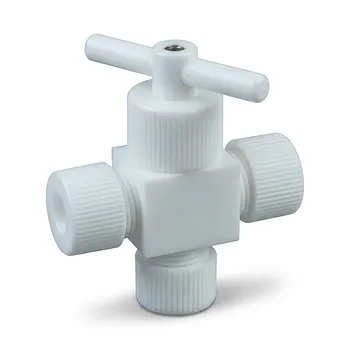
Flow-path alignment in a PTFE multi-port rotary valve is achieved through the precise, indexed rotation of an internal rotor. By aligning machined channels or holes within the rotor with fixed ports in the valve stator, fluid is selectively directed into specific pathways for functions such as injection, distribution, or diversion.
The core principle of a multi-port rotary valve is the selective mechanical overlap of rotor channels and stator ports. This configuration transforms a simple rotational movement into a complex fluid-routing logic, using PTFE to ensure chemical inertness and a leak-proof seal.
The Mechanics of Indexed Rotation
The Rotor and Stator Relationship
The valve consists of two primary functional components: a stationary stator containing multiple entry and exit ports, and a moving rotor.
The rotor features specifically machined grooves or holes that act as internal bridges between the stator ports.
When the rotor is in a "sealed" position, these channels do not align with any ports, effectively blocking all fluid flow across the interface.
The Indexing Process
Alignment occurs when the rotor is moved—either manually or via an electronic actuator—to a predefined indexed position.
Each index corresponds to a specific degree of rotation that perfectly matches a rotor channel to two or more stator ports.
This alignment creates a continuous, unobstructed flow path, allowing the process medium to transition from the inlet to the desired outlet.
The Role of PTFE in Fluid Control
Low-Friction Actuation
PTFE is a self-lubricating material, which is critical for the internal components of a rotary valve.
This property ensures that the operating torque remains low, even when the valve is under high differential pressure or has been stationary for long periods.
Low friction allows for smoother transitions between indexed positions and reduces the wear on electronic actuators.
Achieving a Bubble-Tight Seal
In these valves, the rotor is often pressed firmly against the stator or machined seats to prevent cross-port leakage.
Because PTFE is slightly compliant, it can create a bubble-tight seal when compressed against the internal components.
This ensures that fluid only moves through the intended aligned path and does not "bleed" into adjacent ports.
Functional Applications of Alignment
Distribution and Diversion
In distribution mode, a single central inlet port is aligned with one of several peripheral outlet ports.
By rotating the rotor to different indices, the operator can "step" the flow through a series of different containers or process lines.
This is commonly used in automated sampling systems or multi-column chromatography.
Injection and Sampling
Rotary valves are frequently used to inject a precise volume of fluid into a stream.
The rotor channels can be designed to hold a specific volume; when the rotor turns, it disconnects from the "load" ports and aligns with the "inject" ports.
This mechanism allows for the highly repeatable introduction of samples into analytical instruments.
Understanding the Trade-offs
Dead Volume and Carryover
While rotary valves are efficient, the internal channels in the rotor can trap small amounts of fluid.
This dead volume can lead to "carryover," where a previous sample contaminates the current flow path.
Users must ensure proper flushing sequences between rotations to maintain the integrity of the process medium.
Material Wear and Alignment Precision
Over time, the mechanical friction between the rotor and stator—even with PTFE—can lead to wear.
If the rotor becomes slightly misaligned due to mechanical play or wear, the flow path may be partially restricted.
Partial restriction increases turbulence and pressure drops, which can negatively impact sensitive analytical processes.
Making the Right Choice for Your Goal
To maximize the performance of a PTFE multi-port rotary valve, consider your primary operational objective:
- If your primary focus is Chemical Compatibility: Ensure the entire wetted path, including the stator and rotor, is lined with or machined from virgin PTFE to prevent corrosion from aggressive media.
- If your primary focus is High-Precision Sampling: Select a valve with a high-resolution electronic actuator to ensure the rotor channels align perfectly with the stator ports every time.
- If your primary focus is Minimizing Contamination: Prioritize "low-dead-volume" rotor designs and implement a rigorous cleaning cycle between port transitions.
Reliable fluid routing depends on the synergy between precise mechanical indexing and the unique sealing properties of PTFE.
Summary Table:
| Feature | Description | Role of PTFE |
|---|---|---|
| Rotor | Internal part with machined channels | Self-lubricating for low-torque rotation |
| Stator | Stationary body with multiple fixed ports | Provides a rigid surface for the seal interface |
| Indexing | Precise mechanical or electronic positioning | Ensures perfect alignment for unobstructed flow |
| Sealing | Compression between rotor and stator seats | Compliant material ensures a bubble-tight seal |
| Flow Logic | Selective overlap of channels and ports | Facilitates distribution, diversion, or injection |
Optimize Your Fluid Logic with KINTEK
Achieve uncompromising precision in your laboratory workflows with KINTEK’s high-performance fluoropolymer solutions. Whether you require reliable multi-port rotary valves or complex fluid transfer components, our end-to-end custom CNC fabrication ensures every part meets your exact technical specifications.
From everyday basic labware (beakers, measuring cylinders, crucibles, reagent bottles) and high-purity trace analysis tools to advanced reaction apparatus like electrochemical cells and microwave digestion vessels, KINTEK manufactures virtually all imaginable supplies from PTFE and PFA.
Why partner with KINTEK?
- Exclusive Material Focus: Absolute specialization in high-performance fluoropolymers for maximum chemical inertness.
- Bespoke Engineering: Expert CNC machining for complex non-standard parts and custom laboratory setups.
- Full Spectrum Supply: Everything from O-rings, tubing, and valves to battery testing fixtures and microchannel reactors.
Ready to enhance your lab's efficiency and eliminate contamination? Contact us today to discuss your project!
Related Products
- Custom PTFE Multi Port Reaction Bottle Caps Corrosion Resistant High Purity GL32 GL45 Laboratory Closures
- High Corrosion Resistant PTFE Faucet Polytetrafluoroethylene Valve for Chemical Storage Drums and Fluid Transfer Systems Customizable Industrial Grade
- High Purity PTFE Faucet Corrosion Resistant Polytetrafluoroethylene Drum Valve Customizable Lab Chemical Fluid Control
- Corrosion Resistant PTFE Polytetrafluoroethylene Valve and Customizable Laboratory Fluid Dispensing Faucet for Aggressive Chemical Handling in Industrial Storage Tanks and Plastic Drums
- Custom PTFE Valve 2-Way 3-Way Corrosion Resistant Low Background Virgin Fluoropolymer Industrial Fluid Control
People Also Ask
- What material grades are available for PTFE caps? Choose the Right Grade for Purity or Performance
- What are the specialized types of PTFE caps and their uses? Ensure Sample Integrity and Safety
- What are the electrical insulation properties of PTFE caps? Superior Dielectric Performance for Demanding Applications
- What are the applications of PTFE-lined bottle caps? Ensure Ultimate Purity and Chemical Resistance
- What are the safety features of PTFE-lined bottle caps? Ensure Chemical Inertness and Sample Integrity