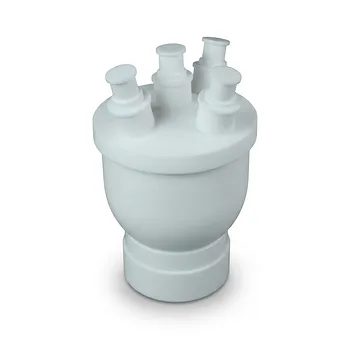
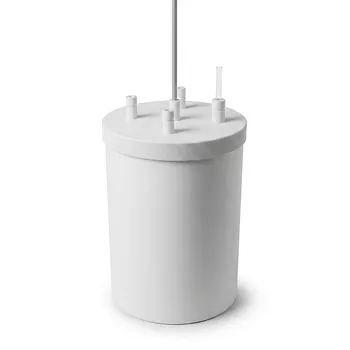
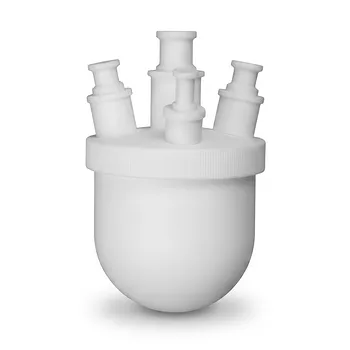
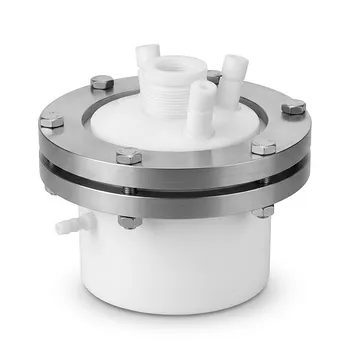
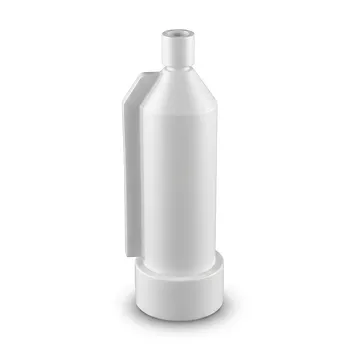
The PTFE liner acts as a chemically inert, corrosion-resistant reaction vessel that isolates the precursor solution from the reactor's metallic walls. During the preparation of nickel-cobalt hydroxide intermediates, it ensures that the synthesis occurs at high temperatures (typically 120°C) and pressures without introducing impurities or damaging the external autoclave.
Core Takeaway: The PTFE liner is essential for maintaining the chemical purity and structural integrity of nickel-cobalt intermediates by preventing metal leaching from the reactor and providing a non-stick surface for uniform crystal nucleation.
Maintaining Chemical Purity and Integrity
Prevention of Metal Ion Leaching
The primary role of the PTFE liner is to serve as a physical barrier between the corrosive precursor solution and the stainless steel reactor body. Without this liner, the nickel and cobalt salts could react with or leach heavy metals (like iron or chromium) from the steel, contaminating the final hydroxide product.
Resistance to Corrosive Precursors
Nickel-cobalt synthesis often involves urea and various salts that can become highly aggressive under hydrothermal conditions. PTFE’s extreme chemical resistance allows it to withstand these strong acids or bases, ensuring the reaction environment remains stable and uncontaminated throughout the heating cycle.
Ensuring High-Purity Microspheres
By eliminating external chemical interference, the liner allows for the formation of high-purity hierarchical microspheres. This purity is critical for the electrochemical performance of the resulting nickel-cobalt hydroxide, as even trace metal impurities can disrupt the desired crystal structure.
Facilitating Precise Morphological Growth
Non-Stick Properties for Uniform Nucleation
PTFE is famously non-stick, which is a functional advantage during the "in-situ" growth of nanomaterials. This property prevents the nickel-cobalt intermediates from adhering prematurely to the vessel walls, promoting more uniform nucleation and growth on intended substrates, such as nickel foam.
Stability Under Autogenous Pressure
As the reactor heats to 120°C, internal autogenous pressure builds significantly. The PTFE liner maintains its structural integrity and seal within the stainless steel shell, providing a controlled environment where the precursor can undergo consistent crystallization and morphology development.
Simplified Product Recovery
The anti-adhesion characteristics of PTFE make the post-experimental recovery of the synthesized powders much more efficient. This ensures that the yield of the hierarchical nanostructures is maximized and the reactor is easier to clean for subsequent cycles.
Understanding the Trade-offs and Limitations
Temperature Ceiling
While PTFE is excellent for standard hydrothermal synthesis at 120°C, it has a functional limit generally around 220°C. Exceeding these temperatures can cause the liner to soften or "creep," potentially leading to seal failure or permanent deformation of the vessel.
Thermal Lag and Conductivity
PTFE is a thermal insulator, meaning there is a slight delay between the temperature of the oven and the temperature of the internal reaction solution. Users must account for this thermal lag to ensure the precursor solution actually reaches the target 120°C required for nickel-cobalt hydroxide formation.
Mechanical Deformation
Under repeated high-pressure cycles, PTFE liners can experience "cold flow" or slight shape changes. It is vital to inspect the liner regularly for thinning or warping, as a compromised liner can lead to the corrosive solution reaching—and eventually pitting—the stainless steel outer shell.
How to Optimize Your Synthesis Results
To achieve the best results when synthesizing nickel-cobalt hydroxide intermediates, consider the following recommendations:
- If your primary focus is material purity: Ensure the PTFE liner is thoroughly acid-washed between runs to remove any residual metal ions from previous experiments.
- If your primary focus is morphological consistency: Do not fill the liner beyond 70-80% of its capacity to allow sufficient "headspace" for pressure stabilization and uniform heat distribution.
- If your primary focus is equipment longevity: Always check for "pitting" or discoloration on the external stainless steel autoclave, which indicates the PTFE liner may have a micro-crack or seal leak.
The PTFE liner is the silent enabler of hydrothermal synthesis, transforming a raw industrial pressure vessel into a high-precision environment for advanced nanomaterial chemistry.
Summary Table:
| Feature | Role in Hydrothermal Synthesis | Key Benefit |
|---|---|---|
| Chemical Inertness | Prevents metal leaching from reactor walls | Ensures high product purity |
| Non-Stick Surface | Facilitates uniform nucleation on substrates | Precise morphological growth |
| Corrosion Resistance | Withstands aggressive urea/salt precursors | Protects stainless steel autoclave |
| Thermal Stability | Maintains integrity up to 220°C | Reliable performance at 120°C |
| Anti-Adhesion | Reduces material sticking to vessel walls | Maximizes yield and easy cleaning |
Elevate Your Synthesis Precision with KINTEK
Achieve uncompromising purity and consistent results in your hydrothermal research. KINTEK specializes in high-performance fluoropolymer materials, providing the essential tools needed for advanced nanomaterial chemistry.
From everyday basic labware (beakers, measuring cylinders, crucibles, dishes, reagent/wash bottles, centrifuge and digestion tubes) to specialized hydrothermal synthesis liners and microwave digestion vessels, we manufacture virtually all imaginable laboratory supplies crafted from PTFE and PFA.
Whether you require high-purity trace analysis instruments, comprehensive fluid transfer components (tubing, fittings, valves), or complex custom CNC fabricated non-standard parts, KINTEK is your dedicated partner. We offer everything from sample prep and filtration tools (separatory funnels, filters, tweezers) to advanced reaction apparatus like electrochemical cells and battery testing fixtures.
Don't let impurities compromise your intermediates. Contact us today to discuss your bespoke laboratory setup or high-volume orders and experience the KINTEK advantage in high-performance fluoropolymer engineering.
References
- Shadeepa Karunarathne, Amr M. Abdelkader. Triphase Heterogeneous Electrocatalysts of Ni and Co for High‐Performing Li‐O<sub>2</sub> Batteries. DOI: 10.1002/eom2.70002
This article is also based on technical information from Kintek Knowledge Base .
Related Products
- PTFE Lined High Pressure Digestion Vessel 50ml High Temperature Hydrothermal Synthesis Tank
- High Pressure Custom TFM Reactor Stainless Steel Outer Vessel PTFE Inner Cup for Corrosive Synthesis
- High Temperature Corrosion Resistant Hydrothermal Synthesis Reactor with TFM Inner Liner and Straight Cylinder Design
- Custom TFM Reaction Vessel with Stainless Steel Jacket and PTFE Inner Cup for High Corrosion Resistance
- High Purity TFM Microwave Digestion Vessels PTFE Acid Evaporation Liners Domestic GT-400 Equivalent Laboratory Reaction Containers
People Also Ask
- What are the benefits of using a PTFE-lined vessel for carbon-sulfur cathode treatment? Maximize Purity & Performance
- Why are PTFE-lined pressure digestion vessels required for the preparation of Ag/CeO2 catalysts? Purity & Performance
- What is the function of high-pressure PTFE digestion vessels in mineral analysis? Optimize Sample Mineralization
- What safety features are typically incorporated into high-pressure PTFE digestion vessel designs? Ensure Lab Safety
- What is the function of PTFE lined high-pressure vessels in g-C3N4 synthesis? Achieve High-Purity Material Growth