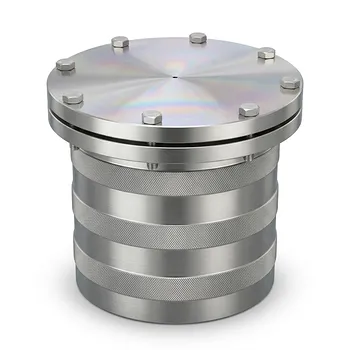
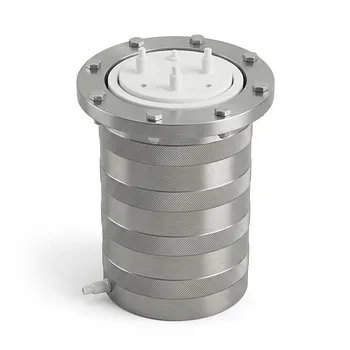
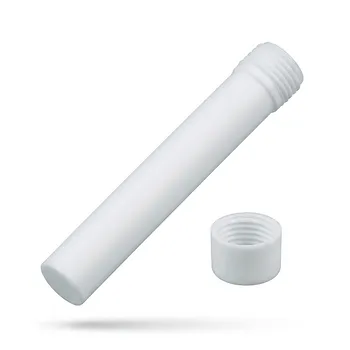
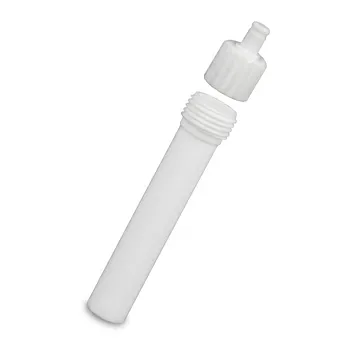
The use of a PTFE-lined stainless steel autoclave is essential for the hydrothermal synthesis of CF@BCZT fillers because it provides a pressurized, chemically inert environment. This setup allows the reaction to exceed the solvent’s boiling point, generating autogenous pressure that drives the in situ nucleation and growth of cobalt ferrite (CF) directly onto the surface of BCZT seed particles.
The autoclave acts as a high-pressure reactor that facilitates the formation of a strong heterogeneous interface between the cobalt ferrite and BCZT. This precise control over the synthesis environment is critical for ensuring high purity and enhancing the final material’s magnetoelectric coupling performance.
Facilitating the Hydrothermal Synthesis Process
Generating Autogenous Pressure
The sealed nature of the autoclave allows the internal pressure to rise naturally as the temperature increases, reaching states that exceed the solvent's atmospheric boiling point. This high-pressure environment is the physical foundation required to promote the dehydration and ordered assembly of nanocrystals.
Promoting In Situ Nucleation
In the preparation of CF@BCZT, the autoclave enables cobalt and iron salt precursors to nucleate directly onto the surfaces of BCZT seed particles. This in situ growth is vital for creating a tightly bonded interface, which ensures efficient magneto-stress transfer between the two phases.
Achieving High Crystallinity
By maintaining a constant temperature—such as the 130 °C cited for this specific synthesis—the autoclave promotes the growth of high-crystallinity, single-phase products. The stable thermal environment prevents defects and ensures the material achieves the desired magnetic and electrical properties.
The Critical Role of the PTFE Liner
Protection Against Strong Alkalines
The synthesis of cobalt ferrite often requires strong alkaline environments, which would aggressively corrode standard laboratory glassware or bare metal. The PTFE (polytetrafluoroethylene) liner is chosen for its exceptional chemical stability, allowing it to withstand these harsh reagents without degrading.
Elimination of Metallic Contamination
The liner serves as a physical barrier that prevents the precursor solution from reacting with the stainless steel shell. This isolation is crucial to ensure the final CF@BCZT fillers remain free from metallic impurities or iron ions leached from the autoclave walls.
Facilitating Product Recovery
PTFE possesses a naturally anti-adhesive and smooth surface, which prevents the synthesized powder sediments from sticking to the container. This characteristic significantly simplifies the recovery and collection of the solid precipitates once the reaction is complete.
Understanding the Trade-offs
Temperature and Pressure Limitations
While highly versatile, PTFE liners have a maximum operating temperature (typically around 220 °C to 250 °C) beyond which they may soften or emit toxic fumes. Exceeding these limits can lead to liner deformation, potentially compromising the seal and damaging the stainless steel outer shell.
Cooling and Heating Rates
Hydrothermal synthesis in an autoclave requires patience, as the high thermal mass of the stainless steel necessitates slow heating and cooling cycles. Rapid temperature changes can cause uneven expansion between the PTFE liner and the steel body, leading to leaks or structural failure of the vessel.
Maintenance and Cleaning Requirements
Despite its chemical inertness, the PTFE liner can become porous over time or retain "memory" from previous reactions if not cleaned meticulously. Cross-contamination is a risk in high-precision material science if the liners are not dedicated to specific chemical families.
How to Apply This to Your Project
Recommendations for Material Synthesis
- If your primary focus is maximizing interface strength: Ensure the autoclave remains sealed throughout the entire thermal cycle to maintain the autogenous pressure required for in situ growth.
- If your primary focus is product purity: Use a fresh or dedicated PTFE liner to prevent the introduction of trace metal ions or secondary phases from previous synthesis runs.
- If your primary focus is equipment longevity: Always operate within the specific temperature limits of your PTFE liner (often 200 °C for standard units) to prevent mechanical deformation and ensure a tight seal.
By leveraging the unique high-pressure and chemically shielded environment of the PTFE-lined autoclave, researchers can achieve the precise interface engineering necessary for high-performance magnetoelectric fillers.
Summary Table:
| Feature/Component | Role in CF@BCZT Synthesis | Key Material Benefit |
|---|---|---|
| Stainless Steel Shell | Withstands internal autogenous pressure | Enables reaction temperatures above boiling point |
| PTFE Liner | Provides a chemically inert barrier | Prevents metallic contamination and corrosion |
| High Pressure | Drives in situ nucleation on BCZT seeds | Ensures strong interface for magneto-stress transfer |
| Thermal Stability | Maintains constant 130 °C environment | Promotes high crystallinity and single-phase products |
| Smooth Surface | Anti-adhesive properties | Simplifies recovery of solid CF@BCZT precipitates |
Precision Fluoropolymer Solutions for Advanced Material Science
Elevate your research and production with KINTEK, your premier partner for high-performance fluoropolymer laboratory supplies. Whether you are synthesizing magnetoelectric fillers like CF@BCZT or performing high-purity trace analysis, we provide the exact tools you need to ensure contamination-free results.
From everyday basic labware—including beakers, crucibles, reagent bottles, and centrifuge tubes—to advanced components like hydrothermal synthesis liners, microwave digestion vessels, and custom electrochemical cells, KINTEK manufactures virtually every laboratory essential from premium PTFE and PFA.
Why Choose KINTEK?
- Expert Fabrication: End-to-end custom CNC machining for complex, non-standard parts.
- Comprehensive Range: Everything from fluid transfer components (tubing, valves) to sample prep tools (filters, pipettes, tweezers).
- High-Volume & Bespoke: We handle everything from bulk consumables like O-rings and stirring bars to unique, large-scale laboratory setups.
Achieve absolute purity and structural integrity in your next project. Contact KINTEK today to discuss your custom requirements!
References
- Abhishek Sasmal, A. Arockiarajan. Simultaneously improved dipolar interaction at inorganic-inorganic and organic-inorganic interfaces for multimode energy harvesting from heterostructured CoFe2O4@BCZT loaded P(VDF-TrFE). DOI: 10.1038/s41598-025-13253-3
This article is also based on technical information from Kintek Knowledge Base .
Related Products
- Custom TFM Reaction Vessel with Stainless Steel Jacket and PTFE Inner Cup for High Corrosion Resistance
- PTFE Lined High Pressure Digestion Vessel 50ml High Temperature Hydrothermal Synthesis Tank
- High Pressure Custom TFM Reactor Stainless Steel Outer Vessel PTFE Inner Cup for Corrosive Synthesis
- High Purity TFM Microwave Digestion Vessels PTFE Acid Evaporation Liners Domestic GT-400 Equivalent Laboratory Reaction Containers
- High Purity PTFE Microwave Digestion Vessel Replacement Liner for Acid Sample Preparation and Trace Analysis
People Also Ask
- Why are high-performance pressure-resistant reaction vessels required for oxygen-assisted hydrothermal conversion at 150 °C?
- How do magnetic stirring and reaction vessels impact MOF-derived carbon quality? Optimize Your Composite Performance
- Why are high-quality fluoropolymer-lined reaction vessels required for alk-Ti3C2Tx MXene? Ensure Purity & HF Resistance
- Why are PTFE-lined reaction vessels necessary for forced degradation studies? Ensure high-purity results and accuracy.
- Why is a high-purity PTFE lined reaction vessel required for the acidic etching of MXenes? Ensure Material Purity.