The primary purpose of a four-probe electrochemical test fixture is the isolation of voltage measurement from current delivery. This configuration separates the current-carrying electrodes from the voltage-sensing electrodes to eliminate the influence of contact resistance and lead resistance from the results. By removing these external variables, researchers can accurately measure the inherent proton transport impedance of a membrane to determine its true proton conductivity.
A four-probe fixture is essential for experimental accuracy because it ensures that the measured resistance belongs solely to the membrane material. This setup prevents interface and wire resistance from masking the actual electrochemical performance of the proton exchange membrane.
Overcoming the Limitations of Two-Probe Systems
The Problem of Lead and Contact Resistance
In standard two-probe setups, the measured resistance includes the resistance of the wires and the interface where the electrode touches the membrane. These parasitic resistances can be significantly higher than the membrane's actual resistance, leading to skewed data and underestimations of conductivity.
How the Four-Probe Configuration Works
Two "outer" electrodes supply a constant current while two "inner" electrodes measure the voltage drop across a specific section of the membrane. Because the voltage-sensing circuit has very high impedance and draws almost no current, the voltage drop across the sensing leads and contact points becomes negligible.
Accuracy in Hydrated States
This method is particularly critical for measuring PVdF-based composite membranes or SPEEK membranes in a hydrated state. It provides the reliable data necessary to calculate conductivity based on the membrane's actual physical dimensions and internal proton mobility.
Material Integrity and Signal Accuracy
The Role of Platinum Electrodes
High-purity platinum electrodes are utilized for their superior electrochemical activity and low contact resistance. These properties allow the fixture to accurately capture the relatively weak impedance signals generated by proton transport within the membrane.
PTFE for Environmental Stability
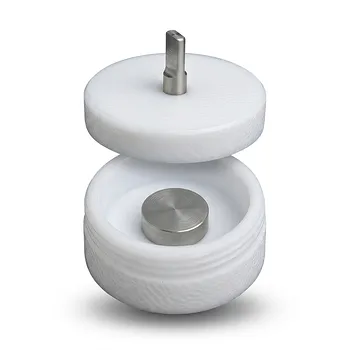
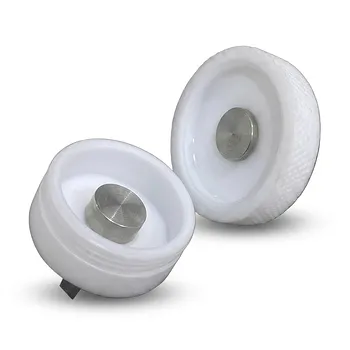
The fixture frame is typically constructed from Polytetrafluoroethylene (PTFE) due to its extreme chemical inertness and electrical insulation. This material ensures that no impurity ions interfere with the results, even in harsh environments such as 80°C and 100% relative humidity.
Thermal and Chemical Resistance
PTFE blocks can withstand significant temperature fluctuations without deforming or introducing parasitic currents. This stability ensures that the electrical current passes strictly through the membrane sample immersed in double-distilled water, maintaining the integrity of Electrochemical Impedance Spectroscopy (EIS) tests.
Standardizing the Physical Environment
Uniform Mechanical Pressure
High-precision fixtures apply uniform and controllable pressure across the Membrane Electrode Assembly (MEA). This ensures optimal electrical contact between the gas diffusion layer and the catalyst layer, further reducing measurement noise.
Hydrothermal Control and Flow Design
Specialized fixtures often incorporate integrated fluid distributors and flow channels to guide reactant gases or deionized water. These features allow researchers to simulate the hydrothermal dynamics of a functional fuel cell stack while collecting electrochemical data.
Geometric Precision
The fixture provides a precise geometric active area, which is the physical foundation for obtaining reproducible polarization curves. Without this standardized boundary, calculating the specific conductivity (S/cm) would be impossible due to undefined path lengths.
Understanding the Trade-offs
Increased System Complexity
While four-probe systems provide superior accuracy, they require more complex hardware and precise alignment. Researchers must ensure that the distance between the sensing electrodes is measured with high precision, as this distance is a primary variable in the conductivity equation.
Pressure Sensitivity
Although the fixture is designed to eliminate contact resistance, excessive mechanical pressure can physically deform thin membranes. This deformation can change the proton transport path, potentially leading to higher-than-actual conductivity readings if the membrane thickness is significantly reduced during the test.
Strategies for Accurate Membrane Characterization
Selecting the right testing protocol depends on your specific research objectives and the material properties of your proton exchange membrane.
- If your primary focus is measuring inherent material properties: Utilize a four-probe setup to completely isolate the membrane's internal resistance from the influence of leads and interfaces.
- If your primary focus is high-temperature stability: Choose a fixture with PTFE fixing blocks and platinum electrodes to prevent ionic contamination and thermal deformation during testing.
- If your primary focus is fuel cell stack simulation: Employ a fixture with integrated flow channels and uniform pressure distribution to mirror the hydrothermal conditions of an active MEA.
By effectively isolating electrical variables and providing a stable physical environment, the four-probe fixture serves as the definitive tool for characterizing the true electrochemical performance of proton exchange membranes.
Summary Table:
| Feature | Function in PEM Testing | Key Benefit |
|---|---|---|
| Four-Probe Design | Separates current and voltage leads | Eliminates contact and lead resistance |
| PTFE Construction | Provides chemical & thermal insulation | Ensures no ionic interference or deformation |
| Platinum Electrodes | Captures weak impedance signals | Delivers high signal accuracy and activity |
| Controlled Pressure | Applies uniform force to the MEA | Minimizes noise and ensures reproducible data |
| Geometric Precision | Defines a fixed active area | Allows for accurate S/cm conductivity calculation |
Elevate Your Electrochemical Research with KINTEK Precision
Maximize the accuracy of your membrane characterization with high-performance laboratory supplies from KINTEK. We specialize in high-performance fluoropolymer materials, offering an extensive range of products tailored for demanding research environments.
From everyday basic labware like PTFE and PFA beakers, crucibles, and digestion tubes to advanced standard or custom electrochemical cells, battery testing fixtures, and electrode accessories, KINTEK is your single source for excellence. Our capabilities extend to high-purity trace analysis instruments, comprehensive fluid transfer components (tubing, valves), and bespoke custom CNC fabrication for non-standard machined parts.
Whether you need a single bespoke laboratory setup or high-volume orders for consumables like O-rings and stirring bars, our end-to-end manufacturing ensures superior chemical resistance and thermal stability for your most critical tests.
Ready to optimize your lab's performance? Contact us today to discuss your custom requirements and discover how KINTEK’s expertise in high-performance materials can support your next breakthrough.
References
- Pengtao Lei, Zhenkun Jiang. Promoting Proton Conductivity and Methanol‐Resistance of <scp>PVdF</scp>‐Based <scp>PEM</scp> Membrane by Incorporating Dispersive <scp>CNT</scp> Dotted With α‐Zr(<scp>HPO<sub>4</sub></scp>)<sub>2</sub>∙<scp>H<sub>2</sub>O</scp>. DOI: 10.1002/app.57083
This article is also based on technical information from Kintek Knowledge Base .
Related Products
- Acid Resistant PTFE Button Cell Battery Test Fixture Customizable Machining High Purity Electrochemical Testing Clamp
- Corrosion Resistant PTFE Coin Cell Battery Testing Clamps and Acid Proof Custom Fluoropolymer Battery Fixtures
- Custom PFA Microcolumn Racks and PTFE Machined Low Background Corrosion Resistant Laboratory Fixtures
- Square PTFE Electrochemical Cell for Silicon Wafer Processing and Hydrofluoric Acid Resistance in Semiconductor and New Energy Research
- Custom PTFE Electrolytic Cell Corrosion Resistant Low Background Reaction Vessel with Inlet Outlet Ports
People Also Ask
- In what ways do PTFE battery testing fixtures enhance laboratory throughput and reliability? Maximize Research Efficiency
- How does the chemical inertness of PTFE benefit laboratory-scale battery testing? Ensure high-purity research results.
- Why are customized PTFE testing fixtures required for electrochemical testing and battery research? Boost Data Accuracy
- In what industrial manufacturing contexts are PTFE battery clamps or fixtures utilized? Optimize Battery Production.
- What is the thermal operating range for PTFE battery clamps in electrochemical research? Stability from -200°C to +260°C