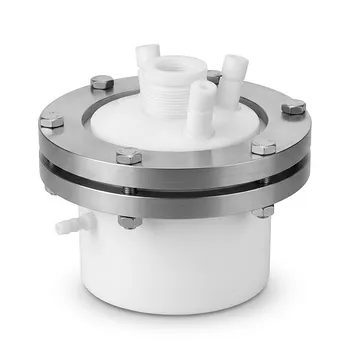
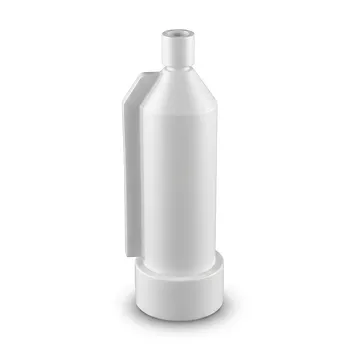
The primary function of a PTFE liner in BFO synthesis is to provide a chemically inert and corrosion-resistant environment that can withstand the high temperatures and pressures required for hydrothermal reaction. This liner specifically protects the reactor's metal walls from the aggressive alkaline mineralizers—such as Potassium Hydroxide (KOH) or Sodium Hydroxide (NaOH)—used to facilitate the growth of Bismuth Ferrite nanoparticles.
The PTFE liner acts as a critical isolation barrier that enables the direct nucleation and growth of high-purity BFO nanoparticles in a liquid phase. By maintaining a sealed, high-pressure environment, it allows for controlled morphologies and eliminates the need for subsequent high-temperature calcination steps.
Protecting Structural Integrity and Purity
The hydrothermal synthesis of Bismuth Ferrite (BFO) requires a delicate balance of extreme conditions and chemical purity. The PTFE liner is the frontline defense for both the equipment and the product.
Resistance to Aggressive Alkaline Mineralizers
BFO synthesis typically utilizes strong bases like KOH or NaOH to act as mineralizers. These chemicals are highly corrosive and would rapidly degrade the stainless steel walls of a standard autoclave at elevated temperatures. The chemical inertness of PTFE ensures that the liner remains stable even when exposed to these harsh alkaline environments.
Prevention of Metal Impurity Interference
Without a liner, the reaction medium would come into direct contact with the metal shell of the reactor. This contact leads to the leaching of metal ions into the solution, which can contaminate the BFO nanoparticles and alter their electromagnetic properties. The PTFE liner provides a sealed and inert space, ensuring the final nanostructures remain free from external metallic interference.
Enabling Advanced Material Characteristics
Beyond mere protection, the PTFE liner facilitates the specific physical conditions necessary for the hydrothermal method to surpass traditional solid-state or sol-gel techniques.
Facilitating High-Pressure Liquid-Phase Synthesis
The liner allows the reaction to occur at temperatures exceeding the solvent's boiling point, creating autogenous pressure. This pressurized environment is essential for the direct nucleation and growth of BFO nanoparticles directly from the aqueous phase. This process results in high crystallinity and allows for the production of specific shapes, such as nanorods or hollow spheres, which are difficult to achieve through other means.
Eliminating the Need for Post-Processing
In traditional methods like sol-gel, a secondary high-temperature calcination step is often required to achieve the desired crystal phase. The stable, high-pressure environment provided by the PTFE-lined reactor achieves the correct perovskite structure during the initial synthesis. By bypassing calcination, researchers can prevent the particle agglomeration that typically occurs during high-heat treatment.
Understanding the Trade-offs
While PTFE is indispensable for hydrothermal synthesis, it is not a "one-size-fits-all" solution and has specific operational boundaries.
Temperature Limitations
PTFE typically has a maximum safe operating temperature of approximately 220°C to 240°C. Exceeding these limits can cause the liner to soften, deform, or release toxic vapors, which risks compromising the seal and damaging the reactor. For reactions requiring higher temperatures, more specialized materials like Para-polyphenylene (PPL) must be used instead.
Heat Transfer Inefficiency
PTFE is an excellent insulator, which means it does not conduct heat as efficiently as the metal walls of the autoclave. This can lead to a lag between the temperature set on the external heating mantle and the actual temperature of the internal reaction solution. Users must account for this thermal lag to ensure the precursors reach the necessary energy levels for nucleation.
How to Apply This to Your Project
When selecting or using a PTFE-lined reactor for BFO synthesis, your primary goals should dictate your operational parameters.
- If your primary focus is Phase Purity: Ensure the PTFE liner is thoroughly cleaned and free of scratches to prevent any precursor "trapping" or cross-contamination from previous batches.
- If your primary focus is Morphological Control: Closely monitor the filling ratio of the liner (typically 60-80%) to maintain consistent autogenous pressure throughout the synthesis.
- If your primary focus is Equipment Longevity: Always inspect the liner for signs of "creeping" or deformation after high-temperature runs, as a compromised liner will eventually lead to expensive corrosion of the outer stainless steel vessel.
The PTFE liner is the silent enabler of Bismuth Ferrite synthesis, bridging the gap between aggressive chemical requirements and the need for high-purity, crystalline nanomaterials.
Summary Table:
| Key Feature | Role in BFO Synthesis | Operational Impact |
|---|---|---|
| Chemical Inertness | Resists aggressive alkaline mineralizers (KOH/NaOH) | Prevents reactor wall corrosion |
| Purity Barrier | Eliminates leaching of metal ions from the autoclave | Ensures high-purity BFO nanostructures |
| Pressure Stability | Enables autogenous pressure for liquid-phase growth | Allows precise morphological control |
| Thermal Limit | Safe up to 220°C - 240°C | Requires monitoring of thermal lag |
| Phase Control | Facilitates direct perovskite structure formation | Eliminates the need for post-calcination |
Elevate Your Synthesis with KINTEK’s High-Performance Fluoropolymers
Precision in Bismuth Ferrite (BFO) synthesis demands materials that can withstand the harshest hydrothermal conditions. KINTEK specializes in manufacturing virtually all imaginable laboratory supplies crafted from high-performance PTFE and PFA.
Whether you need standard hydrothermal synthesis liners, microwave digestion vessels, or complex custom CNC-machined components, we provide end-to-end solutions tailored to your research. Our extensive range covers everything from:
- Advanced Reaction Apparatus: Custom electrochemical cells, battery testing fixtures, and condensation/reflux devices.
- Sample Prep & Fluid Transfer: High-purity tubing, fittings, valves, filters, and separatory funnels.
- General Labware: Beakers, crucibles, reagent bottles, and high-volume consumables like O-rings and gaskets.
Don't let equipment corrosion or metal contamination compromise your results. Backed by expert fabrication and an absolute focus on fluoropolymer excellence, KINTEK is ready to deliver your bespoke laboratory setups and high-volume orders.
Contact KINTEK today to discuss your project requirements!
References
- Kisan, Unni, Rizvi, Syed Asghar Husain. Comparative Study of Sol-Gel and Hydrothermal Synthesis Methods for Bismuth Ferrite Nanoparticles. DOI: 10.5281/zenodo.17803552
This article is also based on technical information from Kintek Knowledge Base .
Related Products
- PTFE Lined High Pressure Digestion Vessel 50ml High Temperature Hydrothermal Synthesis Tank
- High Pressure Custom TFM Reactor Stainless Steel Outer Vessel PTFE Inner Cup for Corrosive Synthesis
- High Temperature Corrosion Resistant Hydrothermal Synthesis Reactor with TFM Inner Liner and Straight Cylinder Design
- Custom TFM Reaction Vessel with Stainless Steel Jacket and PTFE Inner Cup for High Corrosion Resistance
- High Purity TFM Microwave Digestion Vessels PTFE Acid Evaporation Liners Domestic GT-400 Equivalent Laboratory Reaction Containers
People Also Ask
- What are the benefits of using a PTFE-lined vessel for carbon-sulfur cathode treatment? Maximize Purity & Performance
- Why are PTFE-lined pressure digestion vessels required for the preparation of Ag/CeO2 catalysts? Purity & Performance
- What is the function of high-pressure PTFE digestion vessels in mineral analysis? Optimize Sample Mineralization
- What safety features are typically incorporated into high-pressure PTFE digestion vessel designs? Ensure Lab Safety
- What is the function of PTFE lined high-pressure vessels in g-C3N4 synthesis? Achieve High-Purity Material Growth