The short answer: CTA structure affects fluoropolymer latex particle size mainly by changing how quickly transfer products form and whether those products behave as surface-active stabilizers. In vinylidene fluoride iodine transfer polymerization, difunctional CTAs such as 1,4-diiodoperfluorobutane (C4F8I2) can drive latex hydrodynamic radii from approximately 18 nm to 112 nm as concentration increases, while monofunctional CTAs generally leave particle size near 20–30 nm. High-purity fluoropolymer laboratory supplies are essential because adsorption, ionic contamination, or chemical attack can change the latex during sampling and distort particle-size or surfactant measurements.
CTA functionality influences latex morphology, not only polymer molecular weight. Difunctional CTAs generate short, amphiphilic oligomeric species early in the reaction; their sulfonate end-groups alter particle stabilization and shift the latex toward larger, often broader particle-size distributions. Chemically inert, low-adsorption labware helps ensure that the measured latex reflects the polymerization rather than the handling system.
How CTA Structure Changes Latex Particle Size
The CTA first controls radical-chain behavior
During iodine transfer polymerization, a growing polymer radical undergoes chain transfer with an iodinated CTA. This terminates or caps the original growing chain and creates a radical capable of initiating or continuing another polymer chain.
The CTA therefore affects molar mass control, the number of short-chain species formed, and the chemical groups present at their chain ends.
Difunctional CTAs create a stronger population of short oligomers
A difunctional CTA such as C4F8I2 contains two iodine-functional ends and exhibits higher transfer activity than the monofunctional CTAs considered in the reference system. At increasing concentrations, it produces short oligomeric species particularly early in polymerization.
These oligomers are not merely inactive molecular-weight regulators. When they contain fluorinated segments and sulfonate end-groups, they can behave as amphiphilic, surface-active species at the polymer–water interface.
Amphiphilic oligomers alter particle stabilization
Latex particle size depends on the balance among particle nucleation, growth, stabilization, and possible particle association. CTA-derived oligomers can modify that balance by changing how polymer material is stabilized in the aqueous phase.
With higher C4F8I2 concentrations, this effect shifts the latex toward larger particles and a broader size distribution. In the reported system, hydrodynamic radius increased from about 18 nm to as much as 112 nm.
The important point is that the CTA is influencing colloidal behavior through the species it generates—not simply changing the molecular weight of polymer inside an already established particle.
Why Monofunctional CTAs Behave Differently
C6F13I and C4F9I have limited particle-size impact
Monofunctional CTAs such as C6F13I and C4F9I can still regulate polymer chain length and molecular weight. However, they show a negligible effect on the average latex particle-size distribution under the described conditions.
The latex remains relatively small, with hydrodynamic radii generally around 20–30 nm.
Transfer activity and particle morphology are separate variables
A CTA may provide effective molecular-weight control without substantially changing particle size. For example, the shorter-chain monofunctional CTA C4F9I has higher transfer activity and better linear molecular-weight control than the longer-chain C6F13I in the supplementary comparison.
That does not mean it produces the same colloidal effect as a difunctional CTA. CTA chain length and CTA functionality influence different aspects of the process, although both can affect the final polymer and latex behavior.
Concentration determines how strongly the effect appears
For difunctional CTAs, increasing concentration increases the amount of transfer-derived amphiphilic material available during the early stages of polymerization. This strengthens its influence on particle stabilization and shifts more of the latex population toward larger particles.
Consequently, CTA concentration should be treated as a colloidal-process variable, not only as a molecular-weight-control setting.
Why Fluoropolymer Laboratory Supplies Matter
Latex composition is vulnerable to surface losses
Fluorinated surfactants and related active species can adsorb onto container walls or other wetted surfaces. If this occurs during sampling or storage, the composition of the remaining latex or surfactant solution may no longer represent the reaction mixture.
This is especially significant when the species responsible for stabilization are present at low concentration. Losing them can change apparent latex stability and bias subsequent analysis.
Ionic leaching can create analytical artifacts
Trace ionic species released from unsuitable containers, tubing, filters, or other equipment can interfere with fluoropolymer latexes and active fluorosurfactant solutions. Such contamination may affect colloidal stability, surface chemistry, or measurements intended to characterize the original formulation.
High-purity PFA bottles, PTFE centrifuge tubes, and compatible fluoropolymer filtration tools reduce this risk by minimizing extractables and ionic contamination.
Chemical inertness protects the sample and the equipment
Fluoropolymer synthesis and analysis can involve aggressive fluorinated reagents, solvents, radicals, and surfactants. PTFE and PFA offer strong resistance to these environments and are less likely to degrade or introduce unintended chemical species.
That resistance supports both sample integrity and experimental reproducibility, particularly when evaluating molecular weight, particle size, surfactant concentration, or polymerization kinetics.
Low-adsorption handling improves particle-size measurements
Particle-size analysis is sensitive to aggregation, concentration changes, and losses at interfaces. A container or filter that adsorbs part of the stabilizing surfactant can cause the latex to behave differently before measurement.
The result may be an apparent shift in hydrodynamic radius or distribution width that is caused by handling rather than by CTA structure. Inert, low-adsorption supplies help preserve the connection between the measured size and the actual polymerization mechanism.
Understanding the Trade-offs
A CTA can optimize molecular weight but complicate latex control
Difunctional CTAs can provide strong molecular-weight reduction and control, but their high transfer activity may also produce larger or more broadly distributed particles. The choice therefore involves balancing polymer molecular-weight targets against latex morphology and stability.
A molecular-weight result alone is insufficient for judging whether the CTA was suitable.
Larger particles may affect handling and stability
A shift from approximately 20 nm to more than 100 nm in hydrodynamic radius can change turbidity, sedimentation behavior, filtration response, and storage stability. Broader distributions also make sampling and measurement more sensitive to mixing and processing history.
These effects should be evaluated as part of the formulation, not dismissed as measurement variability.
Fluoropolymer labware is not a substitute for method control
PTFE and PFA supplies reduce adsorption, leaching, and chemical-compatibility problems, but they do not eliminate all sources of error. Consistent sampling, appropriate mixing, clean filtration procedures, controlled storage, and validated particle-size methods remain necessary.
The labware protects the experiment; it does not replace experimental discipline.
How to Apply This to Your Project
CTA selection and latex handling should be designed together rather than treated as separate decisions.
- If your primary focus is molecular-weight control: Compare CTA functionality, concentration, and chain length, recognizing that difunctional C4F8I2 can provide stronger transfer activity and lower molar mass but may also change latex morphology.
- If your primary focus is small, uniform latex particles: Prefer conditions that avoid the strong particle-size shift associated with increasing difunctional CTA concentration, and verify both average size and distribution width.
- If your primary focus is accurate particle-size analysis: Use clean, low-adsorption PFA or PTFE containers and compatible filtration equipment to prevent surfactant loss and handling-induced aggregation.
- If your primary focus is reliable surfactant or trace analysis: Use chemically inert, high-purity fluoropolymer supplies to minimize ionic leaching and contamination from fluorinated reagents or active surfactants.
The most reliable results come from matching CTA structure and concentration to the target latex morphology, then preserving that morphology with chemically compatible laboratory handling.
Summary Table:
| Factor | Impact on Latex Particle Size | Practical Implication |
|---|---|---|
| CTA functionality | Difunctional CTAs (e.g., C4F8I2) create amphiphilic oligomers that increase particle size (e.g., from 18 nm to 112 nm with concentration). Monofunctional CTAs (e.g., C6F13I) have minimal effect, keeping size around 20–30 nm. | Choose CTA functionality based on target particle size and distribution. |
| CTA concentration | Higher difunctional CTA concentrations increase particle size and broaden distribution. | Optimize concentration to balance molecular weight control and colloidal stability. |
| Amphiphilic oligomer formation | Transfer-derived species act as surface-active stabilizers, altering nucleation and growth. | Monitor early-stage polymerization to manage particle morphology. |
| Labware material | PTFE/PFA are inert and low-adsorption, preventing surfactant loss and ionic contamination. | Use high-purity fluoropolymer containers and filtration to ensure accurate particle-size and surfactant measurements. |
Ensure accurate fluoropolymer latex analysis with high-purity PTFE/PFA labware from KINTEK. Our products minimize adsorption and contamination, helping you achieve reliable particle-size and surfactant measurements. Contact us today to discuss your custom requirements and discover how our end-to-end CNC machining capabilities can support your specific lab setup.
Related Products
- Custom PTFE Flask 250ml High Purity Fluoropolymer Laboratory Vessel for Chemical Research
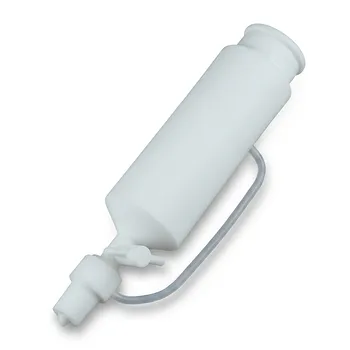
- Custom PTFE Constant Pressure Separatory Funnel 100ml Fluoropolymer Labware for Corrosive Chemical Transfer
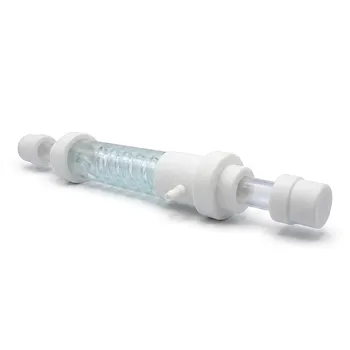
- Custom PTFE Condenser Tube 100ml Serpentine and Straight Fluoropolymer Laboratory Heat Exchanger with Flask Adapters
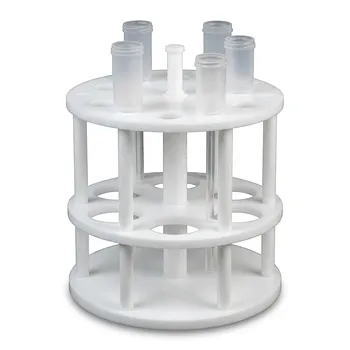
- Custom PFA Microcolumn Racks and PTFE Machined Low Background Corrosion Resistant Laboratory Fixtures
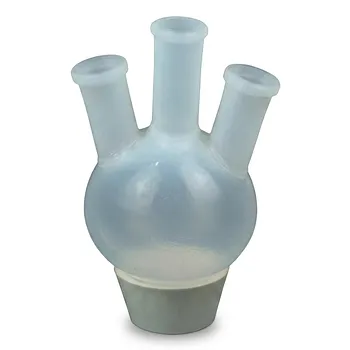
- Custom Corrosion Resistant PFA PTFE Multi Neck Laboratory Reaction Flask GL Standard Mouth Fluoropolymer Flasks
People Also Ask
- What are the key steps for structural integrity in molded PTFE lab reaction vessels? Master fine powder processing.
- What toxicological hazards and safe handling protocols must be established when PTFE fluoropolymer reaction vessels are subjected to pyrolysis temperatures? Learn essential safety measures now.
- When synthesizing TFVE monomers involving reactive organometallic reagents and aggressive polar solvents, what material performance characteristics are required? Ensure purity with PTFE/PFA.
- Why Are High-Purity Fluoropolymer Vessels and Tubing Critical for Trace Analysis? Prevent Contamination Reliably
- How does pressure management influence molar mass distribution and reaction rate in the iodine transfer emulsion polymerization of vinylidene fluoride, and how do custom fluoropolymer reaction vessels support this process?