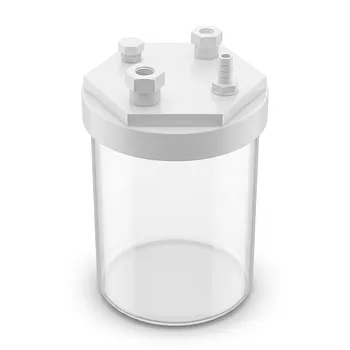
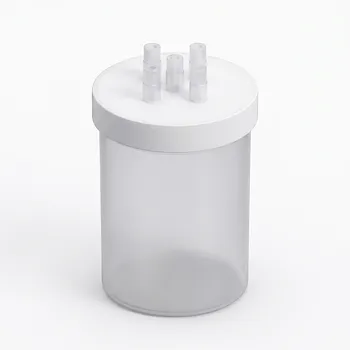
The material function of adding HFP or PAVE monomers is to disrupt PTFE’s highly regular crystalline structure. These comonomers reduce the rate and extent of recrystallization, lowering crystallinity and changing melt behavior so the resulting fluoropolymer can be processed into complex fluid-transfer and labware components. The modification can also increase flexibility and tune melt viscosity while preserving the core advantages of perfluorinated materials: broad chemical resistance, thermal stability, low surface energy, and negligible moisture absorption.
HFP and PAVE comonomers act as controlled structural disruptors: they trade a small amount of PTFE’s maximum crystallinity for improved processability, flexibility, and manufacturability without eliminating its exceptional chemical and thermal performance.
Why Pure PTFE Is Difficult to Manufacture
High crystallinity limits shaping
Pure PTFE has a highly ordered molecular structure and does not flow like a conventional thermoplastic when heated. It is generally processed through techniques such as compression molding, sintering, or specialized machining rather than ordinary melt injection molding.
This creates limitations when a component requires intricate internal passages, thin sections, integrated features, or economical high-volume production.
Recrystallization affects dimensional control
PTFE can recrystallize during cooling and subsequent thermal exposure. That behavior can complicate control of shrinkage, warpage, dimensional tolerances, and long-term part stability.
For precision fittings, valve components, tubing connections, and vessels, these effects matter because small dimensional changes can affect sealing, alignment, or fluid volume.
How HFP and PAVEs Change the Polymer
Comonomers interrupt molecular regularity
HFP and PAVEs introduce structural units that do not fit as efficiently into the regular PTFE chain arrangement. This interruption reduces the polymer’s tendency to form large, highly ordered crystalline regions.
The result is a modified fluoropolymer with a more manageable balance between crystallinity and amorphous content.
Crystallization becomes less dominant
By reducing the rate and extent of recrystallization, these modifiers improve the polymer’s ability to retain controlled dimensions during processing. They can also reduce the rigidity associated with a fully crystalline PTFE structure.
The exact effect depends on the comonomer type, concentration, molecular weight, and processing conditions.
Melt behavior becomes tunable
PAVE-modified fluoropolymers, such as PFA, can be formulated to melt-process through molding and extrusion. HFP-containing copolymers can similarly adjust flexibility, melt viscosity, and other physical characteristics.
This makes it possible to select a resin for a specific combination of geometry, operating temperature, flexibility, and chemical exposure.
What This Enables in Fluid Transfer and Labware
Complex molded components
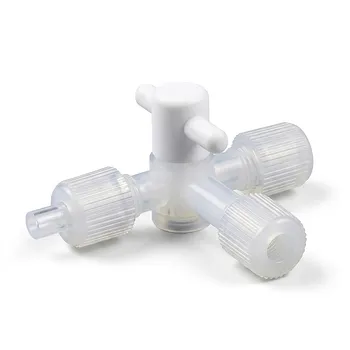
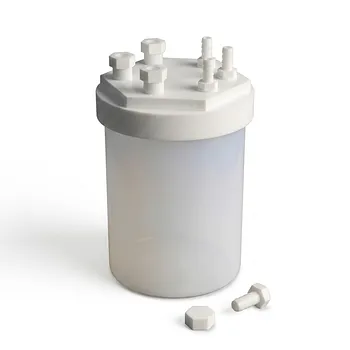
Melt-processable fluoropolymers can be molded into geometries that would be difficult or inefficient to produce from pure PTFE. Examples include customized valves, tubing fittings, manifolds, containers, and digestion vessels.
Molding can also provide more repeatable production of intricate features than relying exclusively on machining or sintering.
Precision-machined parts
Modified fluoropolymers can still be CNC-machined when a component requires custom dimensions, low production volume, or late-stage design changes. Their more controllable structure supports the manufacture of specialized laboratory components without abandoning the fluoropolymer material family.
Machining remains useful for prototypes, replacement parts, and highly customized fluid-handling assemblies.
Flexible tubing and sealing elements
Comonomer selection can influence flexibility and low-temperature behavior. This is important for tubing, valve seals, gaskets, and fittings that must accommodate movement, compression, or thermal cycling while maintaining leak resistance.
The material must still be matched to the pressure, temperature, and chemical environment because flexibility and sealing performance are formulation-dependent.
Reliable chemical containment
The modification is intended to improve manufacturing and physical performance while retaining the fundamental advantages of perfluoropolymers. These include resistance to aggressive chemicals, low adhesion, low surface energy, and minimal moisture uptake.
Those properties help reduce contamination, sample retention, and unwanted interaction with reagents in laboratory fluid-transfer systems.
The Role of Fluorine Content and Composition
Monomer ratios define the performance balance
The type and amount of comonomer influence melting behavior, flexibility, viscosity, crystallinity, and thermal response. They also contribute to the final balance between processability and chemical resistance.
Composition should therefore be treated as a design variable rather than a minor formulation detail.
Higher fluorine content generally favors resistance
In fluorinated olefinic polymers, higher fluorine content generally supports greater chemical resistance, thermal stability, flame resistance, and resistance to environmental exposure. It also tends to reduce surface adhesion and friction-related effects.
The trade-off is that maximizing fluorine content and crystallinity is not always compatible with easy melt processing or flexible part design.
Specialized comonomers serve different requirements
PAVEs can be selected to adjust processability and low-temperature performance. Other compositional changes, including TFE incorporation, can increase heat resistance and resistance to certain solvents, while some TFE/propylene formulations improve resistance to strong bases.
The correct material depends on the actual chemical and mechanical duty cycle, not simply on the presence of fluorine.
Understanding the Trade-offs
Processability is gained at the cost of some maximum performance
Pure PTFE generally represents the upper benchmark for chemical inertness and high-temperature capability. Adding comonomers can reduce crystallinity and improve manufacturing, but the modified resin may not match every property of an ideal PTFE homopolymer.
For most fluid-transfer applications, the practical gain is that the material can be formed into the required component reliably.
“Chemically inert” does not mean universally immune
Modified fluoropolymers retain exceptional broad-spectrum chemical resistance, but no material should be treated as immune to every chemical under every combination of temperature, concentration, pressure, and exposure time.
Compatibility testing remains necessary for aggressive reagents, permeating solvents, elevated temperatures, and long-duration service.
Small formulation changes can affect performance
Comonomer concentration, molecular weight, processing history, and end-group chemistry can alter melt viscosity, flexibility, sealing behavior, and dimensional stability. Two fluoropolymers with similar chemical names may therefore perform differently in a valve or tubing application.
Material selection should use the supplier’s grade-specific data rather than relying only on the polymer family name.
Mechanical design still matters
Fluoropolymers offer strong chemical and thermal endurance, but they are not selected solely for basic mechanical strength. Creep, compression set, pressure, wall thickness, temperature cycling, and dimensional tolerances must be evaluated for seals, fittings, and vessels.
A chemically compatible resin can still fail if the component is poorly designed for its mechanical loading.
Making the Right Choice for Your Goal
The practical decision is whether the component benefits more from maximum PTFE crystallinity or from controlled structural modification.
- If your primary focus is maximum chemical inertness and high-temperature endurance: Use a PTFE-based material when the geometry and manufacturing process can accommodate its non-melt-processable behavior.
- If your primary focus is complex molded geometry or efficient extrusion: Use a melt-processable modified fluoropolymer, such as a suitable PFA grade, and verify its grade-specific chemical and thermal limits.
- If your primary focus is flexible tubing or compliant sealing: Evaluate comonomer-modified formulations for flexibility, low-temperature performance, creep, and compression-set behavior.
- If your primary focus is precision custom labware: Compare melt processing with CNC machining, then select the formulation that provides the required dimensional stability and chemical compatibility.
HFP and PAVE modification makes fluoropolymers manufacturable in forms that better match the geometry and operating demands of real fluid-transfer and laboratory systems.
Summary Table:
| Aspect | Pure PTFE | Modified Fluoropolymers (PFA, FEP, etc.) |
|---|---|---|
| Crystallinity | High | Reduced |
| Processing Methods | Compression molding, sintering, machining | Melt processing (molding, extrusion), machining |
| Dimensional Control | Challenging due to recrystallization | Improved control |
| Flexibility | Limited | Enhanced |
| Chemical Resistance | Exceptional | Maintained (grade-dependent) |
| Thermal Stability | Excellent | Excellent (slightly reduced depending on comonomer) |
Optimize your fluid handling and labware with high-performance PTFE/PFA solutions from KINTEK. Our melt-processable fluoropolymers are ideal for complex geometries and demanding applications. Whether you need components with improved flexibility, precision-machined parts, or custom molded designs, our expertise in PTFE and PFA manufacturing ensures reliable performance and chemical resistance. Contact us today to discuss your specific requirements and benefit from our end-to-end CNC machining capabilities, from prototypes to high-volume orders.
Related Products
- High Purity PFA Chromatography Column with Collection Bottle Corrosion Resistant Fluoropolymer Filtration System for Trace Analysis
- Custom PTFE Flask 250ml High Purity Fluoropolymer Laboratory Vessel for Chemical Research
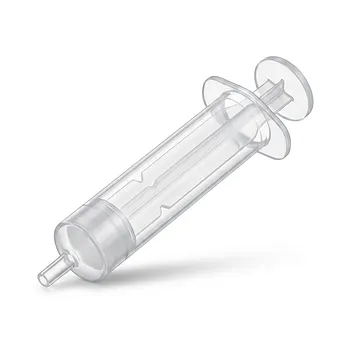
- Corrosion Resistant PFA Syringe Translucent Visual Fluoropolymer Labware 10ml Chemical Handling Tool
- Custom PTFE Reaction Tank Corrosion Resistant Fluoropolymer Chemical Processing Barrel 10L 20L 30L
- Custom PFA Tubing 1/4 Inch High Purity Corrosion Resistant Fluoropolymer Tube with Welding and Machining Services
People Also Ask
- What are the primary functional and temperature differences between PFA and FEP when selecting melt-processible fluoropolymers for custom laboratory apparatus?
- How does PPVE modify PTFE to make melt-processable PFA? Discover key benefits and applications.
- Why is the chemical stability of polymer endgroups critical when selecting melt-processible fluoropolymers like PFA for high-purity laboratory apparatus? Choose Stable Endgroups for Reliable Performance
- What are the characteristics of PFA material? A Guide to Its High-Performance Balance
- Why is Perfluoroalkoxy alkane (PFA) preferred over glass or stainless steel in pharmaceutical process development? Pure Yield