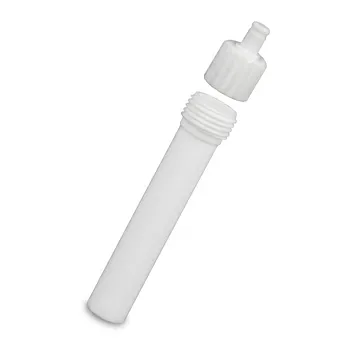
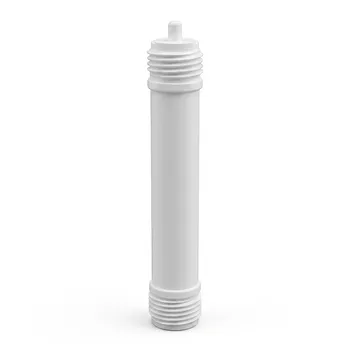
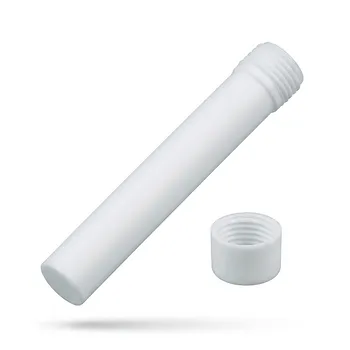
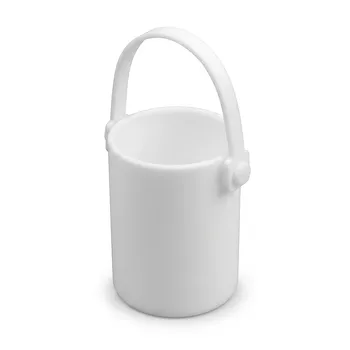
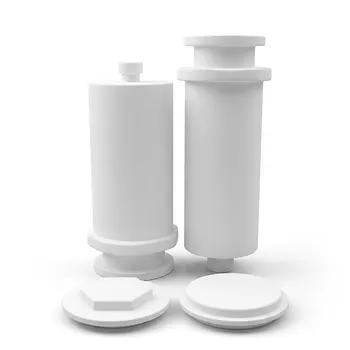
PTFE liners serve as the primary chemical barrier in hydrothermal carbonization (HTC). They isolate highly corrosive reaction environments from the structural stainless steel shell, ensuring both vessel longevity and the chemical purity of the resulting hydrochar. By resisting high temperatures and autogenous pressures, these liners enable the precise dehydration and decarboxylation of biomass in subcritical water.
Core Takeaway: A PTFE liner provides the chemical inertness necessary to withstand acidic reaction fluids and high-pressure conditions while preventing the stainless steel autoclave from contaminating the final carbon product with metallic ions.
The Essential Role of Chemical Inertness
Preventing Shell Corrosion
The primary function of the PTFE liner is to protect the outer stainless steel shell from corrosive reaction fluids. During HTC, biomass decomposition often releases organic acids or requires the addition of strong catalysts like sulfuric acid. Without the liner, these chemicals would cause pitting or stress corrosion cracking in the steel, compromising the vessel's structural integrity.
Ensuring Product Purity
PTFE prevents the leaching of metal ions—such as chromium, nickel, or iron—from the autoclave wall into the reaction mixture. This isolation is critical for producing high-purity hydrochar or nanomaterials where metallic contaminants could alter the desired surface functional groups or catalytic properties. The liner ensures that the chemical transformation remains a closed system, free from external inorganic interference.
Maintaining a Non-Stick Environment
The non-stick properties of PTFE facilitate uniform nucleation and growth of carbon structures and crystals. By preventing the reaction precursors from adhering to the vessel walls, the liner ensures a more consistent yield and simplifies the recovery of the solid products. This characteristic is particularly valuable when synthesizing materials on specific substrates like nickel foam.
Facilitating the HTC Reaction Environment
Sustaining Subcritical Water Conditions
The liner, when properly sealed within the autoclave, allows for the generation of autogenous pressure. This internal pressure is essential for keeping water in a liquid state at temperatures exceeding its boiling point (typically 150°C to 230°C). Under these subcritical conditions, water acts as both a solvent and a catalyst for the hydrothermal process.
Promoting Specific Chemical Pathways
By providing a stable, high-pressure environment, the PTFE-lined vessel enables the critical stages of carbonization: hydrolysis, dehydration, and decarboxylation. These reactions transform raw biomass into carbon-rich hydrochar. The thermal stability of the liner ensures these pathways can proceed uninterrupted at the constant temperatures required for polymerization.
Understanding the Trade-offs and Limitations
Thermal Limitations
While PTFE is exceptionally inert, it has a definite thermal ceiling, generally recommended not to exceed 230°C to 250°C in hydrothermal applications. At temperatures beyond this range, the material can undergo "cold flow" or thermal decomposition, leading to seal failure or the release of toxic vapors. For reactions requiring higher temperatures, more expensive materials like PPL (Polyphenylene polymers) or gold-lined vessels may be necessary.
Pressure Sensitivity and Seal Integrity
The liner itself does not provide structural strength; it relies entirely on the stainless steel shell to sustain the mechanical load of the autogenous pressure. If the liner is not perfectly fitted or if the heating rate is too aggressive, the differential expansion between the PTFE and the steel can cause the liner to deform. This deformation often leads to leaks, which can damage the outer vessel or cause the reaction to fail.
Making the Right Choice for Your Goal
- If your primary focus is high-purity carbon synthesis: Utilize a high-purity PTFE liner to eliminate the risk of metallic ion contamination from the autoclave walls.
- If your primary focus is processing highly acidic biomass: Ensure the PTFE liner is inspected for micro-cracks before use to prevent acid seepage that could compromise the stainless steel shell.
- If your primary focus is operating above 240°C: Avoid standard PTFE liners and instead transition to a PPL-lined vessel or a high-nickel alloy autoclave without a liner.
- If your primary focus is maximizing product yield: Leverage the non-stick surface of the PTFE to ensure all hydrochar can be easily recovered and that nucleation occurs in the bulk solution.
The strategic use of a PTFE liner bridges the gap between the mechanical requirements of high-pressure physics and the delicate requirements of high-purity carbon chemistry.
Summary Table:
| Function | Key Benefit | Detail |
|---|---|---|
| Chemical Barrier | Extends Vessel Life | Isolates steel shell from acidic reaction fluids and catalysts |
| Ion Isolation | Product Purity | Prevents leaching of metal ions (Cr, Ni, Fe) into the sample |
| Surface Property | Non-Stick Yield | Facilitates uniform nucleation and easy recovery of solid products |
| Pressure Control | Reaction Pathways | Sustains autogenous pressure for subcritical water conditions |
| Thermal Stability | Operating Range | Optimized for hydrothermal reactions between 150°C and 250°C |
Achieve Unmatched Purity in Your Hydrothermal Synthesis with KINTEK
Don't let metallic contamination or vessel corrosion compromise your research results. As a specialized manufacturer of high-performance fluoropolymer laboratory supplies, KINTEK provides the ultimate protection for your experimental integrity. From everyday basic labware like beakers, crucibles, and reagent bottles to precision fluid transfer components (tubing, fittings, and valves), we ensure your chemical environment remains inert and pure.
Our expertise extends to advanced reaction apparatus, including custom-machined PTFE liners, electrochemical cells, and microwave digestion vessels. Backed by end-to-end custom CNC fabrication, we are equipped to deliver everything from complex non-standard parts to high-volume orders, maintaining an absolute focus on high-performance materials like PTFE and PFA.
Ready to enhance your lab's efficiency and product quality? Contact us today to discuss your specific requirements!
References
- Arshitha Madhusudhan, Olivier Monfort. A comparative study of different activation methods for hydrochar: surface properties and removal of pharmaceutical pollutant in water. DOI: 10.1007/s11356-025-36706-8
This article is also based on technical information from Kintek Knowledge Base .
Related Products
- Custom TFM Reaction Vessel with Stainless Steel Jacket and PTFE Inner Cup for High Corrosion Resistance
- PTFE Lined High Pressure Digestion Vessel 50ml High Temperature Hydrothermal Synthesis Tank
- High Purity PTFE Microwave Digestion Vessel Replacement Liner for Acid Sample Preparation and Trace Analysis
- High Purity PTFE Microwave Digestion Vessel for Soil and Food Analysis Acid Resistant Fluoropolymer Sample Preparation Liners
- High Purity TFM Microwave Digestion Vessels PTFE Acid Evaporation Liners Domestic GT-400 Equivalent Laboratory Reaction Containers
People Also Ask
- Why are high-performance pressure-resistant reaction vessels required for oxygen-assisted hydrothermal conversion at 150 °C?
- Why are PTFE-lined reaction vessels necessary for forced degradation studies? Ensure high-purity results and accuracy.
- Why are high-quality fluoropolymer-lined reaction vessels required for alk-Ti3C2Tx MXene? Ensure Purity & HF Resistance
- How do magnetic stirring and reaction vessels impact MOF-derived carbon quality? Optimize Your Composite Performance
- Why is a high-purity PTFE lined reaction vessel required for the acidic etching of MXenes? Ensure Material Purity.