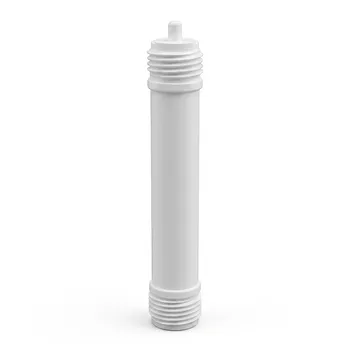
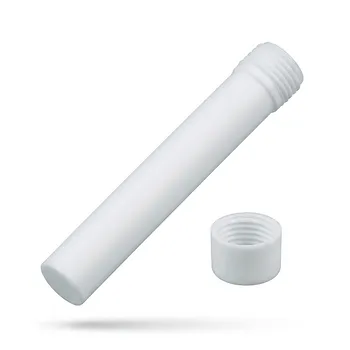
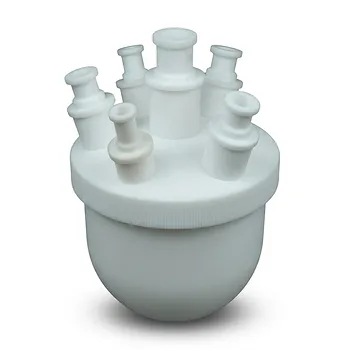
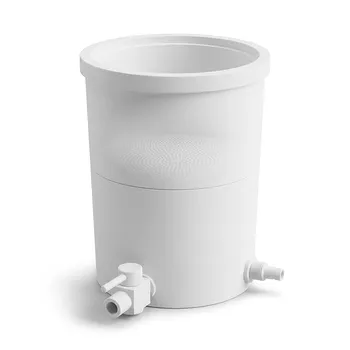
In the hydrothermal synthesis of Copper Bismuth Oxide ($\text{CuBi}_2\text{O}_4$), Polytetrafluoroethylene (PTFE) liners serve as a critical chemically inert barrier. These liners allow the reaction to proceed under extreme conditions—specifically high concentrations of nitric acid and sodium hydroxide—without corroding the reaction vessel or contaminating the final product.
Core Takeaway: The PTFE liner is the primary safeguard in $\text{CuBi}_2\text{O}_4$ synthesis, providing the chemical resistance necessary to handle aggressive reagents while ensuring high product purity by preventing metal ion leaching from the autoclave walls.
Chemical Resilience in Aggressive Environments
Resistance to Corrosive Reagents
The synthesis of $\text{CuBi}_2\text{O}_4$ often requires high concentrations of nitric acid ($\text{HNO}_3$) and sodium hydroxide ($\text{NaOH}$). PTFE is uniquely capable of resisting these strong acids and bases, which would otherwise destroy standard metal containers.
Stability Under High Temperature and Pressure
Hydrothermal processes operate at elevated temperatures, typically up to 220°C, and significant internal pressures. PTFE maintains its structural integrity and chemical inertness in these environments, providing a stable space for crystal growth.
Isolation from the Reactor Shell
The liner acts as a physical divider between the reaction medium and the stainless steel outer shell of the autoclave. This prevents the "aggressive media" from eroding the reactor body, significantly extending the service life of the equipment.
Ensuring Material Purity and Yield
Prevention of Metal Ion Leaching
Without a liner, the high-temperature reaction liquid would cause metal ion leaching from the reactor walls. The PTFE barrier ensures that impurities like iron or nickel do not interfere with the functional groups or the crystalline structure of the $\text{CuBi}_2\text{O}_4$.
Minimizing Precursor Adsorption
The smooth, non-stick surface of PTFE reduces the likelihood of precursors sticking to the vessel walls. This ensures that the reactants remain in the solution where they can fully convert into the target product.
Facile Sample Recovery
The non-stick properties of the liner are essential for the complete recovery of the synthesized powder. After the reaction is complete, the $\text{CuBi}_2\text{O}_4$ can be easily removed, and the liner can be cleaned without leaving significant residue.
Understanding the Trade-offs
Temperature Thresholds
While PTFE is highly versatile, it has a strict thermal limit, generally around 220°C. Exceeding this temperature can cause the liner to deform or "creep," potentially compromising the seal and damaging the autoclave.
Pressure Sensitivity
PTFE is a relatively soft material compared to the metal shell; it relies on the outer reactor for mechanical support. If the pressure exceeds the design limits of the vessel, the liner can fail, leading to hazardous leaks of corrosive reagents.
Material Choice Variations
For reactions requiring even higher temperatures, researchers must sometimes switch from PTFE to Para-polyphenylene (PPL) liners. While PPL offers higher thermal stability, it may not always match the universal chemical non-stick properties of high-purity PTFE.
How to Apply This to Your Project
Making the Right Choice for Your Goal
- If your primary focus is high-purity $\text{CuBi}_2\text{O}_4$: Use high-purity PTFE liners to eliminate metal ion contamination and ensure the purity of the material's surface functional groups.
- If your primary focus is maximizing product yield: Leverage the non-stick surface of PTFE to ensure all precursors are converted and that the final product is easily recovered from the vessel.
- If your primary focus is equipment longevity: Always inspect the PTFE liner for thinning or deformation to prevent corrosive acids from reaching and damaging the stainless steel autoclave shell.
The PTFE liner is not merely a container, but a fundamental tool that enables the controlled, pure, and safe synthesis of complex oxides like Copper Bismuth Oxide.
Summary Table:
| Key Function | Primary Benefit | Technical Detail |
|---|---|---|
| Chemical Inertness | Resists HNO₃ and NaOH | Prevents vessel corrosion |
| Contamination Control | No metal ion leaching | Ensures high-purity crystals |
| Non-Stick Surface | Complete product recovery | Minimizes precursor loss |
| Thermal Stability | Safe hydrothermal reaction | Stable operation up to 220°C |
Elevate Your Material Synthesis with KINTEK’s Precision Fluoropolymers
Maximize the purity and yield of your complex oxide synthesis with high-performance laboratory solutions. At KINTEK, we specialize in the absolute focus of high-performance fluoropolymer materials, providing the reliability your research demands.
From essential PTFE and PFA labware (beakers, crucibles, and digestion tubes) to specialized hydrothermal synthesis liners and microwave digestion vessels, our products are designed to withstand the most aggressive chemical environments. Whether you need standard consumables like stirring bars and O-rings or advanced custom CNC-fabricated components such as electrochemical cells and bespoke fluid transfer systems, we deliver everything from one-off prototypes to high-volume orders.
Ready to optimize your lab setup? Contact us today to discuss how our custom-machined PFA/PTFE solutions can support your next breakthrough.
References
- Saifullahi Shehu Imam. Copper bismuth oxide (CuBi2O4): Synthesis, properties and potential applications. DOI: 10.61186/jcc.7.1.1
This article is also based on technical information from Kintek Knowledge Base .
Related Products
- PTFE Lined High Pressure Digestion Vessel 50ml High Temperature Hydrothermal Synthesis Tank
- High Pressure Custom TFM Reactor Stainless Steel Outer Vessel PTFE Inner Cup for Corrosive Synthesis
- Custom TFM Reaction Vessel with Stainless Steel Jacket and PTFE Inner Cup for High Corrosion Resistance
- High Purity PTFE Microwave Digestion Vessel for Soil and Food Analysis Acid Resistant Fluoropolymer Sample Preparation Liners
- High Purity TFM Microwave Digestion Vessels PTFE Acid Evaporation Liners Domestic GT-400 Equivalent Laboratory Reaction Containers
People Also Ask
- What are the benefits of using a PTFE-lined vessel for carbon-sulfur cathode treatment? Maximize Purity & Performance
- Why are PTFE-lined pressure digestion vessels required for the preparation of Ag/CeO2 catalysts? Purity & Performance
- What safety features are typically incorporated into high-pressure PTFE digestion vessel designs? Ensure Lab Safety
- What is the function of PTFE lined high-pressure vessels in g-C3N4 synthesis? Achieve High-Purity Material Growth
- Role of High-Pressure Digestion Tanks in Perovskite Synthesis: Achieve Superior Stability and Latent Heat