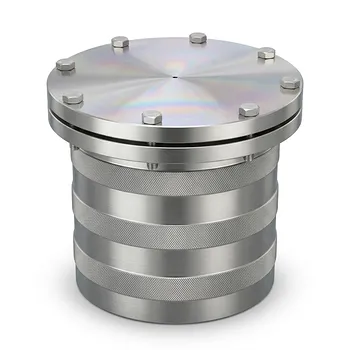
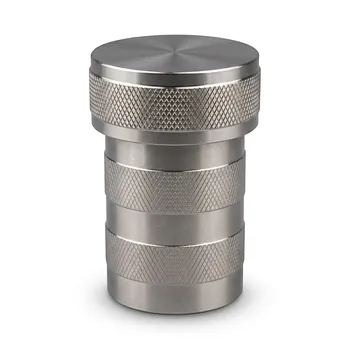
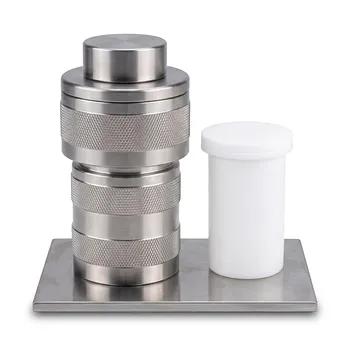
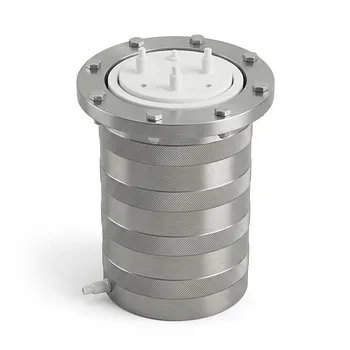
The stainless steel high-pressure autoclave serves as the reaction vessel that provides the critical hydrothermal environment necessary for synthesis. In the conversion of Siam plant extract to carbon quantum dots (CQDs), it maintains a sealed, high-temperature (240°C) and high-pressure state for 12 hours to induce thermochemical carbonization. This specialized equipment ensures that organic molecules from the extract undergo the specific nucleation and growth phases required to form stable nanoparticles.
Core Takeaway: The autoclave acts as a high-strength pressure cooker that forces organic precursors into a carbonized state. Its primary function is to provide the mechanical integrity and chemical isolation needed to transform raw plant extracts into high-purity carbon quantum dots.
Creating the Hydrothermal Environment
Achieving Critical Temperature and Pressure
The conversion process requires a temperature of 240°C, which is well above the boiling point of standard solvents at atmospheric pressure. The sealed environment of the autoclave allows for the generation of autogenous pressure, which keeps the reaction medium in a liquid or supercritical state.
Ensuring Reaction Stability Over Time
The synthesis of CQDs from Siam plant extract is a slow process that requires a consistent environment for 12 hours. The robust construction of the stainless steel outer shell provides the thermal mass and mechanical strength to maintain these conditions without fluctuations or safety failures.
Facilitating the Chemical Transformation
Inducing Thermochemical Carbonization
Under high-pressure and high-temperature conditions, the organic compounds within the Siam plant extract begin to break down. The autoclave facilitates thermochemical carbonization, where complex organic chains are reduced into carbon-rich frameworks.
Governing Nucleation and Growth
Once carbonization begins, the controlled environment of the autoclave allows for nucleation, where carbon atoms begin to cluster. The sustained pressure ensures these clusters grow uniformly into quantum dots rather than precipitating as bulk carbon or soot.
The Vital Role of the PTFE Liner
Preventing Metallic Contamination
Most high-pressure autoclaves utilize a Polytetrafluoroethylene (PTFE) liner inside the steel shell. This liner is chemically inert, preventing the reaction medium from coming into contact with the metal walls and ensuring the final CQDs are free from iron or chromium impurities.
Resisting Chemical Corrosion
Siam plant extracts and potential additives (like ammonia or alkaline solutions) can be corrosive at high temperatures. The PTFE liner protects the structural integrity of the stainless steel shell from being compromised by these aggressive chemical environments.
Improving Product Recovery
The extremely smooth, non-stick surface of the PTFE liner prevents the synthesized carbon quantum dots from adhering to the walls. This facilitates the efficient collection of the liquid-dispersed CQDs once the reaction is complete and the vessel has cooled.
Understanding the Trade-offs and Risks
Temperature and Pressure Limitations
While stainless steel is strong, the PTFE liner has a maximum operating temperature (typically around 250°C). Exceeding these limits can cause the liner to soften or deform, leading to leaks or permanent damage to the autoclave.
Maintenance and Seal Integrity
The effectiveness of the autoclave depends entirely on its ability to maintain a seal. Wear and tear on the gaskets or improper tightening can lead to pressure loss, which halts the carbonization process and results in an incomplete or failed synthesis.
How to Optimize Your Synthesis Results
To achieve the highest quality carbon quantum dots from Siam plant extracts, you must choose the right operational parameters for your equipment.
- If your primary focus is product purity: Ensure the use of a clean, unscratched PTFE liner to prevent the leaching of metal ions from the steel shell into your extract.
- If your primary focus is high yield: Maintain the reaction at the full 240°C for the entire 12-hour duration to ensure complete carbonization of the organic precursors.
- If your primary focus is experimental safety: Never fill the autoclave liner beyond 80% capacity to allow sufficient "headspace" for gas expansion during the heating process.
The autoclave is the essential engine of hydrothermal synthesis, transforming raw botanical extracts into advanced functional nanomaterials through controlled physical force.
Summary Table:
| Component | Primary Function | Key Benefit |
|---|---|---|
| Stainless Steel Shell | High-pressure containment | Ensures structural integrity at 240°C and autogenous pressure. |
| PTFE Liner | Chemical isolation | Prevents metal contamination (Fe/Cr) and provides a non-stick surface. |
| Hydrothermal Environment | Thermochemical carbonization | Facilitates organic breakdown and controlled nucleation of nanoparticles. |
| Sealing Mechanism | Maintaining isolation | Prevents pressure loss to ensure complete conversion over 12 hours. |
Elevate Your Synthesis Precision with KINTEK
Achieving high-purity carbon quantum dots requires equipment that can withstand rigorous hydrothermal conditions without compromising sample integrity. KINTEK specializes in high-performance fluoropolymer solutions designed for the most demanding laboratory environments.
From everyday basic labware like beakers, crucibles, and reagent bottles to advanced reaction apparatus including hydrothermal synthesis liners, microwave digestion vessels, and custom electrochemical cells, we manufacture virtually all laboratory supplies from premium PTFE and PFA.
Whether you need standard consumables (stirring bars, O-rings, gaskets) or bespoke CNC-fabricated components tailored to your specific research setup, KINTEK provides end-to-end solutions with an absolute focus on material purity and durability.
Ready to upgrade your lab's performance? Contact us today to discuss your custom requirements!
References
- Khadijat Kuburat Babalola, Yekinni Kolawole Sanusi. Enhancing organic solar cell efficiency through green synthesis of carbon quantum dots from siam plant extracts. DOI: 10.4314/dujopas.v11i3b.15
This article is also based on technical information from Kintek Knowledge Base .
Related Products
- Custom TFM Reaction Vessel with Stainless Steel Jacket and PTFE Inner Cup for High Corrosion Resistance
- High Temperature Corrosion Resistant Hydrothermal Synthesis Reactor with TFM Inner Liner and Straight Cylinder Design
- PTFE Lined High Pressure Digestion Vessel 50ml High Temperature Hydrothermal Synthesis Tank
- High Pressure Custom TFM Reactor Stainless Steel Outer Vessel PTFE Inner Cup for Corrosive Synthesis
- High Pressure PTFE Digestion Vessel Inner Cup Holder Custom Corrosion Resistant Low Background Teflon
People Also Ask
- Why are high-performance pressure-resistant reaction vessels required for oxygen-assisted hydrothermal conversion at 150 °C?
- How do magnetic stirring and reaction vessels impact MOF-derived carbon quality? Optimize Your Composite Performance
- Why are high-quality fluoropolymer-lined reaction vessels required for alk-Ti3C2Tx MXene? Ensure Purity & HF Resistance
- Why are PTFE-lined reaction vessels necessary for forced degradation studies? Ensure high-purity results and accuracy.
- Why is a high-purity PTFE lined reaction vessel required for the acidic etching of MXenes? Ensure Material Purity.