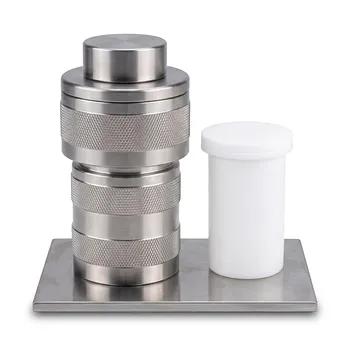
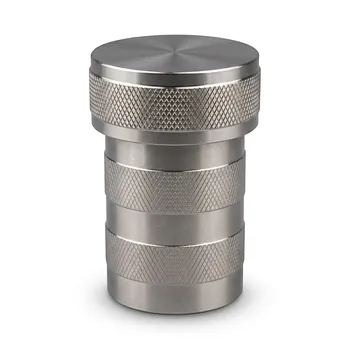
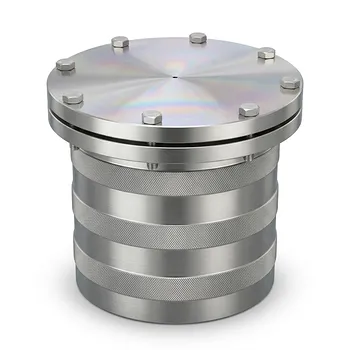
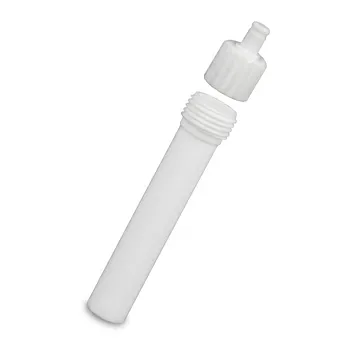
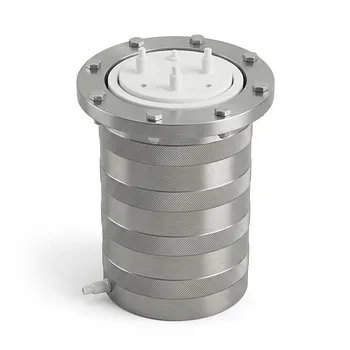
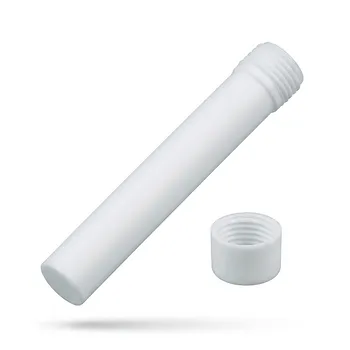
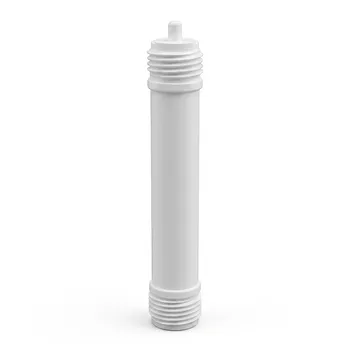
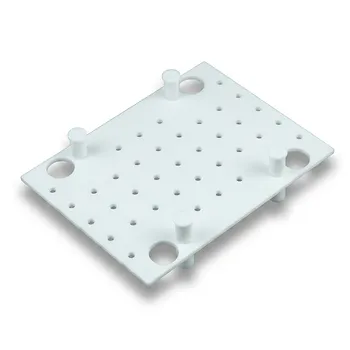
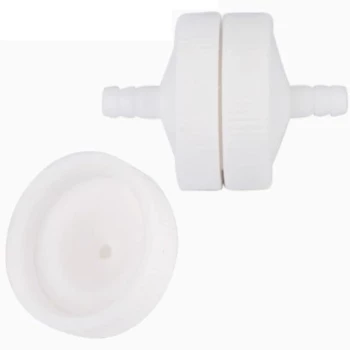
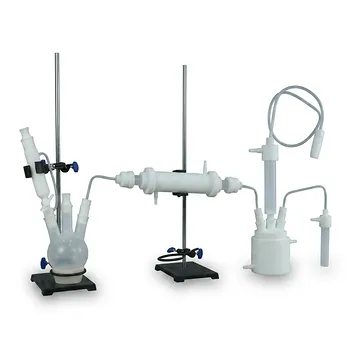
The PTFE liner acts as a chemically inert reaction vessel that enables high-pressure synthesis while protecting the sample from metallic contamination. During the 12-hour preparation of $CeO_2-CuO-Mn_3O_4@rGO$ nanocomposites at 170°C, the liner prevents the corrosive reaction mixture from attacking the stainless steel autoclave walls. This ensures that the nanoparticles anchor uniformly onto the reduced graphene oxide (rGO) sheets without the interference of unintended metal ions.
Core Takeaway: The PTFE liner provides a sealed, corrosion-resistant environment that facilitates the high-pressure kinetics required for nanoparticle growth while maintaining the high chemical purity essential for composite material performance.
Maintaining Chemical Purity and Structural Integrity
Corrosion Resistance in Harsh Environments
The synthesis of $CeO_2-CuO-Mn_3O_4$ often involves strong alkaline or oxidative conditions that would rapidly degrade standard metals. PTFE (Polytetrafluoroethylene) is exceptionally resistant to these chemicals, providing a stable barrier that does not participate in the reaction.
Prevention of Metallic Contamination
If the reaction solution were in direct contact with the stainless steel autoclave, iron, chromium, or nickel ions could leach into the mixture. The PTFE liner eliminates this risk, ensuring that the final nanocomposite maintains its specific stoichiometric ratio and electronic properties.
Protection of the Autoclave Body
High-temperature hydrothermal fluids can cause stress corrosion cracking or pitting in the metal autoclave shell. By containing the reaction, the liner preserves the structural integrity and longevity of the expensive high-pressure hardware.
Enabling High-Pressure Reaction Kinetics
Achieving Subcritical Solvent States
At 170°C, the water inside the sealed liner generates autogenous pressure, reaching a subcritical state where its properties as a solvent change. This environment increases the solubility of precursors and enhances the reactivity of the cerium, copper, and manganese molecules.
Facilitating Uniform Nanoparticle Anchoring
The high-pressure environment driven by the sealed liner is critical for the in situ deposition of metal oxides onto the rGO surface. This pressure forces the precursors into the functional groups of the graphene sheets, leading to robust, uniform anchoring rather than random precipitation.
Morphology and Phase Control
The stability of the PTFE environment allows for precise control over the dissolution-recrystallization process. This ensures that the $CeO_2$, $CuO$, and $Mn_3O_4$ phases develop their intended crystalline structures and morphologies consistently over the 12-hour duration.
Understanding the Trade-offs
Temperature Limitations
While PTFE is excellent for many applications, it begins to soften and undergo "creep" as temperatures approach 250°C. For reactions requiring temperatures higher than 200°C, specialized materials like PPL (para-polyphenylene) are often required to prevent liner deformation.
Thermal Expansion Disparity
PTFE has a significantly higher coefficient of thermal expansion than the stainless steel that surrounds it. If the autoclave is cooled too rapidly, the liner can contract at a different rate, potentially leading to vacuum-sealing issues or mechanical failure of the liner walls.
Porosity and Absorption
Despite its inertness, PTFE is slightly porous at a microscopic level and can absorb certain organic precursors or small ions. This can lead to cross-contamination between different synthesis batches if the liners are not subjected to rigorous acid-washing protocols.
Making the Right Choice for Your Goal
How to Apply This to Your Project
When utilizing hydrothermal synthesis for complex nanocomposites, your choice of liner and operating parameters will dictate the quality of your material.
- If your primary focus is maximum chemical purity: Always use a fresh or rigorously acid-cleaned PTFE liner to ensure no trace metals or previous reaction residues interfere with the nanoparticle anchoring.
- If your primary focus is specific crystalline morphology: Ensure the liner is perfectly sealed to maintain the autogenous pressure required for the dissolution-recrystallization process.
- If your primary focus is long-term equipment safety: Never exceed the 200°C-220°C safety limit of PTFE, as liner failure can lead to catastrophic corrosion of the stainless steel pressure vessel.
The PTFE liner is not merely a container, but a critical tool that defines the chemical environment necessary for advanced material synthesis.
Summary Table:
| Feature | Function in Synthesis | Benefit |
|---|---|---|
| Chemical Inertness | Prevents reaction with corrosive precursors | Eliminates metallic ion contamination (Fe, Cr, Ni) |
| Corrosion Resistance | Protects stainless steel autoclave walls | Extends hardware lifespan and maintains safety |
| Pressure Containment | Facilitates autogenous pressure at 170°C | Enhances solubility and uniform nanoparticle anchoring |
| Morphology Control | Stabilizes dissolution-recrystallization | Ensures consistent crystalline phases and structures |
Elevate Your Material Synthesis with KINTEK Precision
Don't let metallic contamination or liner failure compromise your research. KINTEK provides high-performance fluoropolymer solutions tailored for the most demanding laboratory environments. From standard PTFE and PFA liners for hydrothermal synthesis to custom CNC-fabricated reaction vessels, we offer the chemical resistance and thermal stability your nanocomposite projects require.
Our extensive range includes:
- Laboratory Basics: Beakers, crucibles, and reagent bottles.
- Fluid Transfer: High-purity tubing, fittings, and valves.
- Advanced Apparatus: Custom electrochemical cells and microwave digestion vessels.
- Bespoke Fabrication: Non-standard machined parts to fit your unique autoclave specifications.
Ensure absolute chemical purity and structural integrity in every batch. Contact KINTEK today for a consultation or quote and let us deliver the high-performance laboratory supplies you need.
References
- Sahar Jafari, Zohreh Shaghaghi. Engineering active sites in ternary CeO2-CuO-Mn3O4 heterointerface embedded in reduced graphene oxide for boosting water splitting activity. DOI: 10.1038/s41598-025-87423-8
This article is also based on technical information from Kintek Knowledge Base .
Related Products
- PTFE Lined High Pressure Digestion Vessel 50ml High Temperature Hydrothermal Synthesis Tank
- High Temperature Corrosion Resistant Hydrothermal Synthesis Reactor with TFM Inner Liner and Straight Cylinder Design
- Custom TFM Reaction Vessel with Stainless Steel Jacket and PTFE Inner Cup for High Corrosion Resistance
- High Purity PTFE Microwave Digestion Vessel Replacement Liner for Acid Sample Preparation and Trace Analysis
- High Pressure Custom TFM Reactor Stainless Steel Outer Vessel PTFE Inner Cup for Corrosive Synthesis
People Also Ask
- What are the benefits of using a PTFE-lined vessel for carbon-sulfur cathode treatment? Maximize Purity & Performance
- Why are PTFE-lined pressure digestion vessels required for the preparation of Ag/CeO2 catalysts? Purity & Performance
- What safety features are typically incorporated into high-pressure PTFE digestion vessel designs? Ensure Lab Safety
- What is the function of PTFE lined high-pressure vessels in g-C3N4 synthesis? Achieve High-Purity Material Growth
- Role of High-Pressure Digestion Tanks in Perovskite Synthesis: Achieve Superior Stability and Latent Heat