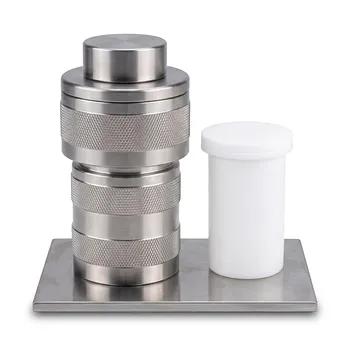
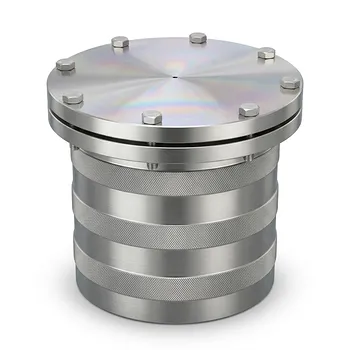
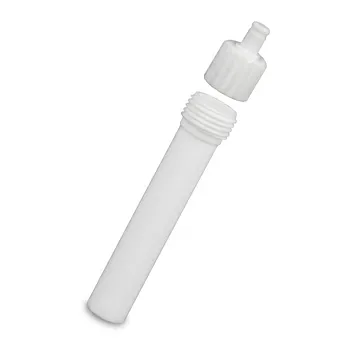
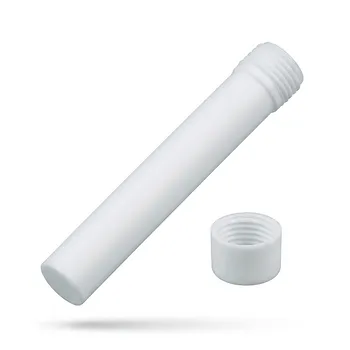
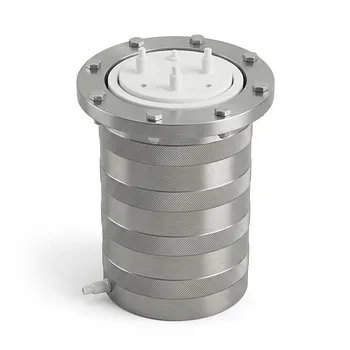
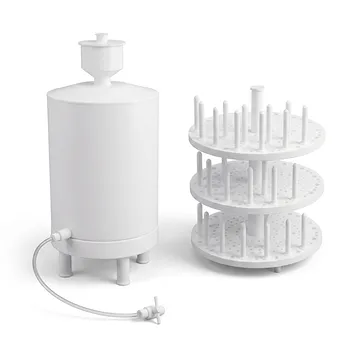
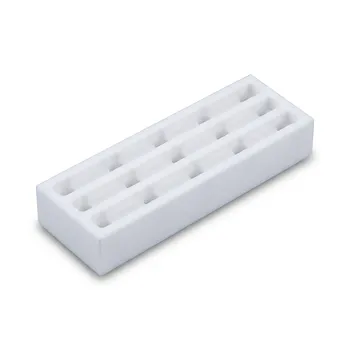
The dual-component design of a PTFE-lined autoclave serves as the critical reaction vessel for creating high-purity magnetite nanoparticles. It functions by providing a high-pressure, high-temperature (HPHT) environment that facilitates the crystallization of $\text{Fe}_3\text{O}_4$ while simultaneously isolating the chemical reaction from the metal walls of the container. This setup ensures that the resulting nanoparticles are both chemically pure and structurally uniform.
This specialized autoclave acts as a high-pressure reactor that uses a stainless steel shell for mechanical strength and a PTFE liner for chemical inertness. This combination allows for the controlled growth of nanocrystals under autogenous pressure while preventing metallic contamination that would otherwise degrade the nanoparticles' magnetic properties.
Facilitating the Hydrothermal Environment
The primary role of the autoclave is to create conditions that are impossible to achieve in an open system.
Generation of Autogenous Pressure
In a sealed autoclave, heating a liquid precursor beyond its boiling point generates autogenous pressure. This pressure is the physical catalyst that drives the nucleation and growth of nanocrystals, allowing for the formation of high-crystallinity, single-phase products that cannot be produced at standard atmospheric pressure.
Temperature Stability and Kinetic Control
The stainless steel outer shell provides the mechanical integrity required to safely withstand internal pressures at temperatures typically ranging from 170°C to 220°C. This stable thermal environment allows for precise control over the reaction kinetics, which is essential for achieving a consistent morphology and size distribution in $\text{Fe}_3\text{O}_4$ particles.
Chemical Isolation and Product Purity
While the steel provides the strength, the PTFE (Polytetrafluoroethylene) liner is responsible for the chemical integrity of the synthesis.
Exceptional Corrosion Resistance
Hydrothermal synthesis often involves aggressive reagents, such as sodium hydroxide (NaOH) or ethylene glycol. The PTFE liner is chemically inert, preventing these corrosive solutions from eroding the stainless steel shell and ensuring the structural longevity of the autoclave.
Prevention of Lattice Contamination
Without the liner, metal ions from the stainless steel (such as Chromium or Nickel) could leach into the reaction and integrate into the $\text{Fe}_3\text{O}_4$ crystal lattice. By providing a complete barrier, the PTFE liner ensures that the magnetic response performance remains high and the final product is free of metallic impurities.
Anti-Adhesive Properties
PTFE is naturally anti-adhesive, which prevents the precursor materials and the resulting nanoparticles from sticking to the vessel walls. This property not only simplifies the recovery of the synthesized powder but also prevents the "seeding" of inconsistent crystal growths on the container surface.
Understanding the Trade-offs
While highly effective, the PTFE-lined autoclave system has specific physical limitations that researchers must manage.
Temperature Thresholds
The primary limitation of PTFE is its thermal stability; it begins to soften and can release toxic fumes or deform if temperatures exceed 250°C to 260°C. For reactions requiring higher temperatures, researchers must switch to alternative liners like PPL (Para-polyphenylene) or use unlined specialty alloys.
Mechanical Fatigue and Scaling
The stainless steel shell is subject to mechanical fatigue over repeated heating and cooling cycles. Additionally, because these are batch processes, scaling up production requires significantly larger, more expensive pressure vessels, making it more difficult to maintain uniform heat distribution throughout the larger volume.
Applying This to Your Synthesis Goals
Choosing the right autoclave configuration depends on the specific requirements of your magnetic nanoparticle project.
- If your primary focus is Maximum Magnetic Saturation: Prioritize a high-purity PTFE liner to ensure zero metal-ion leaching, as even trace impurities can disrupt the magnetic domain alignment in $\text{Fe}_3\text{O}_4$.
- If your primary focus is Rapid Crystal Growth: Ensure the autoclave is filled to the correct "fill-ratio" (usually 60-80%) to optimize the generation of autogenous pressure, which accelerates the crystallization process.
- If your primary focus is High-Temperature Stability (>250°C): Move away from standard PTFE liners and consider PPL liners or specialized high-nickel alloy reactors that can withstand extreme thermal stress without deforming.
By balancing the mechanical strength of the steel with the chemical protection of the PTFE, you create the ideal "pressure cooker" for high-performance nanomaterials.
Summary Table:
| Component/Feature | Primary Function | Key Benefit for Fe3O4 Synthesis |
|---|---|---|
| Stainless Steel Shell | Mechanical Integrity | Safely contains high autogenous pressure at 170°C–220°C. |
| PTFE Liner | Chemical Isolation | Prevents metallic leaching (Cr/Ni) into the crystal lattice. |
| Sealed Design | Pressure Generation | Drives nucleation and growth of high-crystallinity nanoparticles. |
| Inert Surface | Corrosion Resistance | Protects the vessel from aggressive reagents like NaOH. |
| Anti-Adhesive Property | Surface Release | Simplifies powder recovery and prevents inconsistent seeding. |
Elevate Your Research with KINTEK’s Precision Fluoropolymer Solutions
Achieving high-purity results in hydrothermal synthesis requires equipment that stands up to aggressive chemistry without compromise. KINTEK specializes in high-performance fluoropolymer manufacturing, offering an exhaustive range of laboratory supplies crafted from premium PTFE and PFA.
From everyday basic labware like beakers, crucibles, and reagent bottles to specialized hydrothermal synthesis liners, microwave digestion vessels, and custom electrochemical cells, we ensure your experiments are free from metallic contamination. Whether you need standard consumables like stirring bars and O-rings or complex, bespoke CNC-machined components for advanced reaction apparatus, KINTEK delivers end-to-end solutions tailored to your specific research goals.
Ready to optimize your lab’s performance? Contact us today to discuss your custom fabrication needs or high-volume orders with our materials experts.
References
- G.J. Dau, Thi Ngoc Lien Truong. Electrochemical Sensing of Lead Ions Using Ionophore-Modified Raspberry-like Fe3O4–Au Nanostructures via Differential Pulse Voltammetry. DOI: 10.3390/polym17223015
This article is also based on technical information from Kintek Knowledge Base .
Related Products
- PTFE Lined High Pressure Digestion Vessel 50ml High Temperature Hydrothermal Synthesis Tank
- Custom TFM Reaction Vessel with Stainless Steel Jacket and PTFE Inner Cup for High Corrosion Resistance
- High Purity PTFE Microwave Digestion Vessel Replacement Liner for Acid Sample Preparation and Trace Analysis
- High Purity TFM Microwave Digestion Vessels PTFE Acid Evaporation Liners Domestic GT-400 Equivalent Laboratory Reaction Containers
- High Pressure Custom TFM Reactor Stainless Steel Outer Vessel PTFE Inner Cup for Corrosive Synthesis
People Also Ask
- What are the benefits of using a PTFE-lined vessel for carbon-sulfur cathode treatment? Maximize Purity & Performance
- Why are PTFE-lined pressure digestion vessels required for the preparation of Ag/CeO2 catalysts? Purity & Performance
- What safety features are typically incorporated into high-pressure PTFE digestion vessel designs? Ensure Lab Safety
- What is the function of PTFE lined high-pressure vessels in g-C3N4 synthesis? Achieve High-Purity Material Growth
- Role of High-Pressure Digestion Tanks in Perovskite Synthesis: Achieve Superior Stability and Latent Heat