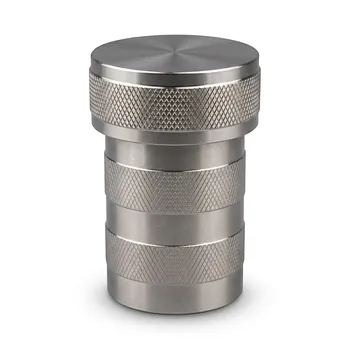
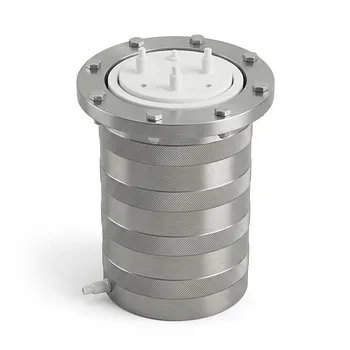
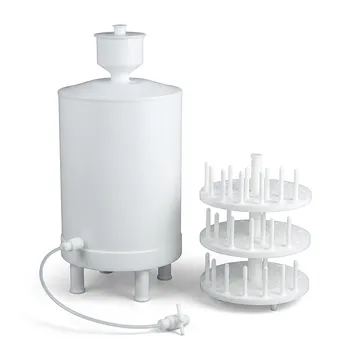
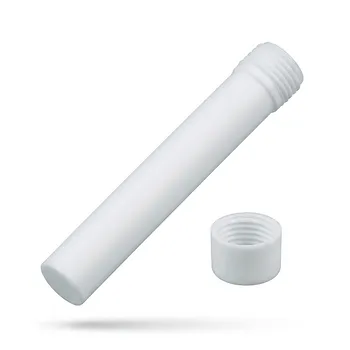
The PTFE-lined hydrothermal synthesis autoclave acts as a pressurized, chemically inert reactor that facilitates the controlled crystallization of copper(I) oxide ($Cu_2O$) nanoparticles. By maintaining solvents in a subcritical liquid state at temperatures well above their atmospheric boiling points, the autoclave creates the necessary supersaturation levels for the nucleation of high-purity, regularly shaped nanocubes.
Core Takeaway: The autoclave provides a dual-function environment: the stainless steel shell maintains the high pressures required for subcritical crystal growth, while the PTFE liner ensures chemical purity by preventing corrosive reactions between the reagents and the vessel walls.
The Role of the High-Pressure Environment
Facilitating Subcritical Conditions
In $Cu_2O$ synthesis, the sealed nature of the autoclave allows organic solvents, such as ethylene glycol, to remain in a liquid state even when heated beyond their normal boiling points. These subcritical conditions significantly enhance the solubility and reactivity of the copper precursors.
Driving Nucleation and Crystal Growth
The high-pressure environment creates a supersaturated state within the solution, which is the primary driver for the slow, uniform growth of crystals. This process is essential for achieving the anisotropic growth required to produce specific structures like nanowires or cubic nanoparticles.
The Chemical Shield: Why PTFE is Essential
Preventing Metallic Contamination
The PTFE (polytetrafluoroethylene) liner is chosen for its exceptional chemical inertness, which prevents the reaction solution from coming into contact with the stainless steel outer shell. This isolation ensures that no metal ions leach from the autoclave walls into the sample, maintaining the high chemical purity of the $Cu_2O$.
Resistance to Corrosive Reagents
Many synthesis protocols involve organic solvents or strong alkaline conditions (such as the hydrolysis of HMT to release ammonia). PTFE effectively resists corrosion from these substances at high temperatures, preventing secondary reactions that could alter the chemical composition of the nanoparticles.
Easy Product Recovery
The non-stick properties of the PTFE material prevent the synthesized $Cu_2O$ nanoparticles from adhering to the vessel walls. This characteristic is vital for maximizing the yield and ensuring that the final product is easily collected after the reaction is complete.
Achieving Structural and Morphological Precision
Controlling Morphology
The stable temperature and pressure conditions provided by the autoclave allow the nanoparticles to develop a regular cubic morphology. By strictly adhering to established process parameters within this closed system, researchers can ensure consistent particle size and shape.
Enabling Long-Duration Reactions
Hydrothermal synthesis often requires extended reaction times, sometimes up to 12 hours or more, to achieve full crystallization. The autoclave's ability to maintain a constant temperature (e.g., 170°C) over long periods is critical for the uniform anchoring of nanoparticles onto substrates like reduced graphene oxide (rGO).
Understanding the Trade-offs and Limitations
Thermal and Pressure Constraints
While PTFE is highly inert, it has a functional temperature limit, typically around 220°C to 250°C. Exceeding these limits can cause the liner to deform or release toxic vapors, meaning the autoclave must be monitored closely to stay within safe operating parameters.
Heat Transfer Delays
The thick walls of the stainless steel shell and the insulating properties of the PTFE liner create a thermal lag. The temperature inside the reaction chamber may take significant time to reach the setpoint of the external oven, which must be accounted for in the reaction timing.
Safety Risks of Sealed Vessels
Operating at high pressures carries inherent risks; if the reaction generates unexpected gases or if the temperature exceeds safety limits, the vessel could fail. It is critical to never fill the liner beyond 60-80% of its capacity to allow for liquid expansion and vapor space.
How to Apply This to Your Project
Making the Right Choice for Your Goal
- If your primary focus is high chemical purity: Ensure the PTFE liner is thoroughly cleaned with acid between runs to prevent cross-contamination of metal ions.
- If your primary focus is specific particle morphology: Maintain strict control over the "fill degree" of the autoclave, as the internal pressure is directly influenced by the volume of the liquid in the sealed space.
- If your primary focus is scaling up production: Account for the thermal lag of the autoclave by using an internal thermocouple or extending the dwell time to ensure the reagents reach the target temperature.
The PTFE-lined autoclave is an indispensable tool that transforms volatile precursors into high-quality $Cu_2O$ nanocrystals through the precise management of chemical isolation and subcritical thermodynamics.
Summary Table:
| Component | Role | Key Benefit |
|---|---|---|
| Stainless Steel Shell | Pressure Containment | Maintains subcritical liquid states for growth |
| PTFE Liner | Chemical Shield | Prevents metallic leaching and reagent corrosion |
| Non-stick Surface | Product Recovery | Ensures high yield and easy particle collection |
| Closed Reactor | Process Stability | Controls nanoparticle size and cubic morphology |
Optimize Your Nanoparticle Synthesis with KINTEK’s High-Performance Solutions
Achieve unparalleled purity and morphological precision in your research. KINTEK specializes in high-performance fluoropolymer materials, manufacturing virtually all imaginable laboratory supplies crafted from PTFE and PFA.
From everyday basic labware (beakers, measuring cylinders, crucibles, reagent/wash bottles, centrifuge and digestion tubes), high-purity trace analysis instruments, and cleaning/storage tanks, to comprehensive fluid transfer components (tubing, fittings, valves), sample prep and filtration tools (separatory funnels, burettes, filters, pipettes), we have your lab covered.
For advanced research needs, we provide reaction apparatus like hydrothermal synthesis liners, microwave digestion vessels, microchannel reactors, and custom electrochemical cells. Backed by end-to-end custom CNC fabrication, KINTEK is equipped to deliver everything from complex non-standard machined parts and bespoke laboratory setups to high-volume orders with an absolute focus on material integrity.
Elevate your research—Contact KINTEK for a custom quote today!
References
- Nor Hafizah Yasin, Wan Zaireen Nisa Yahya. IMMOBILISATION OF COPPER (I) OXIDE/ZINC OXIDE NANOPARTICLES ON THE GAS DIFFUSION LAYER FOR CO2 REDUCTION REACTION APPLICATION. DOI: 10.22452/mjs.vol43sp1.2
This article is also based on technical information from Kintek Knowledge Base .
Related Products
- PTFE Lined High Pressure Digestion Vessel 50ml High Temperature Hydrothermal Synthesis Tank
- High Temperature Corrosion Resistant Hydrothermal Synthesis Reactor with TFM Inner Liner and Straight Cylinder Design
- Custom TFM Reaction Vessel with Stainless Steel Jacket and PTFE Inner Cup for High Corrosion Resistance
- High Pressure Custom TFM Reactor Stainless Steel Outer Vessel PTFE Inner Cup for Corrosive Synthesis
- PTFE Acid Steam Cleaning System HF Resistant Trace Analysis Beaker Digestion Tank Customizable
People Also Ask
- What are the benefits of using a PTFE-lined vessel for carbon-sulfur cathode treatment? Maximize Purity & Performance
- Why are PTFE-lined pressure digestion vessels required for the preparation of Ag/CeO2 catalysts? Purity & Performance
- What is the function of high-pressure PTFE digestion vessels in mineral analysis? Optimize Sample Mineralization
- What safety features are typically incorporated into high-pressure PTFE digestion vessel designs? Ensure Lab Safety
- What is the function of PTFE lined high-pressure vessels in g-C3N4 synthesis? Achieve High-Purity Material Growth