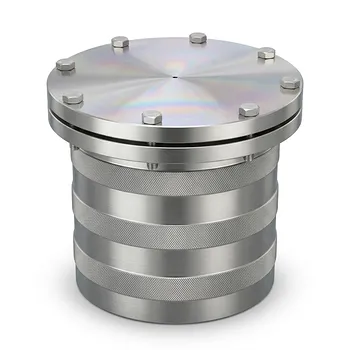
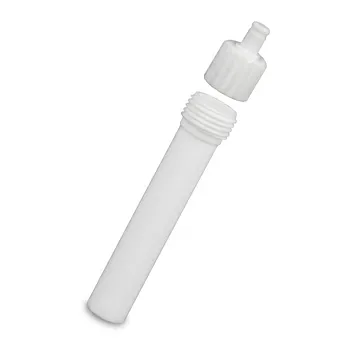
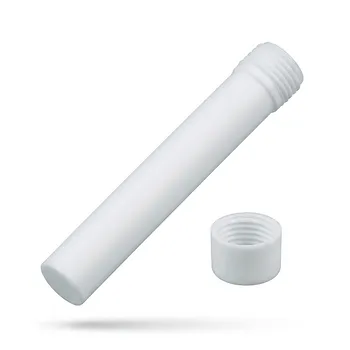
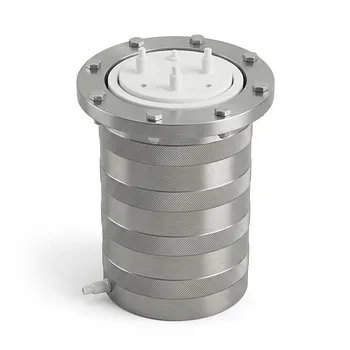
The PTFE-lined autoclave is the essential reaction vessel for the hydrothermal synthesis of MIL-53 (Al), providing a chemically inert environment that protects the equipment and ensures product purity. It allows for the safe management of corrosive precursors like aluminum chloride and terephthalic acid under the high-pressure conditions required for the crystallization of the metal-organic framework (MOF).
Core Takeaway: The PTFE-lined autoclave functions as a dual-layered system where the inner liner ensures chemical stability and purity, while the outer stainless steel shell provides the structural integrity to withstand the high autogenous pressures necessary for MIL-53 (Al) nucleation.
Protection Against Corrosive Environments
Neutralizing Acidic Precursors
The synthesis of MIL-53 (Al) often involves aluminum chloride and terephthalic acid, which can be highly corrosive at elevated temperatures. The Polytetrafluoroethylene (PTFE) liner acts as a primary barrier, preventing these aggressive reagents from coming into direct contact with the metallic walls of the autoclave.
Eliminating Metal Ion Contamination
Maintaining the high purity of a MOF structure is critical for its subsequent performance in gas storage or catalysis. Because PTFE is chemically inert, it prevents the leaching of chromium, iron, or nickel ions from the stainless steel shell into the reaction mixture, ensuring the crystallinity and phase purity of the MIL-53 (Al).
Facilitating High-Pressure Crystallization
Managing Autogenous Pressure
Hydrothermal synthesis occurs at temperatures between 423 K and 475 K, well above the boiling point of the solvent. The stainless steel outer shell provides the mechanical strength to safely contain the autogenous pressure generated during this process, which is vital for the successful growth of the MOF structure.
Enhancing Solubility and Reactivity
The sealed, high-pressure environment forces the solvent into a subcritical state, significantly increasing the solubility of the organic linkers. This creates the supersaturated environment necessary for controlled nucleation and the slow growth of high-quality MIL-53 (Al) crystals.
Understanding the Trade-offs and Limitations
Thermal Operating Envelopes
While PTFE is highly resistant to chemicals, it has a clear thermal limit, typically around 250°C (523 K). Synthesis of MIL-53 (Al) must be carefully monitored to stay within the 423 K to 475 K range to prevent the liner from deforming or releasing toxic vapors.
Thermal Lag and Consistency
The thickness of the PTFE liner can introduce a thermal lag between the oven temperature and the internal reaction temperature. Researchers must account for this delay to ensure the reaction mixture reaches the specific energy levels required for MOF framework assembly.
How to Apply This to Your Synthesis Project
Successful MIL-53 (Al) production depends on matching your equipment to your specific chemical and thermal requirements.
- If your primary focus is phase purity: Always inspect the PTFE liner for any staining or pitting from previous reactions, as surface defects can harbor impurities that disrupt MOF crystallization.
- If your primary focus is reaction safety: Ensure the stainless steel shell is rated for at least 20% higher pressure than the expected autogenous pressure at 475 K to provide a safety margin during the heating phase.
- If your primary focus is crystal size control: Use a dedicated heating mantle or a high-precision forced-air oven to manage the thermal lag of the PTFE liner, allowing for more predictable nucleation rates.
The PTFE-lined autoclave remains the gold standard for MIL-53 (Al) synthesis because it perfectly balances the need for chemical isolation with the physical requirements of high-pressure materials science.
Summary Table:
| Feature | Material | Benefit to MIL-53 (Al) Synthesis |
|---|---|---|
| Chemical Barrier | PTFE Liner | Prevents corrosion from aluminum chloride and acidic precursors. |
| Pressure Stability | Stainless Steel Shell | Safely contains high autogenous pressure required for nucleation. |
| Purity Control | Inert Surface | Eliminates metal ion leaching to ensure crystal phase purity. |
| Reaction State | Sealed System | Facilitates the subcritical solvent state for organic linker solubility. |
Elevate Your Synthesis Precision with KINTEK
High-performance materials science requires equipment that guarantees purity and durability. KINTEK specializes in the absolute focus on high-performance fluoropolymers, providing researchers with the critical tools needed for successful MOF synthesis and trace analysis.
From everyday basic labware (beakers, measuring cylinders, crucibles, dishes, reagent/wash bottles, centrifuge and digestion tubes) and sample prep tools (filters, pipettes, tweezers) to advanced reaction apparatus—including hydrothermal synthesis liners, microwave digestion vessels, and custom electrochemical cells—our products are engineered for excellence.
Why choose KINTEK?
- End-to-End Customization: Our custom CNC fabrication delivers everything from complex non-standard machined parts to bespoke laboratory setups.
- Comprehensive Range: We provide all fluid transfer components (tubing, fittings, valves) and general consumables (O-rings, gaskets, seal tapes) crafted from premium PTFE and PFA.
- Guaranteed Purity: Our chemically inert materials ensure your results remain free from contamination.
Contact us today to discuss your specific project requirements or to request a quote for high-volume orders. Let KINTEK provide the high-performance solutions your laboratory deserves.
References
- Muhammad Fernadi Lukman, Andreas Pöppl. <i>In Situ</i> Electron Paramagnetic Resonance Investigation of Isotope‐Selective Breathing in MIL‐53 During Dihydrogen Adsorption. DOI: 10.1002/chem.202500088
This article is also based on technical information from Kintek Knowledge Base .
Related Products
- PTFE Lined High Pressure Digestion Vessel 50ml High Temperature Hydrothermal Synthesis Tank
- Custom TFM Reaction Vessel with Stainless Steel Jacket and PTFE Inner Cup for High Corrosion Resistance
- High Purity PTFE Microwave Digestion Vessel Replacement Liner for Acid Sample Preparation and Trace Analysis
- High Purity TFM Microwave Digestion Vessels PTFE Acid Evaporation Liners Domestic GT-400 Equivalent Laboratory Reaction Containers
- High Pressure Custom TFM Reactor Stainless Steel Outer Vessel PTFE Inner Cup for Corrosive Synthesis
People Also Ask
- What are the benefits of using a PTFE-lined vessel for carbon-sulfur cathode treatment? Maximize Purity & Performance
- Why are PTFE-lined pressure digestion vessels required for the preparation of Ag/CeO2 catalysts? Purity & Performance
- What safety features are typically incorporated into high-pressure PTFE digestion vessel designs? Ensure Lab Safety
- What is the function of PTFE lined high-pressure vessels in g-C3N4 synthesis? Achieve High-Purity Material Growth
- Role of High-Pressure Digestion Tanks in Perovskite Synthesis: Achieve Superior Stability and Latent Heat