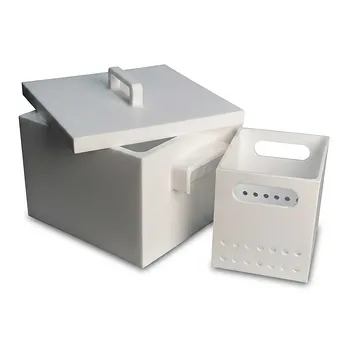
The PTFE-lined autoclave is the critical reaction vessel for MgAl-LDH synthesis. It provides a chemically inert, high-pressure environment that allows precursors like magnesium oxide and alumina to reach subcritical temperatures without corroding the hardware. This setup ensures the chemical purity of the Magnesium-Aluminum Layered Double Hydroxide by preventing metal ion leaching from the autoclave walls and facilitating the formation of highly crystalline structures.
The PTFE liner acts as a protective barrier that enables "soft chemistry" conditions under extreme heat and pressure. By isolating alkaline precursors from the metallic autoclave body, it guarantees the structural integrity and phase purity of the resulting LDH crystals.
The Role of Chemical Inertness in LDH Synthesis
Preventing Metallic Contamination
Hydrothermal synthesis of MgAl-LDH often involves alkaline conditions that are highly corrosive to standard metals. Without a polytetrafluoroethylene (PTFE) liner, the reaction mixture would contact the stainless steel walls of the autoclave. This contact causes metallic impurities to leach into the solution, potentially incorporating unwanted iron or nickel ions into the LDH lattice.
Resisting Alkaline Precursors
The synthesis typically utilizes reagents such as sodium carbonate, magnesium oxide, and alumina. These materials can undergo secondary side reactions with the autoclave's metallic body under high heat. The PTFE liner is selected for its exceptional chemical inertness, ensuring that the chemical environment remains dedicated solely to the intended LDH formation.
Thermodynamic Advantages of the Sealed System
Facilitating Subcritical Conditions
The sealed nature of the autoclave allows solvents to remain in a liquid state at temperatures well above their atmospheric boiling points (e.g., 160°C to 180°C). These subcritical conditions significantly enhance the solubility and reactivity of the magnesium and aluminum precursors. This increased energy state is essential for transforming solid precursors into the desired layered structure.
Enhancing Nucleation and Crystal Growth
The high-pressure environment creates a state of supersaturation within the solvent. This state promotes the controlled nucleation and slow growth of high-quality single crystals. The result is an LDH product with a highly crystalline layered structure and uniform morphology, which is difficult to achieve via standard co-precipitation at room temperature.
Structural Integrity and Precision
The Pressure-Bearing Duo
In this configuration, the PTFE liner handles the chemical environment while the stainless steel outer shell provides the mechanical strength. The steel shell safely withstands the autogenous pressure generated as the internal temperature rises. This division of labor allows the system to operate safely at temperatures and pressures that would otherwise destroy or contaminate the reaction.
Maintaining Stoichiometric Ratios
The strictly sealed environment of the autoclave prevents the evaporation of volatile components or solvents. By maintaining a constant volume and mass, the system ensures that the synthesis ratios of magnesium to aluminum remain precise. This precision is vital for achieving the correct stoichiometric balance required for specific LDH applications.
Understanding the Constraints and Trade-offs
Temperature Limitations
PTFE has a definitive thermal ceiling, typically around 250°C, though most LDH syntheses stay safely below 200°C. Exceeding these limits can cause the liner to soften or undergo thermal decomposition, releasing toxic fluorinated gases. Researchers must balance the need for high-temperature reactivity with the physical limits of the fluoropolymer material.
Thermal Lag and Insulation
PTFE is an effective thermal insulator, which creates a temperature gradient between the heating element and the reaction mixture. This results in a "thermal lag," where the internal solution takes longer to reach the target temperature than the external shell. Precise timing and external temperature monitoring are required to ensure the reaction actually spends the intended duration at the target heat level.
Optimizing Your Synthesis Process
How to Apply This to Your Project
- If your primary focus is phase purity: Ensure the PTFE liner is thoroughly cleaned with acid between uses to prevent cross-contamination from previous batches.
- If your primary focus is high crystallinity: Utilize temperatures near 160°C–180°C to maximize the solubility of precursors, ensuring the autoclave is rated for the resulting autogenous pressure.
- If your primary focus is uniform particle size: Maintain a consistent "fill level" (typically 60-80%) within the liner to ensure stable pressure and heat distribution during the hydrothermal aging process.
By mastering the interface between the inert PTFE environment and the high-pressure steel vessel, you can reliably produce high-quality MgAl-LDH with tailored structural properties.
Summary Table:
| Feature | Function in LDH Synthesis | Key Benefit |
|---|---|---|
| Chemical Inertness | Prevents metal ion leaching from autoclave walls | Ensures high phase purity and zero contamination |
| Pressure Containment | Facilitates subcritical conditions (liquid >100°C) | Increases precursor solubility and reactivity |
| Sealed Environment | Maintains constant volume and mass | Ensures precise Mg:Al stoichiometric ratios |
| Structural Support | SS outer shell bears high autogenous pressure | Safe operation during high-temp nucleation |
| Thermal Protection | Liner protects steel from alkaline corrosion | Extends equipment life and prevents side reactions |
Elevate Your Research with KINTEK’s High-Performance Fluoropolymer Solutions
Achieving high crystallinity and phase purity in LDH synthesis requires the highest quality reaction vessels. KINTEK specializes in high-performance fluoropolymer materials, offering an exhaustive range of laboratory supplies designed for the most demanding chemical environments.
From everyday basic labware (beakers, measuring cylinders, crucibles, dishes, reagent/wash bottles, centrifuge and digestion tubes) and high-purity trace analysis instruments to comprehensive fluid transfer components (tubing, fittings, valves), sample prep tools (filters, pipettes, tweezers), and general consumables (O-rings, seal tapes, stir bars), we provide it all. For advanced research, we offer standard and custom PTFE-lined autoclaves, electrochemical cells, and microwave digestion vessels crafted via expert end-to-end custom CNC fabrication.
Whether you need bespoke laboratory setups or high-volume orders, KINTEK delivers precision-engineered parts tailored to your exact specifications.
Ready to optimize your hydrothermal synthesis? Contact us today to request a quote or custom design!
References
- Qingxin Li, Junfang Zhang. Enhanced Congo red adsorption on defective Mg/Al-layered double hydroxides synthesized with varied Al<sub>2</sub>O<sub>3</sub> crystal regulators. DOI: 10.25259/ajc_180_2025
This article is also based on technical information from Kintek Knowledge Base .
Related Products
- PTFE Lined High Pressure Digestion Vessel 50ml High Temperature Hydrothermal Synthesis Tank
- Custom TFM Reaction Vessel with Stainless Steel Jacket and PTFE Inner Cup for High Corrosion Resistance
- High Purity PTFE Microwave Digestion Vessel Replacement Liner for Acid Sample Preparation and Trace Analysis
- High Purity TFM Microwave Digestion Vessels PTFE Acid Evaporation Liners Domestic GT-400 Equivalent Laboratory Reaction Containers
- High Pressure Custom TFM Reactor Stainless Steel Outer Vessel PTFE Inner Cup for Corrosive Synthesis
People Also Ask
- What are the benefits of using a PTFE-lined vessel for carbon-sulfur cathode treatment? Maximize Purity & Performance
- Why are PTFE-lined pressure digestion vessels required for the preparation of Ag/CeO2 catalysts? Purity & Performance
- What safety features are typically incorporated into high-pressure PTFE digestion vessel designs? Ensure Lab Safety
- What is the function of PTFE lined high-pressure vessels in g-C3N4 synthesis? Achieve High-Purity Material Growth
- Role of High-Pressure Digestion Tanks in Perovskite Synthesis: Achieve Superior Stability and Latent Heat