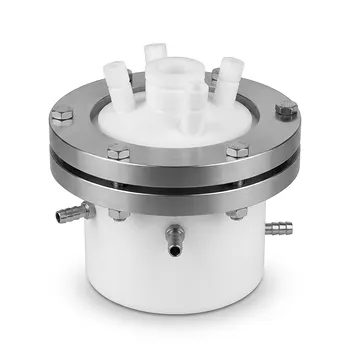
The PTFE-lined stainless steel autoclave acts as a pressurized chemical reactor that facilitates the transformation of liquid precursors into solid nanocrystals. Its primary function is to provide a hermetically sealed, high-temperature environment where autogenous pressure drives the nucleation and growth of high-purity, single-phase nano-spinel ferrites while protecting the sample from metallic contamination.
The autoclave combines the mechanical strength of stainless steel with the chemical inertness of Polytetrafluoroethylene (PTFE) to enable hydrothermal reactions. This synergy allows for the synthesis of complex nanostructures that require temperatures and pressures well beyond the normal boiling point of the solvent.
The Role of the Sealed Environment
Generating Autogenous Pressure
In a hydrothermal process, the precursor solution is heated inside a sealed volume, causing the internal pressure to rise naturally as the temperature increases. This autogenous pressure is the physical foundation for the reaction, forcing the precursors to interact in ways that are impossible at atmospheric pressure.
Promoting Nucleation and Crystal Growth
The high-pressure environment lowers the energy barrier required for nucleation, the initial step in forming a solid crystal. This ensures that the resulting nano-spinel ferrites achieve high crystallinity and a uniform single-phase structure, which is essential for their magnetic and electronic properties.
Enabling Reactions Above Boiling Point
The sealed autoclave allows the aqueous or solvothermal solution to reach temperatures significantly higher than its normal boiling point (e.g., 180°C to 200°C). At these elevated states, the solvent's properties change, increasing the solubility of poorly soluble substances and allowing for thorough mixing and reaction of the precursors.
The Necessity of the PTFE Liner
Preventing Metallic Contamination
Spinel ferrites are highly sensitive to their chemical environment; even trace amounts of unwanted metal ions can alter their magnetic characteristics. The PTFE liner provides a barrier that prevents the corrosive precursor solution from reacting with the stainless steel shell, ensuring that no iron, chromium, or nickel from the vessel enters the final product.
Resistance to Corrosive Precursors
The synthesis of ferrites often involves strong bases, such as sodium hydroxide (NaOH), or acidic metal chloride precursors. PTFE is exceptionally chemically inert, meaning it will not degrade or react when exposed to these aggressive chemicals at high temperatures.
Maintaining High-Purity Morphology
By providing a non-reactive and anti-adhesive surface, the PTFE liner ensures that the morphology (shape and size) of the nanoparticles remains consistent. It prevents reactants from sticking to the vessel walls, which could otherwise lead to uneven growth or "hot spots" in the reaction.
Understanding the Trade-offs and Limitations
Temperature Constraints
While PTFE is highly resistant to chemicals, it has a clear thermal limit, typically around 250°C. Exceeding this temperature can cause the liner to soften or deform, potentially compromising the seal and leading to a dangerous release of pressure.
Thermal Expansion Disparity
Stainless steel and PTFE expand at different rates when heated. If the autoclave is heated or cooled too rapidly, the mechanical stress between the liner and the shell can cause the PTFE to crack or the seal to fail, which is why controlled heating and cooling cycles are vital.
Pressure Monitoring Risks
Because the pressure is generated internally (autogenously), it is not always easy to monitor in real-time without specialized sensors. Users must calculate the filling degree (the volume of liquid relative to the total volume) carefully to avoid over-pressurization, which could lead to an explosion of the stainless steel vessel.
How to Apply This to Your Synthesis Goals
Optimization Based on Objectives
- If your primary focus is phase purity: Ensure the PTFE liner is thoroughly cleaned and free of scratches to prevent "memory effects" from previous experiments contaminating your current spinel ferrite batch.
- If your primary focus is small particle size: Experiment with the filling degree of the autoclave; higher filling degrees can lead to higher autogenous pressures, which often favors faster nucleation and smaller final nanocrystals.
- If your primary focus is experimental safety: Never exceed 80% of the liner's total volume with liquid, as the thermal expansion of the solvent at 200°C requires significant headspace to prevent structural failure.
The PTFE-lined autoclave is a precision tool that masters the balance between extreme physical force and delicate chemical purity to create advanced nanomaterials.
Summary Table:
Key Functions of the PTFE-Lined Autoclave in Hydrothermal Synthesis
| Component/Feature | Role in Synthesis | Impact on Nano-Spinel Ferrites |
|---|---|---|
| Stainless Steel Shell | Provides mechanical strength | Safely contains high autogenous pressures |
| PTFE Liner | Chemical inertness & insulation | Prevents metallic contamination & corrosion |
| Sealed Environment | Temperature elevation | Enables reactions above solvent boiling points |
| Pressure Generation | Drives nucleation | Facilitates uniform crystal growth & high crystallinity |
| Thermal Threshold | Safety & material limit | Critical constraint (max 250°C) to prevent deformation |
Elevate Your Research Precision with KINTEK
Achieving perfect phase purity in nano-spinel ferrites requires equipment that offers both physical resilience and chemical absolute-purity. KINTEK specializes in high-performance fluoropolymer solutions designed for the most demanding hydrothermal environments.
From everyday basic labware (beakers, crucibles, and reagent bottles) to advanced reaction apparatus like hydrothermal synthesis liners, microwave digestion vessels, and custom electrochemical cells, KINTEK manufactures virtually all imaginable laboratory supplies crafted from PTFE and PFA. Our expertise extends across:
- Sample Prep & Filtration: Separatory funnels, burettes, filters, and spatulas.
- Fluid Transfer: Precision tubing, fittings, and valves.
- Custom Fabrication: End-to-end CNC machining for complex non-standard parts and bespoke laboratory setups.
Whether you need high-volume consumables or a custom-engineered reactor for unique synthesis goals, KINTEK provides the reliability your data depends on.
Contact KINTEK today for expert laboratory solutions
References
- Y. Slimani, Anwar Ul‐Hamid. Structural, magnetic, electromagnetic, and hyperfine interactions of rare earth Ho3+ doped in mixed Co–Ni spinel ferrites. DOI: 10.1007/s00339-025-08576-x
This article is also based on technical information from Kintek Knowledge Base .
Related Products
- PTFE Lined High Pressure Digestion Vessel 50ml High Temperature Hydrothermal Synthesis Tank
- Custom TFM Reaction Vessel with Stainless Steel Jacket and PTFE Inner Cup for High Corrosion Resistance
- High Temperature Corrosion Resistant Hydrothermal Synthesis Reactor with TFM Inner Liner and Straight Cylinder Design
- High Pressure Custom TFM Reactor Stainless Steel Outer Vessel PTFE Inner Cup for Corrosive Synthesis
- PTFE Acid Steam Cleaning System HF Resistant Trace Analysis Beaker Digestion Tank Customizable
People Also Ask
- What are the benefits of using a PTFE-lined vessel for carbon-sulfur cathode treatment? Maximize Purity & Performance
- Why are PTFE-lined pressure digestion vessels required for the preparation of Ag/CeO2 catalysts? Purity & Performance
- What safety features are typically incorporated into high-pressure PTFE digestion vessel designs? Ensure Lab Safety
- What is the function of PTFE lined high-pressure vessels in g-C3N4 synthesis? Achieve High-Purity Material Growth
- Role of High-Pressure Digestion Tanks in Perovskite Synthesis: Achieve Superior Stability and Latent Heat