The high-pressure reaction system acts as the fundamental catalyst for precision nanoparticle engineering. It creates a specialized environment where reactants rapidly reach supercritical or near-critical states to facilitate non-equilibrium control of the chemical process. This ensures that doping elements, such as chromium, are uniformly incorporated into the cerium oxide crystal lattice rather than merely adhering to the particle surface, resulting in structurally stable nanomaterials.
The primary function of a high-pressure system in continuous-flow synthesis is to bypass standard thermodynamic limitations. By maintaining reactants in a high-energy, near-critical state, the system enables the creation of doped cerium oxide particles with superior structural integrity and precise atomic distribution.
Driving Chemical Kinetics through High-Energy Environments
Rapid Transition to Supercritical States
The system provides the necessary pressure to allow aqueous solutions to remain in a liquid or supercritical state at temperatures far exceeding their normal boiling point. This rapid transition is essential for continuous-flow synthesis, as it provides the kinetic energy required for near-instantaneous nucleation.
Facilitating Non-Equilibrium Doping
In standard environments, doping elements often fail to integrate into the host lattice, leading to surface-level contamination. High-pressure systems enable non-equilibrium control, forcing dopants like chromium (Cr) to settle into the cerium oxide crystal structure, which ensures the material remains stable under various application conditions.
Enhancing Precursor Solubility and Hydrolysis
High-pressure conditions significantly increase the solubility of chemical precursors that are typically difficult to dissolve. This environment promotes the complete hydrolysis of cerium and metal precursors, providing the necessary conditions for high-crystallinity nanopowders that cannot be synthesized at atmospheric pressure.
Engineering Particle Morphology and Crystal Facets
Precision Control of Crystallographic Growth
By adjusting the pressure and temperature within the sealed reactor, researchers can induce growth along specific crystallographic directions. This allows for the production of cerium dioxide nanorods, nanocubes, and nano-octahedra dominated by highly active (110), (100), and (111) crystal facets.
Promoting Uniform Recrystallization
The high-pressure environment facilitates a continuous cycle of dissolution and recrystallization. This process is critical for achieving a uniform particle size distribution and ensuring that the nanoparticles possess a regular, predictable morphology.
Achieving High-Purity Heterojunctions
In complex composites, the pressure ensures that different phases—such as copper oxides or other dopants—couple efficiently at the heterojunction interface. This creates a dense, integrated network where secondary particles adhere firmly to the primary carrier material.
Understanding the Trade-offs and Limitations
Material Integrity and Contamination Risks
While high pressure is beneficial, it requires specialized reactor liners, such as polytetrafluoroethylene (PTFE), to resist corrosion from strong mineralizers like sodium hydroxide. Without these liners, the reactor walls can introduce metal ion contamination, compromising the purity of the cerium oxide.
Mechanical and Safety Complexity
Operating at subcritical or supercritical pressures (often between 180°C and 220°C or higher) requires robust engineering to prevent system failure. The continuous-flow nature adds complexity, as the system must maintain constant pressure while moving abrasive nanoparticle slurries through the reactor.
Kinetic vs. Thermodynamic Stability
Because these systems operate under non-equilibrium conditions, the resulting nanomaterials are often kinetically trapped. While this allows for unique doping profiles, these materials may require specific handling to prevent phase separation if exposed to extreme heat post-synthesis.
How to Apply These Principles to Your Synthesis Goal
The high-pressure system is a tool for bypassing traditional chemical limits. Your specific goal will dictate how you tune the pressure parameters.
- If your primary focus is uniform lattice doping: Prioritize reaching near-critical states rapidly to force dopant integration before surface precipitation occurs.
- If your primary focus is facet-specific catalysis: Use the reactor to maintain precise temperature-pressure windows that favor the growth of (110) or (100) surfaces.
- If your primary focus is high-purity industrial production: Invest in high-chemical-stability liners (like PTFE) to prevent reactor wall leaching during long-duration continuous runs.
Mastering the high-pressure environment allows you to transition from simple chemical mixing to the precise atomic engineering of stable, high-performance cerium oxide nanoparticles.
Summary Table:
| Function | Key Benefit | Impact on Nanoparticles |
|---|---|---|
| Supercritical State | Rapid transition above boiling point | Enables near-instantaneous nucleation |
| Non-Equilibrium Control | Forces uniform lattice integration | Prevents dopant leaching and surface clustering |
| Precursor Solubility | Complete hydrolysis of metal salts | Results in high-crystallinity nanopowders |
| Morphology Tuning | Facet-specific crystallographic growth | Produces active (110), (100), and (111) facets |
| Liner Protection | PTFE/PFA chemical resistance | Prevents metal ion contamination from reactor walls |
Elevate Your Hydrothermal Synthesis with KINTEK Precision
Success in high-pressure nanoparticle engineering demands materials that can withstand extreme chemical environments and prevent contamination. KINTEK specializes in high-performance fluoropolymer solutions designed specifically for advanced laboratory and industrial reactors.
From everyday basic labware like PTFE and PFA beakers, crucibles, and reagent bottles to critical components such as high-purity hydrothermal synthesis liners, microwave digestion vessels, and custom-machined reactor parts, we provide the durability your research requires. Whether you need standard tubing, fittings, and valves for fluid transfer or complex custom CNC-fabricated components for bespoke setups, our absolute focus on fluoropolymer excellence ensures your cerium oxide synthesis remains pure and stable.
Ready to optimize your lab’s performance? Contact KINTEK today to discuss your custom fabrication needs and explore our full range of high-performance laboratory supplies.
References
- Akira Yoko, Tadafumi Adschiri. Nonequilibrium Process for Doping Under Continuous-Flow Hydrothermal Synthesis of Cerium Oxide-Based Nanoparticles. DOI: 10.1021/prechem.5c00004
This article is also based on technical information from Kintek Knowledge Base .
Related Products
- PTFE Lined High Pressure Digestion Vessel 50ml High Temperature Hydrothermal Synthesis Tank
- High Temperature Corrosion Resistant Hydrothermal Synthesis Reactor with TFM Inner Liner and Straight Cylinder Design
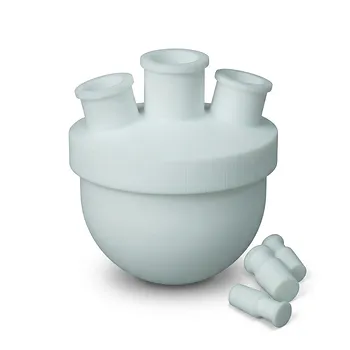
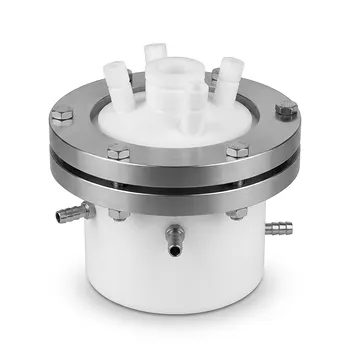
- High Pressure Custom TFM Reactor Stainless Steel Outer Vessel PTFE Inner Cup for Corrosive Synthesis
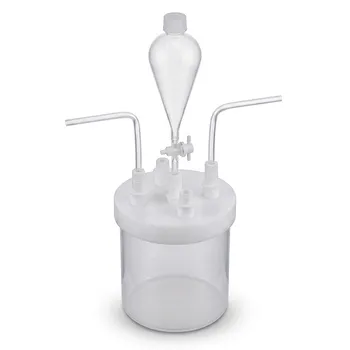
- High Purity PFA Constant Pressure Condensation Reaction System Acid Resistant High Temperature Customizable Teflon Labware
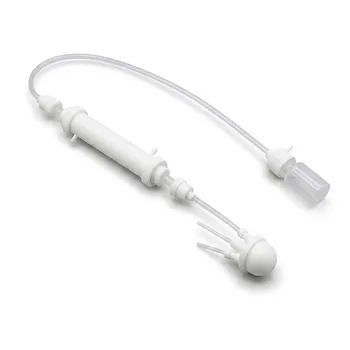
- PTFE Continuous Reaction System Jacketed Constant Pressure Dropping Funnel Corrosion Resistant HF Resistant Customizable
People Also Ask
- What are the benefits of using a PTFE-lined vessel for carbon-sulfur cathode treatment? Maximize Purity & Performance
- Why are PTFE-lined pressure digestion vessels required for the preparation of Ag/CeO2 catalysts? Purity & Performance
- What safety features are typically incorporated into high-pressure PTFE digestion vessel designs? Ensure Lab Safety
- What is the function of PTFE lined high-pressure vessels in g-C3N4 synthesis? Achieve High-Purity Material Growth
- Role of High-Pressure Digestion Tanks in Perovskite Synthesis: Achieve Superior Stability and Latent Heat