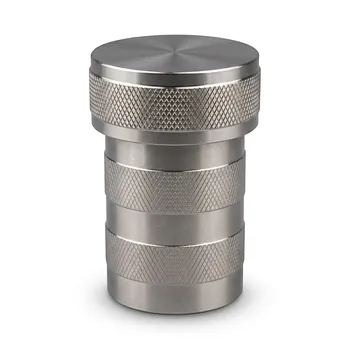
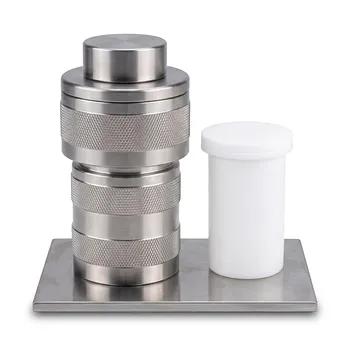
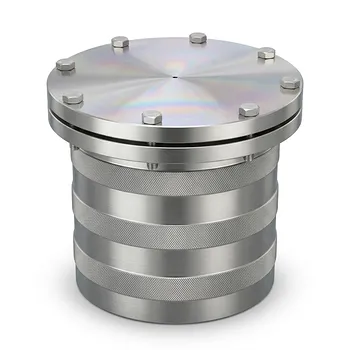
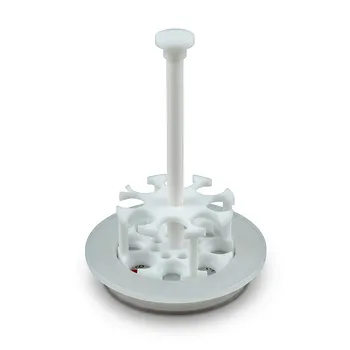
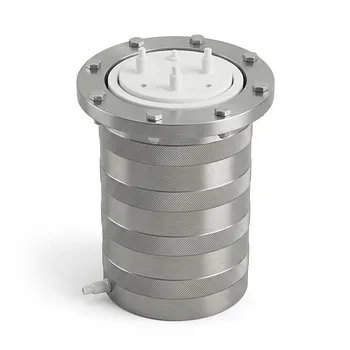
The high-pressure hydrothermal autoclave is the essential reactor that enables solvothermal synthesis. It provides a sealed environment where solvent mixtures, such as methanol and deionized water, reach temperatures (typically 180°C) and autogenous pressures far exceeding their atmospheric boiling points. This specific physical state is required to crystallize $Bi_2MoO_6$ while simultaneously allowing methanol to reduce $Bi(III)$ ions into zero-valent metallic bismuth ($Bi^0$) to form the final composite.
Core Takeaway: The autoclave acts as a high-energy pressure vessel that facilitates subcritical solvent behavior, which is the primary driver for both the crystallization of the semiconductor framework and the chemical reduction of bismuth to create surface plasmon resonance effects.
Creating the Subcritical Reaction Environment
Maintaining Liquid States Above Boiling Point
In a standard open system, solvents like methanol or water would evaporate long before reaching the temperatures required for $Bi@Bi_2MoO_6$ synthesis. The sealed nature of the autoclave prevents evaporation, forcing these solvents to remain in a liquid or subcritical state at temperatures like 180°C.
Generating Autogenous Pressure
As the internal temperature rises, the thermal expansion of the liquid and the vapor pressure of the solvents generate autogenous pressure. This pressure increases the kinetic energy of the reactants, promoting effective collisions between precursor ions that would not occur under standard laboratory conditions.
Enhancing Solvent Penetration and Solubility
Under high pressure, the physical properties of the solvent mixture change, significantly increasing its ability to penetrate solid precursors. This facilitates the complete dissolution of metal salts and organic ligands, ensuring a homogeneous reaction medium for the subsequent growth of the composite.
Driving Chemical Reduction and Phase Formation
Methanol as an Active Reducing Agent
The autoclave environment is critical for the chemical transformation of bismuth. Under these high-pressure conditions, methanol gains the energy required to act as a reducing agent, stripping oxygen or electrons from $Bi(III)$ ions to produce metallic $Bi^0$.
Facilitating the Crystallization of $Bi_2MoO_6$
While the reduction occurs, the high-temperature environment provides the activation energy necessary for the nucleation and growth of $Bi_2MoO_6$ crystals. The autoclave ensures that these two distinct processes—reduction and crystallization—happen simultaneously to form a stable composite structure.
Enabling Surface Plasmon Resonance (SPR)
By successfully reducing $Bi(III)$ to $Bi^0$ within the $Bi_2MoO_6$ matrix, the autoclave facilitates the creation of surface plasmon resonance effects. This metallic bismuth component is vital for enhancing the photocatalytic activity of the resulting material.
Understanding the Trade-offs and Technical Constraints
Material Limitations of Autoclave Liners
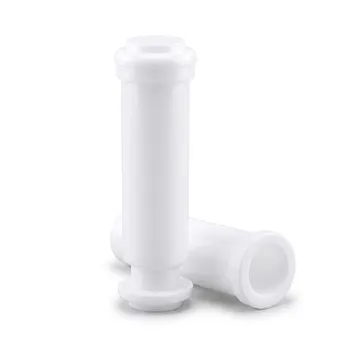
Most hydrothermal synthesis requires a Polytetrafluoroethylene (PTFE) or Teflon liner to prevent corrosion of the stainless steel shell. However, PTFE has a strict thermal limit (usually around 220°C–250°C), meaning users must carefully balance the need for high temperature against the risk of liner deformation or toxic off-gassing.
The Complexity of Pressure Control
Because the pressure in a standard autoclave is autogenous (self-generated by temperature), it cannot be adjusted independently of the temperature. This lack of independent control means that the fill degree of the vessel must be precisely calculated to avoid over-pressurization and potential vessel failure.
Cooling and Crystallization Rates
The sealed nature of the autoclave means that cooling occurs slowly, which can significantly impact the final morphology and grain size of the $Bi@Bi_2MoO_6$. Rapid cooling is often impossible without specialized equipment, which may lead to unwanted crystal overgrowth or phase separation in the composite.
How to Apply This to Your Synthesis Goals
Strategic Recommendations for Synthesis
- If your primary focus is maximizing metallic Bi content: Ensure the methanol-to-water ratio is optimized and maintain the temperature at or above 180°C to provide sufficient energy for the reduction process.
- If your primary focus is high crystallinity of the $Bi_2MoO_6$ phase: Increase the reaction hold time within the autoclave to allow for the slow, ordered growth of the crystal lattice.
- If your primary focus is specific particle morphology (e.g., nanosheets): Carefully control the fill volume of the autoclave (typically 60-80%) to maintain consistent autogenous pressure throughout the heating cycle.
By mastering the high-pressure environment of the autoclave, researchers can precisely tune the interaction between solvents and precursors to create advanced functional materials.
Summary Table:
| Feature | Role in Synthesis | Impact on Bi@Bi2MoO6 |
|---|---|---|
| Sealed Environment | Prevents solvent evaporation | Maintains liquid state at 180°C+ for solvothermal growth |
| Autogenous Pressure | Increases reactant kinetic energy | Enhances solubility and penetration of solid precursors |
| Thermal Energy | Provides activation energy | Drives the reduction of Bi(III) to metallic Bi0 by methanol |
| PTFE/PFA Liners | Chemical & corrosion resistance | Protects the reactor shell from aggressive precursors/solvents |
| Controlled Cooling | Regulates crystallization rate | Determines final crystal morphology and SPR efficiency |
Elevate Your Material Synthesis with KINTEK’s Precision Engineering
Achieving the perfect subcritical environment for $Bi@Bi_2MoO_6$ requires hardware that stands up to extreme pressure and corrosive chemistry. At KINTEK, we specialize in high-performance fluoropolymer solutions tailored for advanced research.
Whether you need standard PTFE or PFA hydrothermal synthesis liners, microwave digestion vessels, or custom-machined reaction apparatus, we provide the durability and purity your lab demands. Our expertise extends from everyday basic labware (beakers, measuring cylinders, crucibles, reagent bottles) and fluid transfer components (tubing, valves, fittings) to specialized sample prep tools and complex electrochemical cells.
Why choose KINTEK?
- End-to-End Customization: CNC fabrication for bespoke laboratory setups and non-standard parts.
- High-Purity Focus: Exclusive use of premium fluoropolymers to ensure zero contamination.
- Scalable Solutions: From high-volume consumable orders (O-rings, septa, stirring bars) to advanced reactor components.
Contact us today to discuss your custom project or request a quote!
References
- Priti Rohilla, Raj Kumar Das. Construction of a Bi-doped g-C <sub>3</sub> N <sub>4</sub> /Bi <sub>2</sub> MoO <sub>6</sub> ternary nanocomposite for the effective photodegradation of ofloxacin under visible light irradiation. DOI: 10.1039/d4ra08493d
This article is also based on technical information from Kintek Knowledge Base .
Related Products
- High Temperature Corrosion Resistant Hydrothermal Synthesis Reactor with TFM Inner Liner and Straight Cylinder Design
- PTFE Lined High Pressure Digestion Vessel 50ml High Temperature Hydrothermal Synthesis Tank
- Custom TFM Reaction Vessel with Stainless Steel Jacket and PTFE Inner Cup for High Corrosion Resistance
- High Performance TFM Microwave Digestion Vessel Rack 15 Position Customizable Sample Preparation Support
- High Pressure Custom TFM Reactor Stainless Steel Outer Vessel PTFE Inner Cup for Corrosive Synthesis
People Also Ask
- What is the role of a corrosion-resistant reactor in the synthesis of lignin-based carbon dots? Ensure Maximum Purity
- What are the technical advantages of using hydrothermal synthesis reactors for advanced electronic & optical nanomaterials?
- How does a hydrothermal synthesis reactor facilitate the production of crystalline materials with tailored morphologies? Precision Crystal Growth
- Why is the sealing reliability of a hydrothermal synthesis reactor critical for 24-hour cycles? Ensure Nano-Precision
- What role do hydrothermal synthesis reactors play in CQD preparation? Achieve High-Purity Nanomaterial Synthesis