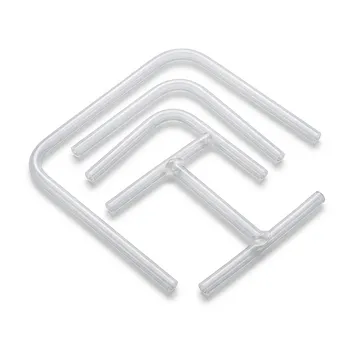
Selecting PTFE tubing for high-pressure or high-temperature environments requires a precise calculation of pressure derating, wall thickness, and mechanical reinforcement. You must account for the fact that PTFE’s mechanical strength significantly decreases as temperatures rise, necessitating a reduction in the allowable operating pressure. Furthermore, ensuring fitting compatibility and managing thermal expansion are critical to maintaining system integrity.
Core Takeaway: PTFE is a high-performance material with unique limitations; its selection hinges on the "Pressure-Temperature" relationship, where exceeding the material's thermal limits drastically reduces its ability to contain pressure without mechanical reinforcement.
Navigating the Relationship Between Temperature and Pressure
The Critical Role of Pressure Derating
As temperature increases, the mechanical strength of PTFE decreases. It is essential to apply pressure derating factors to the tubing’s nominal burst pressure to determine the safe working pressure at elevated temperatures. Failing to derate will lead to premature tubing failure or rupture.
Wall Thickness and Reinforcement
In high-pressure scenarios, standard thin-wall tubing is often insufficient. Engineers must evaluate the wall thickness (the difference between the inner and outer diameters) and consider mechanical reinforcement, such as stainless steel braiding, to prevent the tubing from expanding or bursting under load.
Managing Thermal Expansion
PTFE has a high coefficient of thermal expansion, which can be significantly different from the metal fittings it connects to. During thermal cycling, this discrepancy can lead to gaps at the connection points, potentially causing leaks if the fittings are not specifically designed for such movement.
Material Integrity and Environmental Factors
Chemical Compatibility and Concentration
While PTFE is known for its near-universal chemical resistance, you must still verify compatibility with the specific type and concentration of the media. Certain aggressive chemicals can behave differently at high temperatures, accelerating the degradation of the material or impacting its sealability.
Material Grade and Fillers
The choice between virgin PTFE and filled PTFE (e.g., glass, carbon, or bronze fillers) depends on the need for improved mechanical properties. Filled grades can offer better resistance to cold flow (creep) and higher compressive strength, which are vital in high-pressure gasket or tubing applications.
External Environmental Stress
Beyond internal fluid dynamics, consider external factors like UV light, moisture, and abrasive materials. For outdoor or high-vibration environments, the tubing must be shielded or selected for its ability to withstand mechanical stress without cracking or thinning.
Understanding the Trade-offs
Cold Flow and Creep
PTFE is prone to cold flow, a phenomenon where the material permanently deforms under a constant load or pressure. This is a significant trade-off when using PTFE in high-pressure seals or fittings; the material may "creep" away from the sealing surface over time, requiring periodic maintenance or specialized fitting designs.
Limited Mechanical Strength
Compared to metallic or reinforced polymer alternatives, PTFE has relatively low tensile and compressive strength. While it offers superior chemical purity and temperature resistance, it cannot match the structural rigidity of metal-bodied components, making it less suitable for applications involving extreme physical impacts or structural loads.
Cost vs. Longevity
High-grade PTFE or reinforced variants often carry a higher total cost of ownership. However, selecting a lower-grade material for a high-stress application frequently results in shorter lifespans and higher maintenance costs, making the initial investment in premium tubing more cost-effective in the long run.
Making the Right Choice for Your Goal
To ensure your fluid system operates safely and efficiently, tailor your selection to your most critical operational requirement.
- If your primary focus is extreme high pressure: Prioritize reinforced (braided) tubing and calculate a rigorous safety factor for the wall thickness based on the maximum possible surge pressure.
- If your primary focus is high-temperature stability: Apply a strict pressure derating schedule and select a material grade designed to resist thermal expansion and cold flow.
- If your primary focus is chemical purity: Use high-purity virgin PTFE and ensure all end connections and fittings are made of compatible, non-contaminating materials.
By balancing these technical variables against your specific environmental conditions, you can ensure a reliable, leak-free system that withstands the rigors of your application.
Summary Table:
| Selection Factor | Critical Consideration | Impact on System Integrity |
|---|---|---|
| Pressure Derating | Mechanical strength drops as temperature rises | Risk of tubing burst or rupture |
| Wall Thickness | Difference between ID and OD dimensions | Determines base pressure handling |
| Reinforcement | Stainless steel braiding or fillers | Increases resistance to expansion |
| Thermal Expansion | Mismatch with metal fitting coefficients | Potential for leaks at connections |
| Cold Flow (Creep) | Permanent deformation under constant load | Long-term seal failure and gaps |
Optimize Your Fluid Systems with KINTEK Precision
From essential labware like beakers and reagent bottles to complex fluid transfer components including PTFE and PFA tubing, fittings, and valves, KINTEK is your ultimate source for high-performance fluoropolymers.
Whether you need standard consumables or bespoke laboratory setups—such as custom electrochemical cells or microwave digestion vessels—our end-to-end custom CNC fabrication delivers absolute precision for non-standard machined parts and high-volume orders.
Ready to upgrade your laboratory’s durability and chemical purity? Contact KINTEK today to discuss your specific high-temperature and high-pressure requirements with our material experts!
Related Products
- Custom Thickened PTFE Laboratory Beaker for High Temperature Hot Plate Applications
- PTFE Lined High Pressure Digestion Vessel 50ml High Temperature Hydrothermal Synthesis Tank
- Custom PTFE Digestion Tube Double Sided Openable High Temperature Corrosion Resistant Low Background
- High Temperature Chemical Resistant 50ml PTFE Syringe Customized Teflon Injector with Threaded Seal for Trace Analysis
- Custom PTFE Digestion Vessel Sample Vial Straight Wall Test Tube High Temperature Low Background
People Also Ask
- Why is the material of the reaction vessel critical for tribocatalytic degradation? Boost Your Catalytic Yield!
- How does thermal stability and fluoride evolution impact the performance of high-temperature PTFE laboratory vessels? Uncover the key factors for reliable operation.
- What are the limitations of pure PTFE in high temperature applications? Understanding the 200°C Ceiling
- In what high-temperature applications is PTFE used? The Ultimate Polymer for Extreme Heat & Corrosion
- Are Teflon parts capable of withstanding high temperatures? Understanding the 260°C Limit for Performance