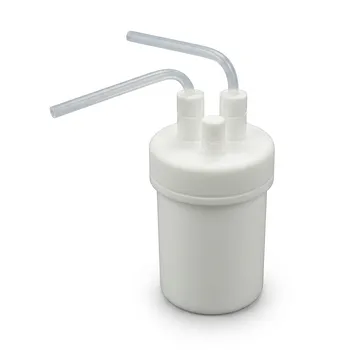
PTFE microchannel reactors leverage specific mechanical and material properties to ensure operational longevity. These reactors utilize a modular compression-based assembly—often referred to as a "click" design—that allows for rapid disassembly and manual cleaning of the internal channels. This physical accessibility, paired with the low surface energy and chemical inertness of PTFE, prevents material adhesion and fouling that typically lead to terminal clogging in fixed-capillary systems.
The core advantage of PTFE microchannel reactors lies in the synergy between accessible mechanical architectures and non-stick material science. By allowing the user to physically open and clean the reactor, these designs solve the "permanent failure" problem inherent in microfluidic devices handling solids or precipitating reagents.
Mechanical Design for Accessibility
The Compression Assembly Advantage
Unlike permanently bonded glass or silicon chips, PTFE reactors often use a mechanical 'click' or compression design. This allows the device to remain hermetic during operation while being easily openable for maintenance.
Modular CNC-Machined Plates
Channels are frequently CNC-machined into solid PTFE blocks rather than relying solely on thin capillaries. This plate-based architecture facilitates straightforward disassembly, enabling operators to scrub or sonicate individual channel surfaces if deposits form.
Reusability and Cost Efficiency
Because the system is not a "black box," it can be cleaned and reused multiple times. This addresses the common industry pain point where clogging issues in fixed systems necessitate the disposal of expensive reactor components.
Material-Driven Clogging Prevention
The Power of Low Surface Energy
PTFE and its variants, such as PFA, possess a low-friction, non-stick surface. This property minimizes the adhesion between passing particles and the channel walls, significantly reducing the rate of fouling.
Chemical and Thermal Resilience
With a melting point exceeding 350 degrees Celsius and near-universal chemical inertness, PTFE remains stable under aggressive conditions. This prevents material degradation or "pitting" that could otherwise create anchor points for particle accumulation.
Dynamic Particle Regulation
Advanced designs may utilize the shock waves from bubble collapses to actively regulate particle distribution within the flow. By using high-purity PTFE in critical areas like narrow bends, manufacturers ensure that particles are less likely to adhere at high-stress points.
Strategic Flow Management
Optimized Fluid Distribution
Uniform flow is critical for preventing stagnation zones where solids might settle. Optimized fluid distributor designs ensure that reagents are delivered evenly across all parallel microchannels, maintaining consistent velocity and preventing local blockages.
Integration of Active Mitigation
Operators can integrate ultrasonic devices or online catalyst regeneration strategies to inhibit solid adhesion. These tools work in tandem with the PTFE surface to ensure that solids remain suspended in the flow rather than depositing on the walls.
Porous Packing Structures
In some configurations, high-porosity packing structures, such as single pellet strings, are used. These structures help manage flow dynamics and can reduce the probability of a total microchannel blockage by distributing the fluid path more effectively.
Understanding the Trade-offs
Mechanical Strength vs. Inertness
While PTFE is chemically superior, it has moderate pressure ratings and can be prone to "cold flow" or deformation under high stress. In high-pressure applications, PTFE must often be used as a liner or coating inside metallic or silicon substrates to provide structural integrity.
Thermal Conductivity Constraints
PTFE is a thermal insulator, which can make precise temperature control more challenging compared to metal reactors. Designers must balance the maintenance benefits of PTFE with the need for efficient heat transfer, often by optimizing wall thickness.
Precision vs. Durability
CNC-machined PTFE channels typically operate in the 100 to 1000 micrometer range. While these dimensions are excellent for preventing clogs, they may not offer the extreme precision of sub-10-micron channels found in specialized lithographic glass chips.
How to Apply This to Your Project
When selecting or designing a PTFE microchannel reactor, your choice should be dictated by the specific fouling risks of your chemical process.
- If your primary focus is handling solids or precipitates: Prioritize a plate-based reactor with a compression assembly that allows for manual cleaning and integrated ultrasonic agitation.
- If your primary focus is high-pressure synthesis: Look for PTFE-lined metallic reactors that combine the non-stick properties of fluoropolymers with the mechanical strength of steel.
- If your primary focus is long-term continuous operation: Focus on designs with optimized fluid distributors and PFA-coated bends to ensure uniform flow and minimal wall adhesion.
By matching the reactor's mechanical accessibility to the fouling potential of your reagents, you can ensure a reliable, high-uptime flow chemistry process.
Summary Table:
| Feature | Maintenance & Clogging Benefit | Description |
|---|---|---|
| Compression Assembly | Rapid Disassembly | Modular 'click' designs allow for manual opening and scrubbing of internal channels. |
| Low Surface Energy | Anti-Fouling | PTFE's non-stick property prevents material adhesion and particle accumulation on walls. |
| CNC-Machined Plates | Enhanced Durability | Solid PTFE blocks offer structural integrity and are easier to clean than thin capillaries. |
| Chemical Inertness | Zero Degradation | Resistance to aggressive reagents prevents pitting and surface damage that can cause clogs. |
| Optimized Distribution | Uniform Flow Velocity | Fluid distributors ensure even flow across channels to prevent stagnation and solid settling. |
Optimize Your Flow Chemistry with KINTEK’s Fluoropolymer Expertise
Are clogging issues and difficult maintenance cycles hindering your laboratory’s productivity? At KINTEK, we specialize in high-performance fluoropolymer solutions designed to tackle the toughest chemical challenges.
From everyday essentials like beakers, crucibles, and reagent bottles to advanced microchannel reactors, hydrothermal synthesis liners, and custom electrochemical cells, we manufacture a comprehensive range of labware from premium PTFE and PFA.
Why choose KINTEK?
- Precision Engineering: Our end-to-end custom CNC fabrication allows us to deliver complex, non-standard machined parts tailored to your specific reactor designs.
- Material Superiority: We focus exclusively on high-performance fluoropolymers to ensure maximum chemical resistance and non-stick performance.
- Scalable Solutions: Whether you need a bespoke laboratory setup or high-volume orders for consumables like O-rings and tubing, we provide absolute reliability.
Don’t let reactor downtime stall your research. Contact us today to discuss your custom fabrication needs and discover how our PTFE expertise can enhance your laboratory’s efficiency.
Related Products
- Customizable Polytetrafluoroethylene PTFE Reactor and Corrosion Resistant Teflon Flask
- PTFE 10L Reaction Vessel with Stirring Paddle Customizable Corrosion Resistant High Temperature Reactor for Biopharmaceutical and Chemical Processing
- Custom PTFE Multilayer Reaction Apparatus High Temperature Corrosion Resistant Threaded Modular Sieve System
- Custom PTFE Volatile Matter Condensation Reflux Reaction Device Corrosion Resistant Pressure Resistant
- High Performance Customizable PTFE Reaction Vessel and Corrosion Resistant Polytetrafluoroethylene Flask for Chemical Laboratory Use
People Also Ask
- What functional advantages do PTFE reactors provide over glass? Achieve Superior Purity and Safety in Synthesis
- What are the primary fabrication methods for capillary-based and monolithic PTFE reactors? Expert Production Insights
- Why are PTFE or PFA reaction vessels required for the selective etching process of MXene using hydrofluoric acid (HF)?
- Why is a Teflon-lined (PTFE) reactor vessel required for the hydrothermal synthesis of V2O5 and SnO2 nanomaterials?
- What is the role of high chemical inertness reaction vessels in the organic synthesis of acylhydrazone ligands? | Guide