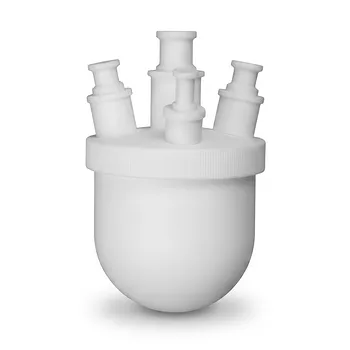
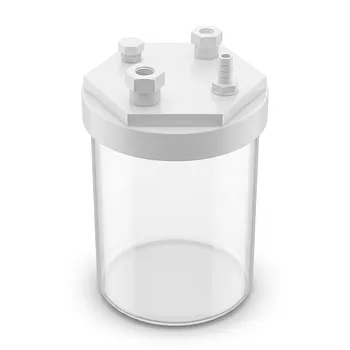
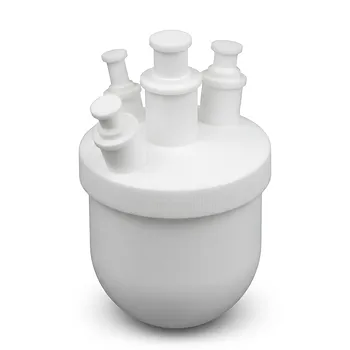
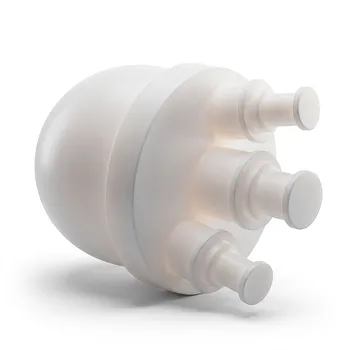
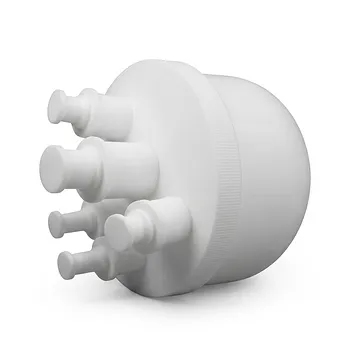
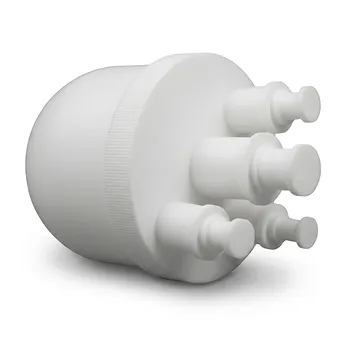
Custom reaction vessels for gaseous fluorinated monomers must be designed as both high-performance gas–liquid contactors and chemically resistant pressure systems. In vinylidene fluoride (VDF) emulsion polymerization, the monomer is present primarily in the gas phase rather than as liquid droplets, so the vessel must promote controlled transfer from the headspace into the aqueous latex. The most critical factors are gas–liquid contacting, agitation and shear control, pressure and temperature management, material compatibility, sealing, heat removal, and precise semi-batch monomer feeding.
The vessel must provide enough interfacial area and mixing to sustain monomer transport without destabilizing the latex. Chemical resistance alone is insufficient: the pressure boundary, seals, agitator, instrumentation, heat-transfer system, and feed controls must work together under the reaction’s pressure, temperature, and chemical conditions.
Designing Around Gas–Liquid Mass Transfer
Create Sufficient Gas–Water Interfacial Area
Because VDF is gaseous under typical reaction conditions, polymerization depends on transferring monomer from the reactor headspace into the aqueous phase and then into the latex particles.
The vessel geometry, liquid fill level, headspace volume, gas-distribution method, impeller, and baffles should therefore be evaluated as one mass-transfer system. A vessel that mixes the liquid effectively but leaves poor contact with the headspace can still limit polymerization performance.
Optimize the Stirrer and Baffles
The impeller should provide reliable circulation between the headspace interface and the bulk liquid without creating excessive localized shear. Baffles can reduce bulk swirling and improve axial or radial turnover, depending on the selected impeller and vessel proportions.
The correct configuration is process-specific. It should be established through mixing studies, gas-transfer testing, or scale-up data rather than by selecting an agitator solely from vessel size.
Control Agitation Precisely
Moderate agitation generally supports steady monomer transport and helps maintain a stable latex. Excessive agitation can increase shear, promote particle collisions, destabilize the emulsion, and cause premature breakdown.
The drive system should provide accurate speed control over the intended operating range. Torque monitoring is also valuable because changes in torque can indicate viscosity changes, fouling, solids accumulation, or an emerging stability problem.
Managing Pressure, Temperature, and Reaction Heat
Design the Pressure Boundary First
A gaseous monomer process requires a vessel rated for the maximum credible operating and upset conditions, including monomer feed, heating, cooling failure, gas expansion, and blocked outlets.
The pressure boundary should not rely on the chemical resistance of a fluoropolymer alone. PTFE and PFA are highly resistant wetted materials, but their mechanical strength, creep behavior, thermal expansion, and pressure capability must be considered. A practical design may use chemically resistant fluoropolymer liners or wetted components within a structurally rated metal vessel, where appropriate for the chemistry and contamination requirements.
Provide Reliable Temperature Control
Temperature affects monomer solubility, reaction rate, latex stability, pressure, and heat removal requirements. The vessel should therefore include a properly sized jacket, internal heat-transfer surface, or another validated cooling arrangement.
Temperature sensors should measure the reaction mixture rather than relying only on jacket temperature. The control system should also account for sensor response time and the possibility that polymerization heat generation changes during semi-batch operation.
Allow for Thermal Expansion and Creep
Fluoropolymers have a relatively high coefficient of thermal expansion and can deform or creep under sustained mechanical load. These effects can change clearances, distort sealing surfaces, and alter the alignment of rotating components during temperature cycling.
Custom parts should be designed with suitable allowances for expansion, restrained carefully, and checked at operating temperature. Machining should use sharp tooling, controlled feeds, and temperature management to avoid distortion during fabrication.
Selecting Materials for the Complete System
Separate Chemical Compatibility from Structural Function
Wetted components must resist fluorinated surfactants, initiators, aqueous media, monomer, and reaction intermediates. High-purity PTFE or PFA may be appropriate for wetted liners, tubing, fittings, valve seats, and other chemically exposed parts.
However, chemical inertness does not automatically make a material suitable for the load-bearing vessel, agitator shaft, support structure, or pressure-retaining closure. Each component requires separate evaluation of chemical exposure, mechanical loading, temperature, permeability, and service life.
Control Contamination
Trace contamination can affect nucleation, particle size, reaction rate, and final polymer properties. Materials should be selected not only for resistance to degradation but also for low extractables, low particulate generation, and compatibility with the cleaning and sterilization or passivation procedures used in the process.
Avoiding unnecessary material changes, dead legs, and inaccessible crevices reduces the risk of residue accumulation and cross-batch contamination.
Use Appropriate Seals and Feedthroughs
Mechanical seals, gaskets, valve seats, sampling ports, and agitator feedthroughs are common failure points. Seal materials must tolerate the monomer, aqueous phase, surfactants, initiator system, pressure, temperature, and repeated cycling.
The supplementary references correctly emphasize that aggressive elemental fluorine service requires especially robust fluoropolymer components. That requirement should not be transferred uncritically to ordinary VDF emulsion polymerization, but the broader lesson remains valid: seal selection must be based on the actual chemistry, not on the vessel material alone.
Engineering the Monomer Feed and Headspace
Maintain Controlled Semi-Batch Feeding
VDF feed rate influences pressure, monomer availability, polymerization rate, particle growth, and heat generation. The vessel should support accurate, repeatable semi-batch dosing with appropriate isolation, non-return protection, and flow or mass monitoring.
The feed system should be designed to prevent uncontrolled pressure excursions and to maintain stable operating conditions when feed rate changes during the batch.
Prevent Feed-Line Condensation and Restrictions
Temperature differences between the monomer supply, feed line, and reactor can affect phase behavior and delivery consistency. Feed lines should be routed and insulated or temperature-controlled as required by the process design.
Valves, filters, restrictions, and dead volumes should be minimized or selected so that they do not become plugging points or create large uncontrolled changes in feed rate.
Manage the Headspace Deliberately
Headspace is part of the reaction system because it stores monomer and provides the gas–liquid interface. Its volume, shape, pressure measurement location, and gas circulation pattern can influence transfer behavior and response to feed changes.
The design should also include provisions for inerting, evacuation, venting, sampling, and safe isolation consistent with the monomer’s flammability, toxicity, and pressure hazards.
Protecting Latex Quality
Avoid Excessive Localized Shear
Latex stability depends on more than average agitation speed. Impeller tip speed, clearance, baffle geometry, shaft alignment, gas entrainment, and local turbulence can all affect particle stability.
The impeller should be positioned to circulate the full liquid volume while avoiding intense shear zones near the surface, vessel wall, feed point, or gas inlet.
Minimize Fouling and Dead Zones
Polymer deposits can form on vessel walls, baffles, probes, seals, and gas inlets. Deposits reduce heat transfer, alter mixing, interfere with instrumentation, and may later detach as contamination.
Smooth internal surfaces, accessible cleaning paths, appropriate nozzle placement, and minimized crevices are important. The vessel should be designed for inspection and cleaning rather than treating cleaning as a separate operational problem.
Preserve Instrument Reliability
Pressure, temperature, agitation speed, feed rate, and potentially level or torque should be measured with instruments compatible with the process environment. Probe placement matters because measurements from poorly mixed or gas-exposed regions may not represent bulk conditions.
Critical measurements should have independent alarms or shutdown functions where a sensor failure could create a pressure, temperature, or latex-stability hazard.
Understanding the Trade-offs
More Agitation Does Not Always Improve Performance
Increasing speed can improve circulation and gas transfer, but it also increases shear, power demand, mechanical loading, and the risk of latex destabilization.
The objective is not maximum mixing intensity. It is the lowest agitation level that reliably provides the required monomer transfer and suspension quality.
Fluoropolymer Components Offer Resistance but Have Mechanical Limits
PTFE and PFA provide strong chemical resistance and low contamination risk, but they can creep, expand substantially with temperature, and be difficult to use as unsupported pressure-retaining structures.
A fluoropolymer-lined pressure vessel or hybrid construction may provide a better balance between chemical compatibility and mechanical integrity than an entirely fluoropolymer pressure vessel.
Higher Pressure Can Improve Monomer Availability but Raises Risk
Increasing pressure can affect the amount of gaseous monomer available to the aqueous phase and may improve process throughput. It also increases requirements for vessel certification, closure design, relief protection, feed isolation, leak testing, and operational controls.
Pressure should therefore be selected from reaction and mass-transfer requirements, then matched by a documented mechanical design basis.
Direct Fluorination Guidance Is Not Automatically VDF Guidance
The supplementary references focus partly on elemental fluorine and fluorinated plasma systems, which are substantially more aggressive than a VDF emulsion-polymerization environment. Their recommendations about high-purity fluoropolymers, seals, and contamination control are useful where chemically relevant, but the materials and hazard analysis must be based on the actual VDF formulation.
Making the Right Choice for Your Goal
The vessel should be specified from a complete process and mechanical design basis rather than from a reactor volume alone.
- If your primary focus is stable polymerization: Prioritize optimized impeller and baffle geometry, controlled agitation, sufficient headspace contact, reliable temperature control, and feed-rate stability.
- If your primary focus is pressure safety: Define all credible pressure and temperature excursions, use a structurally rated pressure boundary, and provide validated relief, isolation, and leak-detection measures.
- If your primary focus is chemical purity: Use compatible high-purity wetted materials, minimize crevices and extractables, and design for repeatable cleaning and inspection.
- If your primary focus is scale-up: Preserve relevant mixing, gas-transfer, shear, heat-removal, and feed-control conditions rather than scaling only by geometric volume.
- If your primary focus is long service life: Account for fluoropolymer creep, thermal expansion, seal aging, shaft alignment, fouling, and repeated pressure and temperature cycles during the original design.
A successful custom vessel treats gas transfer, latex stability, chemical compatibility, pressure integrity, and controllability as one integrated engineering problem.
Summary Table:
| Design Factor | Key Considerations |
|---|---|
| Gas–Liquid Mass Transfer | Maximize interfacial area, optimize impeller/baffles, control agitation |
| Pressure & Temperature | Design pressure boundary, reliable temperature control, handle thermal expansion |
| Materials & Seals | Chemical compatibility, structural integrity, low contamination, robust seals |
| Monomer Feed & Headspace | Controlled feeding, avoid condensation, manage headspace |
| Latex Quality | Minimize shear, prevent fouling, ensure instrument reliability |
| Trade-offs | Balance mixing vs. shear, fluoropolymer limits, pressure vs. risk |
Optimize your custom reaction vessel with KINTEK's high-performance PTFE/PFA components. From impellers to seals, our fluoropolymer expertise ensures chemical resistance, purity, and reliability. Contact us today to discuss your design.
Related Products
- Customizable PTFE Reaction Vessel with Electric Stirring Paddle and Buchner Funnel Vacuum Filtration System
- PFA Chemical Reaction Tank with Customizable Fittings for Corrosive Solvent Synthesis and High Purity Lab Applications
- Custom PTFE Continuous Reaction Bottles Virgin Fluoropolymer High Purity Low Background Synthesis Vessels
- Custom PFA Reaction Bottles High Purity PTFE Reaction Vessels Corrosion Resistant Petrochemical Containers
- PTFE 10L Reaction Vessel with Stirring Paddle Customizable Corrosion Resistant High Temperature Reactor for Biopharmaceutical and Chemical Processing
People Also Ask
- Why are fluoroplastic (PTFE) reaction vessels recommended for Methylene Blue (MB) adsorption kinetic experiments?
- Why are high-purity PTFE or PFA reaction vessels recommended for the synthesis of PANI-TiC hybrid materials? - Guide
- What reaction vessel and fluid handling considerations are necessary for living cationic polymerization of fluorinated monomers involving Lewis acid catalysts? Key design and safety tips
- Why is a high-quality PTFE reaction vessel required for the etching preparation of Ti3C2Tx MXene? Ensure Pure Synthesis.
- How do perfluorinated solvent environments influence the selection of reaction vessels and fluid handling components in nonaqueous emulsion polymerizations? Choose fluoropolymer materials.