Fluorinated polymethacrylate matrices trade some thermal endurance for practical melt processability. They typically contain about 60 wt% fluorine, versus approximately 75 wt% for PTFE, and begin measurable thermal degradation above 200 °C, with essentially complete degradation by 400 °C in both argon and air. In contrast, PTFE has a higher thermal operating window but is conventionally regarded as non-melt-processable because its melt viscosity is extremely high.
Core takeaway: Fluorinated polymethacrylates are better suited to conventional thermoplastic manufacturing, including melt extrusion and high particle loading, but they cannot match PTFE’s long-term thermal stability or high-temperature degradation resistance.
How the Thermal Limits Compare
Fluorinated polymethacrylate degradation range
The referenced fluorinated polymethacrylate composites begin degrading at temperatures above approximately 200 °C. Thermal degradation is effectively complete by 400 °C, whether the material is exposed to an inert argon atmosphere or an oxidizing air atmosphere.
These temperatures define a practical upper boundary for processing and energetic applications. Exposure near or above this range should not be treated as a normal operating condition because polymer decomposition can compromise mechanical integrity and generate degradation products.
PTFE’s broader thermal stability
PTFE has substantially greater thermal resistance. Its typical continuous-use limit is approximately 260 °C, while its melting transition occurs near 327 °C.
Melting does not mean that PTFE can be processed like an ordinary thermoplastic. Above its melting point, PTFE remains extremely viscous, and conventional flow-based molding or extrusion is generally impractical.
Degradation is not the same as melting
The comparison requires separating three different temperature concepts:
- Continuous-use temperature: the range in which the material can function for extended periods.
- Melting or softening temperature: the point at which crystalline regions lose their ordered structure.
- Degradation temperature: the point at which chemical bonds begin breaking down.
Fluorinated polymethacrylates offer useful melt processing at temperatures below their ultimate degradation range. PTFE melts at a higher temperature and remains chemically stable over a broader range, but its melt viscosity prevents standard thermoplastic processing.
Melt-Processing Capabilities
Fluorinated polymethacrylates are conventionally processable
Fluorinated polymethacrylate matrices can be processed using conventional melt extrusion techniques. This is the primary manufacturing advantage over standard PTFE.
Their thermoplastic behavior allows the material to be heated, shaped, and cooled using equipment and process concepts used for other thermoplastics, provided that the processing temperature remains below the onset of significant degradation.
High filler or particle loadings are possible
The referenced composites can accommodate particle loadings of up to approximately 60 wt% while remaining suitable for melt extrusion.
They retain thermoplastic behavior up to approximately 70 wt% loading, although high loading will generally reduce the amount of polymer available to flow and can increase viscosity. In practice, the usable limit depends on particle size, dispersion, surface chemistry, and the required mechanical properties.
PTFE requires specialized fabrication
Standard PTFE is typically formed through compression molding, sintering, paste extrusion, or machining, rather than ordinary melt extrusion.
Although PTFE passes through a melting transition around 327 °C, its melt viscosity is orders of magnitude higher than that of melt-processable fluoropolymers. This makes conventional injection molding and melt extrusion unsuitable for standard PTFE in most applications.
What the Fluorine Content Means
Higher fluorine content generally supports resistance
PTFE’s approximately 75 wt% fluorine content contributes to its exceptional chemical resistance, low surface energy, and high thermal stability.
Fluorinated polymethacrylates generally contain around 60 wt% fluorine because their structures include non-fluorinated methacrylate subunits. This lower fluorine fraction helps explain why their thermal degradation window is narrower than PTFE’s, although fluorine content alone does not determine all material properties.
Polymer architecture also controls processability
The difference is not simply a matter of fluorine percentage. PTFE’s molecular structure produces highly stable chains but also exceptionally high melt viscosity.
Fluorinated polymethacrylates incorporate a matrix architecture that provides thermoplastic flow. The result is a material that is easier to manufacture but reaches its chemical degradation limit at lower temperatures than PTFE.
Understanding the Trade-offs
Processing convenience versus thermal endurance
The main trade-off is straightforward:
- Fluorinated polymethacrylates: easier to extrude and shape, but degradation begins above roughly 200 °C.
- PTFE: much more thermally robust, but difficult to process using conventional melt equipment.
A process engineer should therefore avoid selecting PTFE solely because it has a melting point. Its melting transition does not provide the same manufacturing flexibility as a conventional thermoplastic melt.
Processing temperature must remain below the degradation boundary
For fluorinated polymethacrylates, the fact that the material remains thermoplastic up to high particle loading does not eliminate the need for thermal control.
Processing should be designed with adequate margin below the temperature where degradation begins. Residence time, shear heating, repeated thermal cycles, and local hot spots can all increase the risk of molecular-weight loss or discoloration.
Inert atmospheres do not remove the fundamental limit
The referenced fluorinated polymethacrylate composites reach complete degradation by about 400 °C in both argon and air.
An inert atmosphere may reduce oxidation-related reactions, but it does not prevent the polymer backbone from thermally decomposing. Atmosphere selection therefore cannot be used to extend the material’s temperature limit indefinitely.
PTFE also has a practical service limit
PTFE can tolerate far greater temperatures before rapid decomposition, but its recommended continuous-use temperature remains approximately 260 °C.
Long-term performance must also account for mechanical loading, dimensional stability, pressure, thermal cycling, and possible contamination from decomposition products. A high decomposition temperature is not equivalent to an unlimited operating temperature.
Choosing Between the Two
When fluorinated polymethacrylates are the better choice
Use a fluorinated polymethacrylate matrix when the application requires:
- Conventional melt extrusion or thermoplastic forming
- High particle or filler loading
- Complex profiles or continuous extruded parts
- Manufacturing flexibility and shorter fabrication cycles
- Operating temperatures that remain comfortably below the approximately 200 °C degradation onset
When PTFE is the better choice
Use PTFE when the application requires:
- Maximum long-term thermal resistance
- A continuous-use temperature near 260 °C
- Superior resistance to thermal breakdown above the fluorinated polymethacrylate range
- Extreme chemical resistance and low-friction performance
- Components that can be produced by sintering, compression molding, paste extrusion, or machining
Making the Right Choice for Your Goal
Material selection should begin with the actual processing method and temperature history, not fluorine content alone.
- If your primary focus is conventional melt manufacturing: Choose a fluorinated polymethacrylate system because it supports melt extrusion and remains thermoplastic at particle loadings approaching 70 wt%, subject to viscosity and dispersion constraints.
- If your primary focus is maximum thermal endurance: Choose PTFE because it has a higher fluorine content, a continuous-use limit near 260 °C, and a substantially broader resistance to thermal degradation.
- If your primary focus is high filler loading: Evaluate fluorinated polymethacrylates first, since the referenced systems can be extruded with up to approximately 60 wt% particles.
- If your primary focus is operation near or above 260 °C: Treat PTFE as the more credible candidate, while recognizing that it still requires specialized forming and should not be selected solely on the basis of its melting point.
The essential decision is whether the application values thermoplastic manufacturability or PTFE-level thermal endurance more highly.
Summary Table:
| Property | Fluorinated Polymethacrylate | PTFE |
|---|---|---|
| Fluorine Content | ~60 wt% | ~75 wt% |
| Degradation Onset | ~200 °C | >400 °C |
| Continuous Use Temp. | <200 °C | ~260 °C |
| Melt Processability | Conventional melt extrusion | Not melt-processable (sintering, etc.) |
| Maximum Filler Loading | ~60-70 wt% | N/A |
Ready to Choose the Right Fluoropolymer?
At KINTEK, we specialize in high-performance fluoropolymers like PTFE and PFA. Our expertise in custom CNC machining and labware manufacturing means we can provide the exact solution for your thermal and processing needs. Whether you're working with fluorinated polymethacrylates or need robust PTFE components, our team is here to help.
Contact us today to discuss your application and get a tailored recommendation.
Related Products
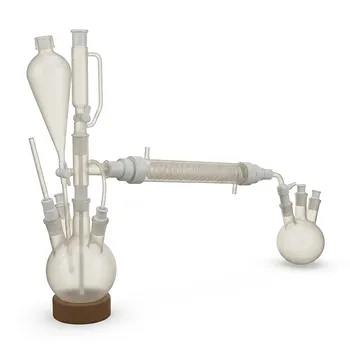
- PTFE Distillation Condensation Apparatus High Temperature Hydrofluoric Acid Resistant Fluorination Reaction Flask
- Large Capacity PTFE Reaction Flask 20L Custom Multi Neck Laboratory Boiling Flask Fluoropolymer Chemical Processing Vessel
- High Purity PTFE Single Neck Reaction Flask Acid Resistant Customizable Fluoropolymer Laboratory Reactor
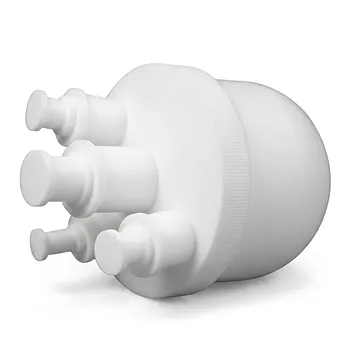
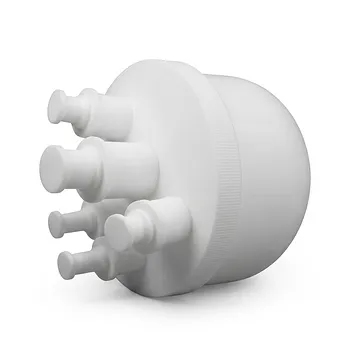
- Custom Multi Neck PTFE Flask for Chemical Engineering and High Purity Laboratory Synthesis Applications
- Custom PFA Reaction Bottles High Purity PTFE Reaction Vessels Corrosion Resistant Petrochemical Containers
People Also Ask
- How does the low surface energy of PTFE benefit the condensation process? Boost Heat Transfer and Prevent Fouling
- What structural characteristics provide PTFE fluoropolymer laboratory apparatus with high thermal stability? Strong C-F bonds, dense fluorine shielding, and rigid helical conformation ensure stability during high-temperature analysis.
- How can autopolymerization of TFE gas be prevented during storage and handling? Master TFE safety with oxygen control, inhibitors, and robust system design.
- When synthesizing fluorinated polymers using volatile and toxic monomers like octafluorocyclopentene (OFCP) or decafluorocyclohexene (DFCH), what material safety and thermal features are required for fluoropolymer laboratory reaction apparatus and fluid h
- How do pyrolysis temperature and steam diluent ratios influence tetrafluoroethylene (TFE) conversion and yield in fluoropolymer monomer reaction apparatus? Optimize TFE yield with temperature and steam control