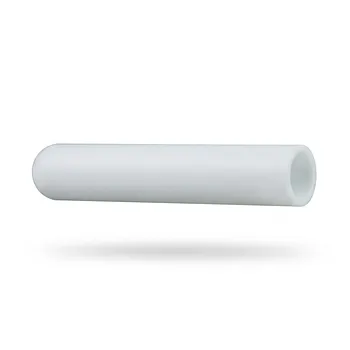
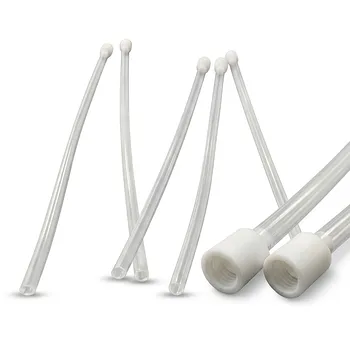
Core-shell modified PTFE resin is structurally engineered for extreme paste extrusion. Its particles contain different concentrations of comonomer in the core and outer shell, improving deformation and fibrillation during processing. This enables fine-powder PTFE to reach reduction ratios exceeding 10,000:1 with lower extrusion pressure, making it suitable for thin-walled tubing and wire insulation with fewer defects.
The core-shell architecture balances processability and final-part performance: it allows high reduction-ratio extrusion while reducing pressure-related flaws, helping produce tubing with consistent walls, smooth surfaces, high clarity, and strong flex-fatigue resistance.
Why High Reduction Ratios Are Difficult
Reduction ratio increases processing stress
The reduction ratio compares the cross-sectional area of the paste in the extruder barrel with the cross-sectional area of the finished tubing. Very thin walls and narrow profiles require the material to undergo substantial reduction, which increases extrusion pressure and stresses the resin.
If the resin cannot deform and fibrillate uniformly, the result may be micro-cracks, voids, wall-thickness variation, or poor mechanical integrity.
Conventional fine powders impose a processing limit
Standard PTFE fine powders vary considerably in their reduction-ratio capability and extrusion pressure requirements. Processing beyond a resin’s suitable range can overburden equipment and create defects in the extrudate.
The practical challenge is therefore not simply forcing more material through a smaller die. The resin must form a cohesive, continuous structure while flowing through the tooling.
How the Core-Shell Structure Improves Extrusion
Differential comonomer distribution changes particle behavior
In core-shell modified PTFE, the core and outer shell contain different concentrations of modifier comonomer, such as perfluoroalkyl vinyl ether. The particle is therefore not chemically uniform; it is designed to respond more favorably to the stresses of paste extrusion.
The core can provide the required deformability, while the particle architecture supports controlled fibril formation as the paste is compacted and reduced.
The particles fibrillate more effectively
PTFE paste extrusion depends on the formation of fibrils that knit the powder into a coherent extrudate. Core-shell modification improves the resin’s ability to generate this structure without requiring the same level of extrusion pressure associated with less-extrudable grades.
This is the central structural advantage: the resin can sustain large geometric reductions while maintaining continuity in the polymer network.
Lower pressure supports smoother die flow
At a given high reduction ratio, improved paste extrudability reduces the pressure required to move the material through the die. Lower pressure can reduce excessive shear and stress concentrations in both the resin and the processing equipment.
The result is smoother flow through forming dies and a lower likelihood of pressure-induced surface or internal flaws.
Advantages in Thin-Walled Tubing
More consistent wall structure
Uniform fibrillation and improved flow help maintain consistent wall thickness and density along the tube. This is essential when the tubing must withstand internal pressure or prevent leakage in fluid-transfer applications.
A resin selected for the required reduction ratio is less likely to produce localized weak areas or dimensional variation.
Fewer micro-defects and cracks
High reduction ratios amplify the consequences of poor resin behavior. Core-shell modified PTFE reduces the tendency toward structural micro-flaws by allowing the powder to deform cohesively rather than fracture or separate during extrusion.
This supports reliable performance in thin-wall tubing, narrow fluid lines, and electrical insulation.
Better surface quality and optical clarity
The improved particle structure can produce smoother internal and external surfaces with fewer visible or microscopic irregularities. Modified PTFE also offers improved optical clarity compared with standard homopolymer grades.
For laboratory tubing, this can make the product easier to inspect while helping reduce sites where contamination or fluid retention might occur.
Benefits Beyond Extrusion
Higher flex-fatigue life
Modified PTFE generally provides superior flex-fatigue performance. This is valuable for tubing that is repeatedly bent, repositioned, or exposed to vibration.
The benefit is particularly important when a high reduction ratio produces a thin, flexible wall that must still resist repeated mechanical cycling.
Improved stress-crack resistance
The modified structure can improve resistance to stress cracking and reduce the risk of premature failure under mechanical and chemical loading. This supports use with aggressive reagents and demanding fluid-transfer conditions.
Lower chemical permeability
Modified PTFE components can provide lower chemical permeability than standard materials. In thin-wall tubing, this helps limit permeation of aggressive fluids and supports cleaner, more reliable containment.
Better secondary fabrication performance
Core-shell modified PTFE products can respond well to operations such as flanging, welding, convoluting, and blow molding. This expands design flexibility after the primary extrusion step.
Understanding the Trade-offs
High reduction capability does not eliminate process control
A resin capable of exceeding 10,000:1 reduction ratios still requires appropriate lubricant concentration, die geometry, extrusion speed, and tooling design. Poorly selected processing conditions can create defects even when the resin itself has high capability.
Extrusion pressure remains an important selection criterion
Lower pressure is beneficial, but the resin must still generate adequate compaction and fibrillation. Excessively low or poorly matched processing conditions may compromise cohesion, density, or mechanical strength.
The correct target is controlled pressure with complete structural consolidation, not simply the lowest possible pressure.
Resin capability must match part geometry
Reduction ratio depends on the preform and finished-part cross-sectional areas. Engineers should calculate the required ratio for the specific tubing geometry and compare it with the resin’s recommended operating range.
Processing a grade outside its capability can still cause wall variation, cracks, or reduced burst resistance.
Material properties remain application-dependent
Core-shell modification improves extrudability and several performance characteristics, but resin selection must also consider chemical resistance, thermal stability, mechanical strength, clarity, and the demands of subsequent fabrication.
High reduction-ratio capability should be treated as one critical selection criterion rather than the sole basis for material choice.
Making the Right Choice for Your Goal
Select the resin and process together; the highest reduction ratio is useful only when it produces a defect-free part with the required end-use properties.
- If your primary focus is ultra-thin tubing: Choose a core-shell modified fine powder with a reduction-ratio capability exceeding the calculated geometry requirement, then optimize die design, lubricant level, and extrusion speed.
- If your primary focus is dimensional consistency: Prioritize the grade’s pressure behavior and fibrillation stability to minimize wall-thickness variation and internal defects.
- If your primary focus is flexing or repeated handling: Use the improved flex-fatigue and stress-crack resistance of modified PTFE to support thin, flexible tubing designs.
- If your primary focus is high-purity fluid transfer: Favor the smoother, lower-defect surfaces and lower permeability associated with properly processed modified PTFE.
- If your primary focus is wire insulation: Use the core-shell resin’s high reduction-ratio processability to form thin insulation layers without excessive extrusion pressure or micro-flaws.
Core-shell modified PTFE resin enables extreme material reduction while preserving the continuous, defect-resistant structure required for reliable thin-walled fluoropolymer tubing.
Summary Table:
| Feature | Benefit |
|---|---|
| Differential comonomer distribution | Enhanced deformability and fibrillation |
| Improved fibrillation | Cohesive extrudate at high reduction ratios |
| Lower extrusion pressure | Reduced defects and smoother flow |
| Consistent wall thickness | Reliable performance in fluid transfer |
| Fewer micro-defects | Improved mechanical integrity |
| Better surface quality | Easier inspection and lower contamination risk |
| Higher flex-fatigue life | Suitable for repeated bending and vibration |
| Improved stress-crack resistance | Withstands mechanical and chemical loading |
| Lower chemical permeability | Cleaner containment of aggressive fluids |
| Better secondary fabrication | Flanging, welding, convoluting, blow molding |
Ready to Upgrade Your Tubing Performance?
At KINTEK, our core-shell modified PTFE resin enables you to produce thin-walled fluoropolymer tubing with extreme reduction ratios, defect-free surfaces, and superior flex-fatigue resistance. Ideal for high-purity fluid transfer, wire insulation, and demanding laboratory applications, our materials are backed by end-to-end PTFE/PFA custom CNC machining capabilities, ensuring precise, reliable components for your specific needs. Contact our experts today to discuss your project and discover how our advanced fluoropolymer solutions can enhance your product's performance and reliability.
Contact us now for a personalized consultation!
Related Products
- Custom PTFE Digestion Tube Double Sided Openable High Temperature Corrosion Resistant Low Background
- Custom PTFE Digestion Tubes and Corrosion Resistant Centrifuge Tube Racks for Low Background Trace Analysis
- High Purity PFA Coiled Tubing Custom PTFE Machining PFA Welding and Precision Bending Solutions
- Custom PTFE Condenser Tube 100ml Serpentine and Straight Fluoropolymer Laboratory Heat Exchanger with Flask Adapters
- Custom PTFE Test Tubes Corrosion Resistant Low Background Fluoropolymer Labware 50ml 30ml
People Also Ask
- How do PTFE digestion tubes facilitate the analysis of food and agricultural products? Ensure High-Purity Mineralization
- What is the primary role of a PTFE digestion tube in analytical chemistry? Ensure High Purity and Trace Accuracy
- How does a PTFE digestion tube facilitate sample decomposition in a conventional hot-block heating system? Boost Efficiency & Purity
- What are the common capacities and physical configurations available for PTFE digestion tubes? Expert Selection Guide
- What is the primary function of PTFE digestion tubes in a laboratory setting? Essential for Pure Sample Mineralization