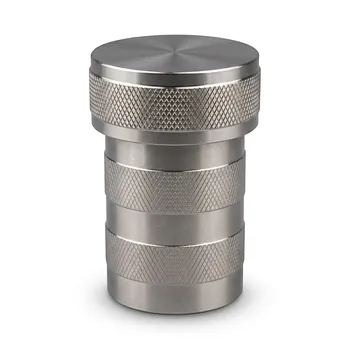
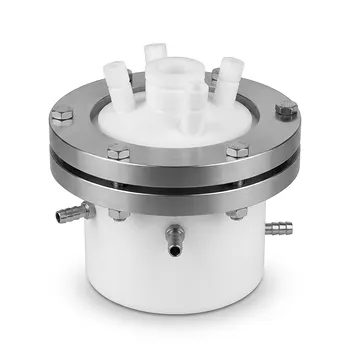
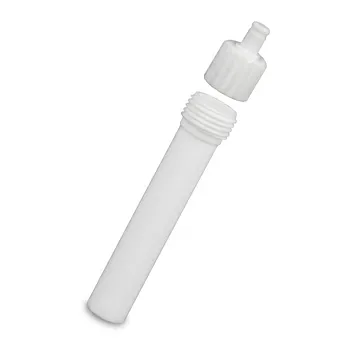
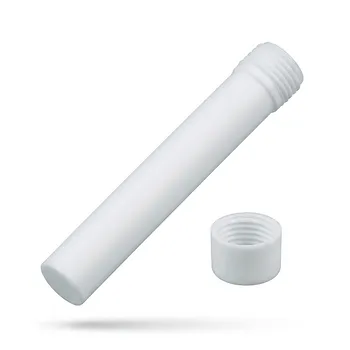
Selecting a PTFE-lined autoclave over traditional glass is essential for $TiO_2$ synthesis because it provides critical resistance to the aggressive acidic or alkaline precursors required for the hydrothermal method. While glass containers are susceptible to etching and lack the structural integrity for high-pressure reactions, PTFE liners offer extreme chemical inertness and a non-stick surface that prevents metal ion contamination and ensures phase purity.
Core Takeaway: PTFE-lined autoclaves enable $TiO_2$ synthesis under extreme pH and temperature conditions that would compromise glass, ensuring the production of high-purity nanoparticles by providing a sealed, non-reactive, and contamination-free environment.
Superior Chemical Resistance in Aggressive Media
Protection Against Corrosive pH Environments
Hydrothermal synthesis of $TiO_2$ often requires strong acids like hydrochloric acid or strong bases like 1M sodium hydroxide. PTFE (polytetrafluoroethylene) remains chemically inert in these environments, whereas glass can leach silica or even dissolve (etch) when exposed to concentrated alkaline solutions at high temperatures.
Elimination of Metal Ion Contamination
The PTFE liner acts as a definitive barrier between the reaction media and the stainless steel body of the autoclave. This prevents the corrosive solvents from attacking the metal shell, ensuring that no impurity ions are introduced into the system, which is vital for maintaining the optical performance of the titanium dioxide.
Enhanced Structural and Thermal Stability
Handling High-Pressure Environments
The hydrothermal method relies on the sealed environment of an autoclave to generate high internal pressures that accelerate the breaking and recombination of chemical bonds. Unlike glass, which poses a significant risk of failure under pressure, the PTFE liner within a steel jacket safely facilitates the synthesis of vertically aligned, single-crystal nanowire arrays.
Extended Temperature Operating Ranges
While standard glass containers are limited by thermal shock and structural integrity, PTFE-lined systems can reliably operate at temperatures ranging from 120°C to 220°C. This thermal stability is necessary for the directional growth of complex nanostructures and the formation of precise heterojunctions.
Optimized Morphology and Yield
Non-Stick Surface for Precursor Integrity
The highly hydrophobic and non-stick surface of PTFE prevents reaction precursors and nanomaterials from adhering to the vessel walls. This ensures that the synthesized $TiO_2$ nanotubes or particles do not become "lost" to the container surface, maintaining high structural integrity and yield.
Facilitating Heterogeneous Nucleation
By providing a stable and clean interface, PTFE liners support the heterogeneous nucleation of titanium sources onto specific substrates, such as FTO glass. This level of control is difficult to achieve in glass containers where surface interactions can interfere with the intended growth pattern of the nanostructures.
Understanding the Trade-offs
Temperature Limitations of PTFE
Despite its advantages, PTFE has a strict upper temperature limit, typically around 250°C, above which it begins to soften and lose its sealing properties. For reactions requiring temperatures higher than this, specialized materials like PPL (polyphenylene polymers) or quartz liners may be necessary.
Pressure Sensitivity and Cooling Rates
While the steel jacket provides strength, the PTFE liner inside can deform if the autoclave is cooled too rapidly or subjected to excessive pressure beyond its design limit. Users must balance the high-pressure benefits with controlled heating and cooling cycles to prevent "creeping" or permanent deformation of the liner.
Making the Right Choice for Your Goal
To determine if a PTFE-lined autoclave is the appropriate choice for your specific $TiO_2$ project, consider the following recommendations:
- If your primary focus is phase purity and optical performance: Use a high-purity PTFE liner to completely eliminate the risk of metal ion leaching from the autoclave body.
- If your primary focus is synthesis in strong alkaline media (e.g., NaOH): Avoid glass entirely and utilize PTFE, as it is uniquely resistant to the caustic etching that occurs at elevated temperatures.
- If your primary focus is producing complex nanostructures like nanowires: Leverage the non-stick properties of PTFE to ensure uniform growth and easy recovery of the nanomaterials from the vessel.
The transition from glass to PTFE-lined autoclaves represents a move toward greater process control, safety, and material consistency in advanced chemical synthesis.
Summary Table:
| Feature | Traditional Glass Containers | PTFE-Lined Synthesis Autoclave |
|---|---|---|
| Chemical Resistance | Susceptible to etching by strong acids/bases | Highly inert to aggressive pH environments |
| Pressure Capability | High risk of failure/explosion | Safe operation under high internal pressures |
| Purity & Leaching | Risk of silica or metal ion leaching | Zero metal ion contamination; PFA/PTFE inertness |
| Temperature Range | Limited by thermal shock | Stable performance from 120°C to 220°C |
| Material Yield | Precursors stick to vessel walls | Non-stick surface ensures high yield and recovery |
Elevate Your Synthesis with KINTEK’s Fluoropolymer Expertise
Achieving high-purity results in hydrothermal synthesis requires equipment that can withstand the most demanding chemical environments. KINTEK specializes in high-performance PTFE and PFA laboratory solutions designed to eliminate contamination and ensure process stability.
From everyday basic labware like beakers, crucibles, and digestion tubes to advanced hydrothermal synthesis liners, microwave digestion vessels, and custom electrochemical cells, we provide the tools researchers trust. Our capabilities extend to end-to-end custom CNC fabrication, allowing us to deliver everything from complex non-standard machined parts to high-volume orders of fluid transfer components, filters, and high-purity trace analysis instruments.
Don't let equipment limitations compromise your material's phase purity. Contact us today to discover how KINTEK’s precision-engineered fluoropolymer solutions can optimize your laboratory workflow.
References
- Sergio Belda-Marco, María Carmen Román‐Martínez. Optimization of Active Sites in TiO <sub>2</sub> –Cu Photocatalysts for H <sub>2</sub> Generation via Cellulose Photo‐Reforming. DOI: 10.1002/cctc.202500250
This article is also based on technical information from Kintek Knowledge Base .
Related Products
- PTFE Lined High Pressure Digestion Vessel 50ml High Temperature Hydrothermal Synthesis Tank
- Custom TFM Reaction Vessel with Stainless Steel Jacket and PTFE Inner Cup for High Corrosion Resistance
- High Temperature Corrosion Resistant Hydrothermal Synthesis Reactor with TFM Inner Liner and Straight Cylinder Design
- High Pressure Custom TFM Reactor Stainless Steel Outer Vessel PTFE Inner Cup for Corrosive Synthesis
- Custom PTFE Reaction System with Hose Barb Fittings Corrosion Resistant High Sealing 2L 4L Lab Reactor with Separatory Funnel
People Also Ask
- What are the benefits of using a PTFE-lined vessel for carbon-sulfur cathode treatment? Maximize Purity & Performance
- Why are PTFE-lined pressure digestion vessels required for the preparation of Ag/CeO2 catalysts? Purity & Performance
- What safety features are typically incorporated into high-pressure PTFE digestion vessel designs? Ensure Lab Safety
- What is the function of PTFE lined high-pressure vessels in g-C3N4 synthesis? Achieve High-Purity Material Growth
- Role of High-Pressure Digestion Tanks in Perovskite Synthesis: Achieve Superior Stability and Latent Heat