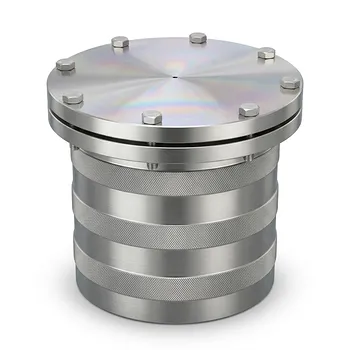
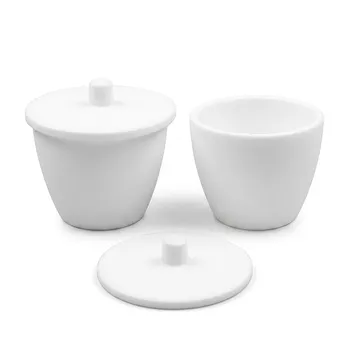
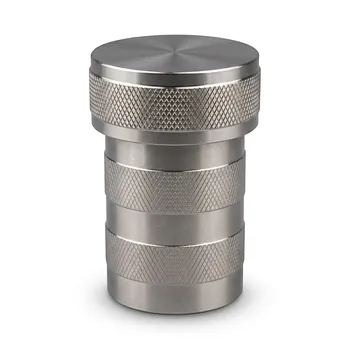
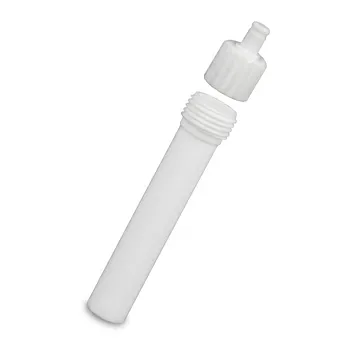
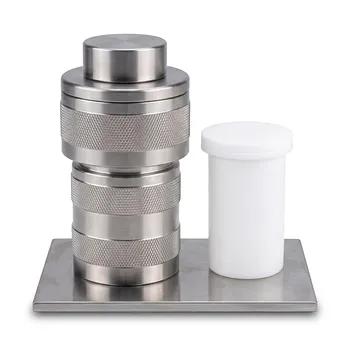
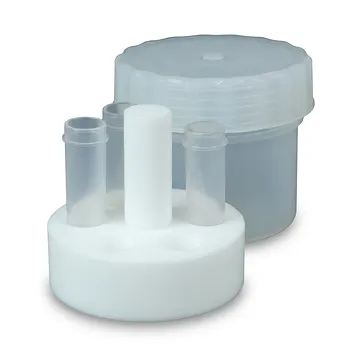
In hydrothermal synthesis, a Teflon-lined stainless steel autoclave acts as a specialized pressure vessel that creates a high-purity, high-energy environment. It functions primarily by using its stainless steel shell to withstand high internal pressures while its Teflon liner prevents chemical corrosion and sample contamination. This dual-material design is essential for successfully growing crystalline SnO2 nanoparticles directly onto a nanocellulose matrix.
The core function of this autoclave is to safely facilitate the dissolution and recrystallization of precursors at temperatures and pressures far exceeding atmospheric levels. By separating mechanical support from chemical resistance, it ensures the synthesis of high-purity, crystalline composites.
The Mechanical Role: Managing High-Energy Environments
Withstanding Autogenous Pressure
The external stainless steel casing provides the mechanical strength required to contain the "autogenous pressure" generated as the liquid precursors are heated. In the synthesis of SnO2/nanocellulose, temperatures can reach 180°C, creating a high-pressure state that would rupture a standard glass or plastic vessel.
Facilitating Thermal Stability
The heavy metal shell ensures a constant-temperature environment throughout the reaction period. This thermal stability is critical for the uniform growth of SnO2 nanoparticles, preventing temperature fluctuations that could lead to irregular particle sizes or poor adhesion to the cellulose.
The Chemical Role: Protecting Material Integrity
Prevention of Metal Contamination
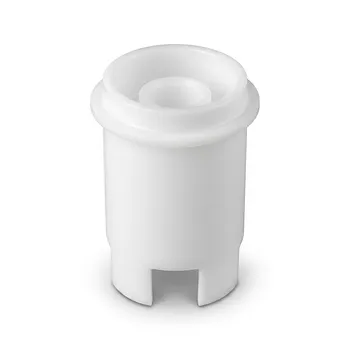
The internal Teflon (PTFE) liner is chemically inert, meaning it does not react with the precursor solutions. This ensures that the resulting SnO2/nanocellulose composite remains free from metal impurity ions that might otherwise leach from the stainless steel walls during the reaction.
Resistance to Chemical Corrosion
Hydrothermal precursors for SnO2 often involve acidic or basic solutions that are highly corrosive at elevated temperatures. The Teflon liner protects the structural integrity of the outer stainless steel shell from chemical erosion, extending the life of the equipment and maintaining safety.
The Synthesis Role: Promoting Crystalline Growth
Driving Dissolution and Recrystallization
The high-pressure environment inside the autoclave increases the solubility of precursor molecules, allowing them to dissolve and then recrystallize into specific structures. This process is what allows SnO2 to transition from a liquid precursor into a tetragonal rutile structure on the surface of the nanocellulose.
Controlling Morphology and Adhesion
By maintaining a sealed, pressurized state, the autoclave enables SnO2 nanoparticles to grow with high crystallinity and regular morphology. This controlled environment is what facilitates the deep reaction and structural stability required to bond the inorganic nanoparticles to the organic nanocellulose matrix.
Understanding the Trade-offs
Temperature Limitations of Teflon
While Teflon is excellent for chemical resistance, it has a physical limit, typically around 240°C to 260°C. Exceeding these temperatures can cause the liner to soften or deform, potentially leading to a seal failure or "creeping" of the material under pressure.
Differential Thermal Expansion
Stainless steel and Teflon expand at different rates when heated, which can cause the liner to become stuck or slightly distorted over many cycles. Users must ensure the liner is properly cooled before removal to avoid damaging the seal or the internal components.
How to Apply This to Your Project
Making the Right Choice for Your Goal
- If your primary focus is high-purity SnO2 synthesis: Ensure your Teflon liner is thoroughly cleaned with dilute acid between runs to prevent cross-contamination of metal ions.
- If your primary focus is achieving specific SnO2 morphologies: Focus on the precise control of the "fill degree" (the volume of liquid inside the liner), as this directly dictates the internal autogenous pressure generated.
- If your primary focus is the longevity of the autoclave: Avoid rapid cooling (quenching) after the reaction, as the disparate contraction rates of steel and Teflon can compromise the liner's fit.
By balancing mechanical containment with chemical isolation, the Teflon-lined autoclave provides the precise conditions necessary to engineer high-performance SnO2/nanocellulose composites.
Summary Table:
| Component | Material | Primary Function | Research Benefit |
|---|---|---|---|
| Outer Shell | Stainless Steel | Mechanical containment | Withstands high autogenous pressure at 180°C+ |
| Inner Liner | PTFE (Teflon) | Chemical isolation | Prevents metal contamination and acidic corrosion |
| Internal Environment | Sealed/Pressurized | Solubility enhancement | Promotes high crystallinity and regular SnO2 morphology |
| Thermal Control | Heavy Metal Casing | Heat stabilization | Ensures uniform nanoparticle growth on cellulose matrix |
Elevate Your Synthesis with KINTEK’s Precision Fluoropolymer Engineering
Successful hydrothermal synthesis of SnO2/nanocellulose composites demands the highest purity and chemical resistance. KINTEK specializes in manufacturing a comprehensive range of laboratory supplies crafted from high-performance PTFE and PFA.
From essential consumables—including beakers, digestion tubes, and stirring bars—to advanced reaction apparatus like hydrothermal synthesis liners, microwave digestion vessels, and bespoke electrochemical cells, we provide the tools necessary for trace analysis and complex material engineering. Our end-to-end custom CNC fabrication allows us to deliver everything from high-volume standard orders to complex, non-standard machined parts tailored to your specific research parameters.
Ready to optimize your lab's performance? Contact KINTEK today to request a quote or discuss your custom design!
References
- Y. C. Goswami, T.T. Moe. Hydrothermal synthesis of SnO2/cellulose nanocomposites: optical, Structural, and morphological characterization. DOI: 10.1038/s41598-025-87948-y
This article is also based on technical information from Kintek Knowledge Base .
Related Products
- Custom TFM Reaction Vessel with Stainless Steel Jacket and PTFE Inner Cup for High Corrosion Resistance
- High Purity Corrosion Resistant Teflon Crucible Low Background Laboratory PTFE Vessel for Trace Analysis and Acid Digestion
- High Temperature Corrosion Resistant Hydrothermal Synthesis Reactor with TFM Inner Liner and Straight Cylinder Design
- High Purity PTFE Microwave Digestion Vessel Replacement Liner for Acid Sample Preparation and Trace Analysis
- PTFE Lined High Pressure Digestion Vessel 50ml High Temperature Hydrothermal Synthesis Tank
People Also Ask
- Why are high-performance pressure-resistant reaction vessels required for oxygen-assisted hydrothermal conversion at 150 °C?
- How do magnetic stirring and reaction vessels impact MOF-derived carbon quality? Optimize Your Composite Performance
- Why are high-quality fluoropolymer-lined reaction vessels required for alk-Ti3C2Tx MXene? Ensure Purity & HF Resistance
- Why are PTFE-lined reaction vessels necessary for forced degradation studies? Ensure high-purity results and accuracy.
- Why is a high-purity PTFE lined reaction vessel required for the acidic etching of MXenes? Ensure Material Purity.