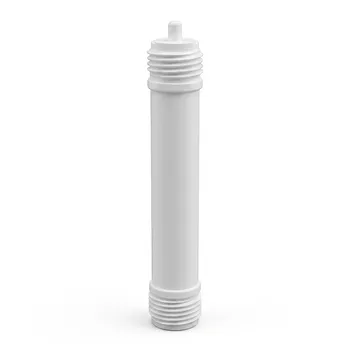
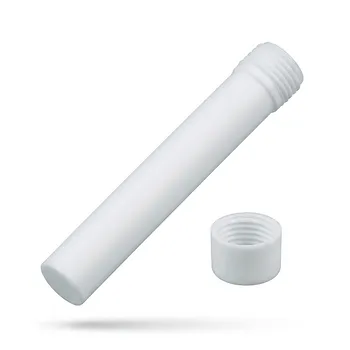
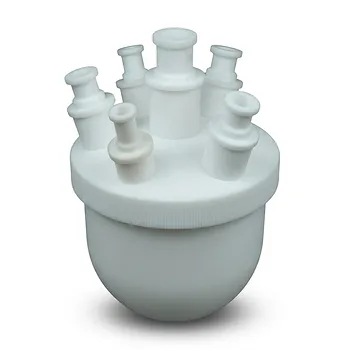
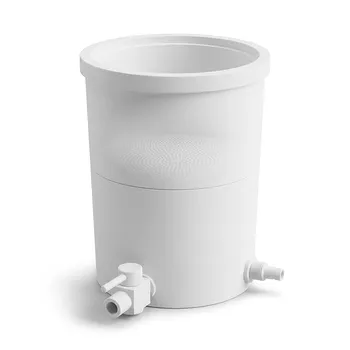
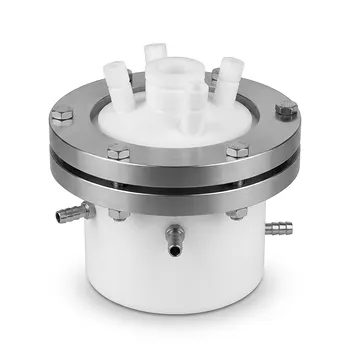
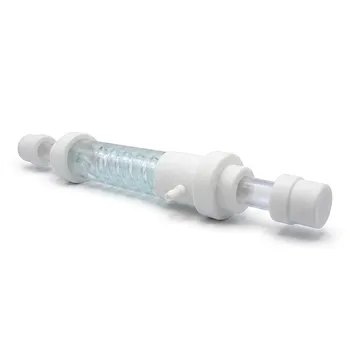
In the hydrothermal synthesis of titanium dioxide, the PTFE (Polytetrafluoroethylene) liner serves as the primary chemical barrier and reaction vessel. It provides an inert environment that withstands temperatures up to 220°C and high pressures, ensuring that the resulting $TiO_2$ powders achieve high phase purity and consistent morphology by preventing contact with the metal walls of the autoclave.
The PTFE liner is essential because it isolates corrosive precursors from the metal reactor, preventing metal ion leaching and ensuring the chemical integrity of the synthesized nanomaterials. Without this isolation, the harsh reaction environment would degrade the equipment and contaminate the product.
Ensuring Chemical and Phase Purity
Prevention of Metal Ion Leaching
During synthesis, the PTFE liner effectively isolates the reaction medium from the metal walls of the autoclave. This prevents the introduction of metal ion impurities into the $TiO_2$ crystal lattice, which is critical for maintaining high phase purity.
Resistance to Corrosive Precursors
The synthesis of titanium dioxide often involves highly reactive precursors such as titanium tetrachloride ($TiCl_4$) or strong acids and bases. PTFE’s exceptional chemical inertness allows it to resist corrosion from these aggressive chemicals, even under high-temperature subcritical conditions.
Low Impurity Leaching Rates
High-purity PTFE materials have extremely low leaching rates, meaning the liner itself does not shed contaminants into the solution. This ensures that the functional groups on the surface of the synthesized powders remain uncontaminated and chemically active.
Facilitating Precision Crystal Growth
Support for Specific Morphologies
The sealed, high-pressure environment provided by the liner allows the reaction to proceed at subcritical temperatures (typically 130°C to 200°C). These conditions are necessary to drive the chemical transformations that produce specific $TiO_2$ shapes, such as nanosheets, nanotubes, or nanorods.
Non-Stick Surface for Sample Recovery
PTFE’s non-stick properties minimize sample loss by preventing the synthesized powders from adhering to the vessel walls. This facilitates the efficient recovery of micro- and nano-powders and ensures morphological consistency across different batches.
Prevention of Cross-Contamination
The easy-to-clean nature of the non-stick surface reduces the risk of cross-contamination between experiments. This is vital for researchers who need to maintain strict control over the experimental variables of each synthesis run.
Structural Protection and Thermal Stability
Shielding the Autoclave Body
The liner acts as a sacrificial but durable shield that protects the expensive metal outer shell of the autoclave from corrosive media. By preventing corrosion of the vessel body, the liner significantly extends the lifespan of the hydrothermal equipment.
Managing High-Pressure Environments
Hydrothermal synthesis relies on the pressure generated within the sealed liner to induce crystal growth. The PTFE liner provides a sealed and stable space that can safely contain these pressures while maintaining thermal stability during the heating cycle.
Understanding the Trade-offs
Thermal Limits and Deformation
While PTFE is highly versatile, it has a definitive thermal ceiling, typically around 200°C to 220°C. Exceeding these temperatures can lead to material softening, permanent deformation, or the release of toxic vapors.
Pressure-Induced Creep
Under prolonged exposure to high pressure and temperature, PTFE can experience "creep," where the material slowly deforms. This requires users to monitor the liner's fit within the autoclave to ensure a proper seal is maintained over time.
Heat Transfer Resistance
PTFE is a thermal insulator, meaning it does not conduct heat as efficiently as the metal walls of the reactor. This can result in a thermal lag between the oven temperature and the actual temperature of the precursor solution inside the liner.
How to Apply This to Your Project
Recommendations for Synthesis Success
- If your primary focus is maximum product purity: Use only high-purity PTFE or PFA liners and implement a rigorous acid-washing protocol between synthesis runs to remove residual ions.
- If your primary focus is high-temperature reactions (>220°C): Consider switching to a Para-polyphenylene (PPL) liner, which offers higher thermal stability than standard PTFE.
- If your primary focus is consistent morphology: Ensure the liner fill level (typically 60-80%) is kept constant across batches to maintain reproducible pressure conditions inside the vessel.
Choosing the correct liner material and respecting its physical limits is the most effective way to ensure the successful and safe preparation of high-performance titanium dioxide nanomaterials.
Summary Table:
| Key Function | Benefit to Synthesis | Operational Consideration |
|---|---|---|
| Chemical Isolation | Prevents metal ion leaching and ensures high phase purity | Maintain thermal limits (<220°C) |
| Morphology Control | Non-stick surface facilitates nanotubes/nanosheet recovery | Monitor for pressure-induced creep |
| Structural Shielding | Protects metal autoclave body from corrosive precursors | Account for thermal insulation lag |
| Purity Maintenance | Low leaching rates ensure active functional groups | Implement rigorous acid-washing |
Optimize Your Nanomaterial Synthesis with KINTEK’s Fluoropolymer Expertise
Precision in hydrothermal synthesis demands the highest quality materials. KINTEK specializes in manufacturing virtually all imaginable laboratory supplies crafted from PTFE and PFA. From high-purity hydrothermal synthesis liners and microwave digestion vessels to advanced reaction apparatus like custom electrochemical cells and microchannel reactors, we ensure your experiments are free from contamination.
Our offerings range from everyday basic labware (beakers, crucibles, and reagent bottles) to complex fluid transfer components and sample prep tools. Backed by end-to-end custom CNC fabrication, we deliver everything from complex non-standard machined parts to high-volume orders with an absolute focus on high-performance fluoropolymers.
Ready to elevate your lab's performance? Contact us today to discuss your custom requirements and secure the high-purity environment your research deserves!
References
- Hiroyuki Usui, Hiroki Sakaguchi. Nickel-Doped Titanium Oxide with the Rutile Structure for High-Performance Sodium Storage. DOI: 10.1021/acsmaterialsau.5c00008
This article is also based on technical information from Kintek Knowledge Base .
Related Products
- PTFE Lined High Pressure Digestion Vessel 50ml High Temperature Hydrothermal Synthesis Tank
- High Pressure Custom TFM Reactor Stainless Steel Outer Vessel PTFE Inner Cup for Corrosive Synthesis
- Custom TFM Reaction Vessel with Stainless Steel Jacket and PTFE Inner Cup for High Corrosion Resistance
- High Purity PTFE Microwave Digestion Vessel for Soil and Food Analysis Acid Resistant Fluoropolymer Sample Preparation Liners
- High Purity TFM Microwave Digestion Vessels PTFE Acid Evaporation Liners Domestic GT-400 Equivalent Laboratory Reaction Containers
People Also Ask
- What are the benefits of using a PTFE-lined vessel for carbon-sulfur cathode treatment? Maximize Purity & Performance
- Why are PTFE-lined pressure digestion vessels required for the preparation of Ag/CeO2 catalysts? Purity & Performance
- What safety features are typically incorporated into high-pressure PTFE digestion vessel designs? Ensure Lab Safety
- What is the function of PTFE lined high-pressure vessels in g-C3N4 synthesis? Achieve High-Purity Material Growth
- Role of High-Pressure Digestion Tanks in Perovskite Synthesis: Achieve Superior Stability and Latent Heat