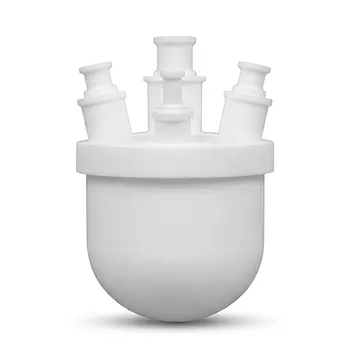
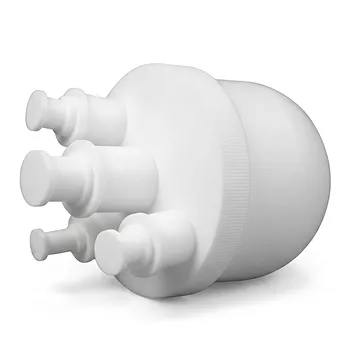
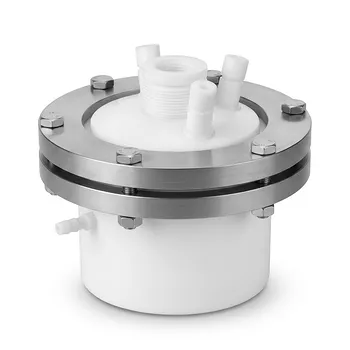
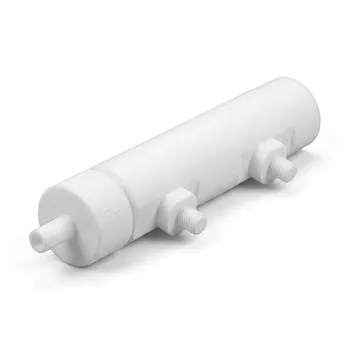
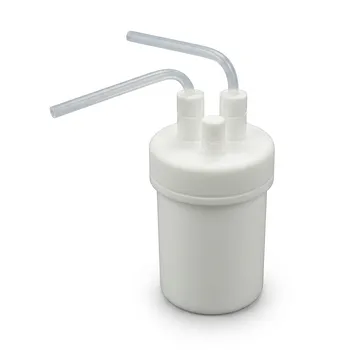
PTFE microchannel reactors are a cornerstone of modern green chemistry. They provide significant environmental advantages by drastically reducing solvent consumption, minimizing waste through superior process control, and lowering energy demands compared to traditional batch manufacturing.
Core Takeaway: PTFE microchannel reactors align chemical manufacturing with sustainability goals by combining "inherent safety" with "process intensification." Their universal chemical resistance and high mass transfer efficiency allow for cleaner, safer, and more energy-efficient production cycles.
Reducing the Environmental Footprint
Minimizing Solvent and Waste Generation
PTFE microchannel reactors significantly reduce the volume of solvents required for chemical synthesis. By providing superior mass transfer, these reactors ensure reagents interact more efficiently, which reduces the formation of unwanted side reactions and byproducts.
The high precision of residence-time control further enhances product purity. This means fewer resources are spent on downstream purification processes, which are typically waste-intensive stages of chemical production.
Lowering Energy Consumption via Process Intensification
The compact design of microchannel reactors enables process intensification, allowing reactions to occur faster and in smaller spaces. This efficiency directly leads to lower overall energy demand for heating and cooling.
Furthermore, the low thermal conductivity of PTFE acts as a natural insulator. This property helps maintain consistent internal temperatures during external heating processes, preventing unnecessary heat loss to the environment.
Enhancing Safety and Chemical Longevity
Superior Thermal Management and Low Inventory
Safety is a critical pillar of sustainability, and PTFE microreactors excel here due to their extremely low hold-up volumes. By maintaining only microliters to milliliters of material in the system, the risk of a large-scale disaster is virtually eliminated.
The high surface-area-to-volume ratio allows for rapid heat dissipation. This is essential for controlling exothermic reactions and preventing thermal runaway, a common safety hazard in traditional bulk manufacturing.
Resistance to Degradation and Fouling
PTFE offers near-universal chemical resistance to aggressive reagents, including hydrofluoric acid and strong oxidizers. This durability extends the lifespan of the equipment, reducing the environmental impact associated with manufacturing and disposing of replacement parts.
The material's low surface energy creates a non-stick environment that prevents the adhesion of solids. This minimizes fouling and reduces the need for aggressive cleaning solvents, further lowering the process's chemical footprint.
Understanding the Trade-offs
Throughput and Scalability Challenges
A single PTFE microchannel has a relatively low throughput, often limited to milliliters or liters per hour. To reach industrial-scale volumes, manufacturers must use "numbering-up" strategies, which involve running many identical channels in parallel.
This parallelization adds complexity to the system design. Engineers must ensure uniform flow distribution across all channels to maintain the sustainability benefits of the reactor at scale.
Pressure Management and Clogging Risks
As channel length or fluid viscosity increases, there is a significant increase in pressure drop. This can limit the types of reactions that are feasible within a microchannel framework without specialized pumping equipment.
While PTFE's non-stick properties help, there is still a risk of clogging if a reaction produces large solids. This requires careful filtration of reagents and precise monitoring to avoid system downtime or failure.
How to Apply This to Your Project
When integrating PTFE microchannel technology, your approach should depend on your specific operational goals.
- If your primary focus is Waste Reduction: Prioritize reactors with the most precise residence-time control to eliminate byproducts at the source.
- If your primary focus is Operator Safety: Utilize the low hold-up volume of microreactors to handle aggressive or air-sensitive reagents that would be too dangerous for batch processing.
- If your primary focus is Long-term Durability: Leverage PTFE's universal chemical inertness to handle corrosive media that would degrade traditional metallic or glass-lined reactors.
By transitioning to PTFE microchannel reactors, you can transform hazardous, resource-heavy processes into streamlined, sustainable operations.
Summary Table:
| Key Feature | Sustainability Advantage | Environmental Impact |
|---|---|---|
| High Mass Transfer | Solvent & Reagent Reduction | Lowers chemical waste and byproduct generation |
| Process Intensification | Lower Energy Consumption | Reduces carbon footprint of heating/cooling cycles |
| Low Hold-up Volume | Inherent Safety | Eliminates risks of large-scale thermal runaway |
| Chemical Inertness | Extended Equipment Lifespan | Reduces waste from frequent part replacement |
| Non-stick Surface | Reduced Cleaning Needs | Minimizes the use of aggressive cleaning solvents |
Revolutionize Your Green Chemistry with KINTEK
Transitioning to sustainable chemical manufacturing requires high-performance materials you can trust. KINTEK is your premier partner for all fluoropolymer-based laboratory and industrial solutions.
From everyday basic labware (beakers, measuring cylinders, and reagent bottles) to advanced PTFE microchannel reactors, battery testing fixtures, and custom-machined electrochemical cells, we provide the tools necessary to minimize waste and maximize safety. Our end-to-end custom CNC fabrication ensures that whether you need high-volume consumables or complex, non-standard bespoke setups, you receive precision-engineered components designed for universal chemical resistance.
Ready to optimize your process efficiency? Contact us today to explore our full range of PTFE and PFA solutions and see how KINTEK’s expertise in high-performance fluoropolymers can bring your sustainability goals to life.
Related Products
- Customizable Polytetrafluoroethylene PTFE Reactor and Corrosion Resistant Teflon Flask
- PTFE 10L Reaction Vessel with Stirring Paddle Customizable Corrosion Resistant High Temperature Reactor for Biopharmaceutical and Chemical Processing
- Custom PTFE Multilayer Reaction Apparatus High Temperature Corrosion Resistant Threaded Modular Sieve System
- Custom PTFE Volatile Matter Condensation Reflux Reaction Device Corrosion Resistant Pressure Resistant
- High Performance Customizable PTFE Reaction Vessel and Corrosion Resistant Polytetrafluoroethylene Flask for Chemical Laboratory Use
People Also Ask
- What functional advantages do PTFE reactors provide over glass? Achieve Superior Purity and Safety in Synthesis
- What are the primary fabrication methods for capillary-based and monolithic PTFE reactors? Expert Production Insights
- Why are PTFE or PFA reaction vessels required for the selective etching process of MXene using hydrofluoric acid (HF)?
- Why is a Teflon-lined (PTFE) reactor vessel required for the hydrothermal synthesis of V2O5 and SnO2 nanomaterials?
- What is the role of high chemical inertness reaction vessels in the organic synthesis of acylhydrazone ligands? | Guide