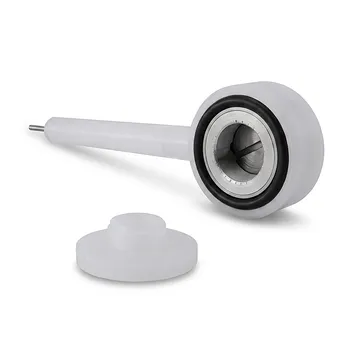
PVDF is chemically resistant to many acids, oxidizers, halogens, hydrocarbons, alcohols, and chlorinated solvents, but it is not as broadly inert as PTFE. The key limitation is PVDF’s susceptibility to strong bases, amines, esters, and ketones, which can cause swelling, softening, loss of mechanical integrity, or complete dissolution as concentration and temperature increase. PTFE is generally the safer choice for fluid handling and laboratory equipment exposed to aggressive polar solvents, strong alkaline solutions, or demanding purity requirements.
PVDF is a strong, rigid fluoropolymer for many chemical-handling applications, but its partially fluorinated structure leaves it vulnerable to chemical classes that fully fluorinated PTFE tolerates. Choose PVDF for mechanical performance when the chemistry is compatible; choose PTFE when broad-spectrum chemical inertness is the priority.
Where PVDF Performs Well
Resistance to Inorganic Chemicals
PVDF provides excellent resistance to many inorganic acids, acid mixtures, weak bases, halogens, and oxidizing agents. This makes it suitable for numerous laboratory fittings, valves, piping components, and transfer systems.
Its actual performance still depends on chemical concentration, operating temperature, exposure duration, stress, and resin grade. Compatibility charts and supplier data should be checked for critical applications.
Resistance to Many Organic Solvents
PVDF generally resists aliphatic, aromatic, and chlorinated solvents, as well as hydrocarbons and alcohols. This is why it is often used in chemical processing and laboratory fluid-handling systems where rigidity and wear resistance matter.
However, “resistant to many solvents” does not mean resistant to all organic solvents. PVDF’s limitations become important with several polar or strongly reactive solvent classes.
Where PVDF Falls Short of PTFE
Strong Bases and Alkaline Solutions
Strong bases can attack PVDF, particularly at elevated temperatures or high concentrations. The resulting damage may appear as swelling, softening, embrittlement, or gradual loss of dimensional stability.
PTFE has substantially broader resistance to strong alkaline environments. For concentrated caustic solutions, aggressive base cleaning cycles, or highly alkaline process streams, PTFE is usually the more conservative specification.
Amines
PVDF is vulnerable to primary and secondary amines, which can chemically interact with the polymer and cause swelling or degradation. This is a significant limitation in chemical synthesis, pharmaceutical processing, and laboratory systems using amine-containing reagents.
PTFE is generally preferred for tubing, seals, vessels, and valves that will remain in contact with aggressive organic bases or amine solutions.
Ketones
Ketones such as acetone and methyl ethyl ketone can soften or swell PVDF and may cause severe degradation at sufficient concentration or temperature. In extreme conditions, the resin can dissolve.
PTFE is far more suitable for ketone service. PVDF components used in solvent transfer lines, bottles, or valve assemblies should therefore be evaluated carefully before exposure to ketones.
Esters and Other Strong Polar Solvents
Esters can also cause PVDF to swell, soften, or lose mechanical integrity. This matters because a component may remain visibly intact while its dimensions, pressure resistance, seal performance, or extractables profile have already changed.
Fully fluorinated materials such as PTFE and PFA provide a stronger margin for applications involving aggressive polar organic solvents.
Why the Difference Exists
PVDF Is Only Partially Fluorinated
PVDF contains alternating carbon-fluorine and carbon-hydrogen groups. Its fluorine content gives it strong resistance to many chemicals, but the remaining hydrogen-containing backbone is more chemically accessible than the fully fluorinated backbone of PTFE.
PTFE’s carbon backbone is shielded by fluorine atoms, which accounts for its exceptional resistance to a much wider range of reagents.
Mechanical Strength Does Not Equal Chemical Inertness
PVDF is typically stronger, more rigid, and more resistant to abrasion and creep than PTFE. These properties make it attractive for load-bearing fittings, rigid piping, valve bodies, and components subject to wear or long-term mechanical stress.
Those mechanical advantages should not be interpreted as evidence of universal chemical compatibility. A mechanically robust PVDF part can still fail through solvent-induced swelling or chemical attack.
Practical Effects in Fluid Handling Equipment
Tubing, Valves, and Fittings
Chemical attack can change the dimensions and hardness of PVDF tubing, valve components, and fittings. This may lead to leakage, poor sealing, reduced pressure capability, particle generation, or premature mechanical failure.
The risk is greater when the component is under stress, exposed continuously, or operating near the upper temperature limit of the material.
Storage Containers and Bottles
PVDF storage containers may be appropriate for many acids, oxidizers, halogenated solvents, and other compatible chemicals. They are less appropriate for long-term storage of strong bases, amines, ketones, and esters unless documented compatibility data supports the specific combination.
Swelling or dissolution can also create sample contamination, even before obvious structural failure occurs.
Ultra-Trace and High-Purity Applications
For ultra-trace analysis, the issue is not only whether the equipment survives. The material must also avoid contributing extractables, adsorbing analytes, or changing dimensions during contact with the sample.
PTFE and PFA are commonly favored when the process requires the broadest chemical margin and the lowest risk of material interaction.
Temperature Further Reduces PVDF’s Margin
Lower Thermal Capability
PVDF has a lower melting point and service-temperature capability than PTFE and PFA. Its useful operating range depends on the grade, but elevated temperature can accelerate chemical attack and increase the likelihood of softening or deformation.
A chemical that is acceptable at room temperature may be unsuitable for continuous service at a substantially higher temperature.
Combined Chemical and Mechanical Stress
Temperature, pressure, bending, and chemical exposure can act together. Even if PVDF’s chemical resistance appears acceptable in isolation, a stressed component may experience accelerated deformation or failure under actual operating conditions.
Compatibility evaluations should therefore reflect the complete service environment rather than only the chemical name.
Understanding the Trade-offs
PVDF’s Main Advantages
PVDF offers higher tensile strength, rigidity, abrasion resistance, and creep resistance than PTFE. It is often the better engineering material when a component must hold its shape, resist wear, or support mechanical loads.
It also provides strong resistance to many common laboratory and process chemicals while being lighter and easier to use in rigid structural components.
PTFE’s Main Advantages
PTFE offers broader chemical inertness and higher temperature capability. It is especially appropriate for strong bases, aggressive polar solvents, ketones, esters, amines, extreme pH environments, and high-purity applications.
Its weakness is mechanical: compared with PVDF, PTFE is generally softer, less rigid, and more susceptible to creep under sustained load.
Common Selection Mistakes
A common mistake is choosing PVDF solely because it is labeled a fluoropolymer. Fluoropolymer classification does not make PVDF equivalent to fully fluorinated PTFE or PFA.
Another mistake is relying on a general compatibility table without accounting for concentration, temperature, exposure time, pressure, stress, or the exact PVDF formulation.
How to Apply This to Your Project
Use the chemical, thermal, mechanical, and purity requirements together when specifying the material.
- If your primary focus is mechanical rigidity and wear resistance: Consider PVDF for compatible acids, oxidizers, chlorinated solvents, hydrocarbons, alcohols, and many other chemicals where structural strength and creep resistance are important.
- If your primary focus is strong-base or amine service: Specify PTFE or PFA unless validated data confirms that the particular PVDF grade is suitable.
- If your primary focus is ketone or ester handling: Prefer PTFE or PFA to reduce the risk of swelling, softening, dissolution, and sample contamination.
- If your primary focus is ultra-trace analysis or maximum chemical purity: Choose PTFE or PFA because their broader inertness provides a larger margin against chemical interaction and extractables.
- If your primary focus is elevated-temperature service: Compare the actual operating temperature with the manufacturer’s continuous-use limits and generally favor PTFE or PFA when the thermal margin is demanding.
The right choice is straightforward: use PVDF when its mechanical advantages matter and the chemistry is verified, but use PTFE when chemical compatibility and purity leave little room for uncertainty.
Summary Table:
| Chemical Class | PVDF Compatibility | PTFE Compatibility | Notes |
|---|---|---|---|
| Strong Bases | Limited | Excellent | PVDF can swell, soften, or degrade; PTFE is preferred for caustic service. |
| Amines | Poor | Excellent | PVDF susceptible to primary/secondary amines; PTFE recommended for amine exposure. |
| Ketones | Poor | Excellent | PVDF may soften, swell, or dissolve; PTFE is safe for acetone, MEK. |
| Esters | Poor | Excellent | PVDF may lose integrity; PTFE is better for polar solvents. |
| Aliphatic/Aromatic Hydrocarbons | Good | Excellent | PVDF generally resists; PTFE has broader inertness. |
| Alcohols | Good | Excellent | PVDF compatible with many alcohols; PTFE is universally resistant. |
| Inorganic Acids | Good | Excellent | PVDF resists many acids; PTFE handles nearly all concentrations/temperatures. |
| Oxidizers & Halogens | Good | Excellent | PVDF suitable in many cases; PTFE is more broadly inert. |
| Chlorinated Solvents | Good | Excellent | PVDF resists; PTFE is superior for aggressive solvents. |
| Temperature Range | Lower (≤150°C) | Higher (≤260°C) | PVDF's chemical resistance reduces at higher temps. |
Choose the right fluoropolymer for your lab. At KINTEK, we manufacture high-performance PTFE and PFA labware, tubing, valves, and custom components. Our end-to-end CNC machining ensures precise parts for any application. Contact us today to discuss your requirements and get a quote. Contact us to ensure chemical compatibility and purity in your lab.
Related Products
- PVDF Sample Support Body for Corrosion Testing and Electrochemical Analysis
- High Purity PFA Chromatography Column with Collection Bottle Corrosion Resistant Fluoropolymer Filtration System for Trace Analysis
People Also Ask
- How does the gas permeability of PVDF compare with PTFE and PFA? Discover lower gas ingress for sensitive fluids
- How do PVDF, PTFE, and PFA compare in thermal resistance and chemical solubility for lab apparatus?
- How do PVDF, PTFE, and PFA compare for chemical process and filtration applications?
- What is the function of β-phase fluoropolymer interfaces in lithium dendrite suppression, and how does this guide the selection of fluoropolymer electrochemical testing apparatus?
- How to Balance Ionic Conductivity and Water Barrier in Amphiphilic Polymer Electrolyte Membranes? Optimize with Fluoropolymer Testing Supplies