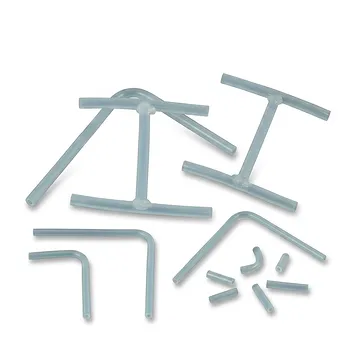
PTFE tubing is a critical component in power generation and water treatment because it offers total immunity to high-chloride corrosion and maintains structural integrity at temperatures up to 500°F. Unlike metal alternatives, it remains inert when exposed to the aggressive oxidizing agents used in dosing lines and desalination processes. This unique combination of chemical and thermal stability ensures that fluid systems remain leak-free while providing untainted samples for environmental monitoring.
PTFE (Polytetrafluoroethylene) serves as a superior alternative to stainless steel in environments where chemical oxidation and thermal "creep" would otherwise cause rapid system failure. Its primary value lies in its near-universal chemical inertness and its ability to maintain high-purity fluid paths over long operational cycles.
Overcoming Corrosion in High-Chloride Environments
Superior Resistance to Oxidizing Agents
In power plant dosing lines and desalination plants, equipment is constantly exposed to aggressive oxidizing agents and high-chloride water. PTFE is immune to these corrosive forces, which would otherwise cause rapid pitting and failure in stainless steel conduits.
Long-Term Operational Stability
By resisting chemical degradation, PTFE tubing eliminates the risk of medium leakage and prevents the introduction of impurities caused by material dissolution. This ensures a consistent and pure chemical reaction path, which is vital for the long-term stability of industrial fluid transfer systems.
Cost-Effective Maintenance Cycles
Because PTFE does not age or become brittle from environmental exposure, it requires significantly less frequent replacement than other polymers or treated metals. This durability translates into lower maintenance costs and reduced downtime for power generation facilities.
Thermal Integrity and Fluid Management
Handling High-Temperature Steam
PTFE maintains its mechanical properties across a massive temperature range, specifically from -325°F to +500°F. This thermal stability allows it to handle steam and hot-water lines without the risk of "creep," a common deformation found in lower-grade plastics.
Hydrophobic and Non-Stick Properties
The surface of PTFE is naturally hydrophobic and has the lowest coefficient of friction among solids. This ensures smooth fluid flow and prevents the buildup of deposits, making the tubing exceptionally easy to clean and maintain in water treatment applications.
Prevention of Material Creep
Under the thermal stresses of a power plant, many materials will slowly deform over time. PTFE’s molecular structure allows it to withstand these stresses, ensuring that fittings and seals remain secure even during temperature fluctuations.
Ensuring Data Accuracy in Monitoring
Protecting Sample Integrity
In environmental monitoring, the inertness of PTFE is its most valuable asset. When sampling stack gases or wastewater, the tubing does not interact chemically with the sample, ensuring that the data collected is a true representation of the environment.
Eliminating Cross-Contamination
Because PTFE is non-stick and physiologically stable, it does not retain residues from previous samples. This makes it the industry standard for high-purity instrumentation systems where even microscopic levels of contamination could skew sensitive environmental data.
Resistance to Weathering and Aging
Environmental monitoring often takes place in harsh outdoor conditions. PTFE is highly resistant to UV radiation and atmospheric aging, ensuring that sampling lines do not degrade or leach chemicals into the samples over years of exposure.
Understanding the Trade-offs
Mechanical Limitations and Pressure
While PTFE is thermally stable, it is a thermoplastic and does not possess the structural strength of reinforced metals. In extremely high-pressure applications, PTFE may require external braiding or reinforcement to prevent bursting or expansion.
Thermal Conductivity vs. Insulation
PTFE is an excellent electrical insulator, but it is not a primary choice for heat exchange due to its relatively low thermal conductivity compared to metals. It is designed to transport hot fluids safely, not necessarily to facilitate the rapid transfer of heat through the tube wall.
Permeability Concerns
While PTFE is chemically inert, it is slightly more permeable to certain gases than metal piping. In highly specialized vacuum or gas-delivery systems, engineers must account for the potential migration of small molecules through the fluoropolymer wall over extended periods.
Applying PTFE to Your Infrastructure
Recommendations for Implementation
Choosing the right tubing depends on your specific operational stressors and purity requirements.
- If your primary focus is corrosion resistance in desalination: Utilize PTFE to replace stainless steel in high-chloride zones to eliminate pitting and extend the life of dosing lines.
- If your primary focus is environmental monitoring accuracy: Use virgin PTFE for all sample-contact conduits to ensure that chemical interactions do not alter stack gas or wastewater data.
- If your primary focus is high-temperature fluid transport: Deploy PTFE in areas reaching up to 500°F where traditional polymers would fail, ensuring the system is rated for your specific pressure requirements.
By integrating PTFE into your fluid systems, you ensure a high-performance environment that balances chemical immunity with long-term thermal reliability.
Summary Table:
| Feature | Benefit in Power & Water Applications | Key Metric/Detail |
|---|---|---|
| Corrosion Resistance | Total immunity to aggressive oxidizing agents and chlorides. | Ideal for desalination dosing lines |
| Thermal Stability | Maintains structural integrity under high-temperature steam. | Range: -325°F to +500°F |
| Chemical Inertness | Prevents sample contamination and material leaching. | Near-universal resistance |
| Surface Properties | Hydrophobic and non-stick to prevent deposit buildup. | Lowest coefficient of friction |
| Durability | Resists UV and atmospheric aging for outdoor monitoring. | Reduced maintenance cycles |
Optimize Your Industrial Fluid Paths with KINTEK
Ensure the highest standards of reliability and purity in your power generation and water treatment infrastructure with KINTEK’s high-performance fluoropolymer solutions. From everyday basic labware (beakers, measuring cylinders, crucibles, and reagent/wash bottles) and fluid transfer components (PTFE/PFA tubing, fittings, and valves) to high-purity trace analysis instruments, we deliver the chemical immunity your systems demand.
At KINTEK, we specialize in the complete lifecycle of laboratory and industrial supplies. Our expertise extends from sample prep and filtration tools (filters, pipettes, spatulas) to advanced reaction apparatus like custom electrochemical cells, battery testing fixtures, and microwave digestion vessels. Every component is crafted with an absolute focus on high-performance PTFE and PFA, backed by our end-to-end custom CNC fabrication capabilities.
Why Partner with KINTEK?
- Bespoke Engineering: We deliver everything from complex non-standard machined parts to bespoke laboratory setups.
- Scalable Production: Equipped for both specialized custom orders and high-volume industrial requirements.
- Unmatched Material Integrity: Zero-contamination fluid paths for environmental monitoring and chemical dosing.
Ready to eliminate corrosion and enhance data accuracy? Contact KINTEK today to discuss your custom fabrication needs.
Related Products
- Custom High Purity PTFE Digestion Tubes and Centrifuge Tubes for Trace Metal Analysis
- High Purity PTFE Digestion Tubes and Custom Centrifuge Tubes 100ml for Trace Analysis and Chemical Digestion
- Corrosion Resistant PTFE Digestion Tubes for Graphite Block Systems with Acid Reflux Caps Custom Dimensions
- Custom PTFE Digestion Tube Double Sided Openable High Temperature Corrosion Resistant Low Background
- Custom PTFE Condenser Tube 100ml Serpentine and Straight Fluoropolymer Laboratory Heat Exchanger with Flask Adapters
People Also Ask
- What are the common capacities and physical configurations available for PTFE digestion tubes? Expert Selection Guide
- How do PTFE digestion tubes minimize contamination during ultra-trace elemental analysis? Achieve high-purity results.
- What is the primary function of PTFE digestion tubes in a laboratory setting? Essential for Pure Sample Mineralization
- How do PTFE digestion tubes assist in pharmaceutical and biological sample preparation? Ensure High Recovery & Purity
- How does the synergy of pressure and temperature within a PTFE digestion tube improve digestion efficiency? Accelerate Sample Prep