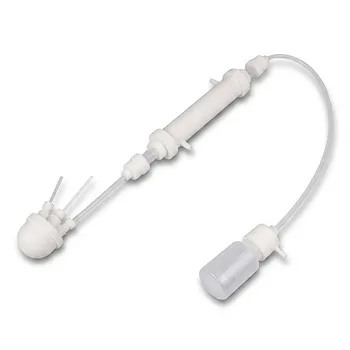
PTFE helical capillary microreactors offer a transformative approach to nanoparticle synthesis by combining ultrafast mixing kinetics with extreme chemical durability. These systems achieve mixing in under 1.4 seconds and maintain a highly uniform residence-time distribution (RTD), which is essential for producing monodisperse nanoparticles like colloidal silica or perovskites.
The core advantage of PTFE helical microreactors lies in their ability to synchronize rapid mass transfer with chemical inertness. This synergy eliminates the common pitfalls of batch processing, such as uneven particle growth and reactor fouling, resulting in superior size control and reproducibility.
Enhancing Fluid Dynamics and Mixing Precision
The Power of Ultrafast Mixing
In nanoparticle synthesis, the speed of mixing determines the uniformity of nucleation. PTFE helical microreactors facilitate mixing in less than 1.4 seconds, ensuring that all precursors encounter each other simultaneously.
This rapid homogenization prevents localized concentration gradients. Without these gradients, the system produces highly monodisperse particles that are difficult to achieve in larger batch reactors.
Uniform Residence-Time Distribution (RTD)
The helical geometry of the capillary creates secondary flows that narrow the residence-time distribution. This ensures that every particle spends the exact same amount of time within the reaction zone.
Precise RTD control is the primary driver behind consistent particle size. It prevents the overgrowth of early-forming nuclei, leading to a narrow particle-size distribution and high fluorescence quantum yields in materials like perovskite nanocrystals.
Chemical Inertness and Material Purity
Eliminating Wall Deposition and Fouling
PTFE is inherently non-stick and chemically inert, which prevents nanoparticles from adhering to the reactor walls. This is a critical advantage over glass or metal reactors where "wall deposition" can lead to clogging and inconsistent yields.
By preventing the accumulation of material on the channel walls, the reactor maintains constant flow dynamics over long periods. This leads to higher reproducibility and simplifies the cleaning process between different synthesis runs.
Prevention of Ion Contamination
In high-temperature or corrosive environments, acidic or alkaline precursors can etch metal reactor walls. PTFE’s universal chemical resistance ensures that no metal ions leach into the reaction mixture.
This purity is vital for sensitive applications, such as the synthesis of active pharmaceutical ingredients (APIs) or high-performance catalysts. The absence of contaminants ensures the resulting nanomaterials maintain their intended morphology and catalytic activity.
Thermal Management and Process Efficiency
Superior Heat Transfer and Stability
Microreactors offer a high surface-to-volume ratio, allowing for near-instantaneous heating and cooling of the reaction fluid. PTFE provides the thermal stability required for high-temperature reductions, such as the polyol synthesis of Au@Ag spiky nanoparticles.
Because the polymer does not release organic volatiles or deform under typical synthesis temperatures (up to 200°C), it remains a reliable medium for in-situ reduction processes.
Rapid Condition Screening
The small internal volume of capillary microreactors allows researchers to screen multiple reaction conditions using minimal reagent volumes. This accelerates the optimization of temperature, flow rate, and concentration.
This efficiency reduces the residual loss of valuable raw materials. It also enables the safe handling of air-sensitive intermediates or aggressive reagents without the need for complex inert-atmosphere gloveboxes.
Understanding the Trade-offs
Structural Limits and Pressure Constraints
While PTFE is chemically superior, it is a relatively soft polymer compared to stainless steel. At extremely high pressures or temperatures, PTFE capillaries may require an outer structural shell to prevent deformation or bursting.
Thermal Conductivity Considerations
PTFE has lower thermal conductivity than metals. While the high surface-to-volume ratio of the microchannel compensates for this, users must carefully calibrate their external heating elements to ensure the internal fluid reaches the target temperature accurately.
How to Apply This to Your Project
Recommendations Based on Synthesis Goals
- If your primary focus is Monodispersity: Utilize the helical capillary design to maximize mixing speed and tighten the residence-time distribution for uniform particle growth.
- If your primary focus is High-Purity Catalysts: Leverage the inertness of PTFE to prevent metal ion leaching and ensure the thermodynamic reactions occur without contamination.
- If your primary focus is Scaling API Intermediates: Use the high surface-to-volume ratio to safely manage exothermic reactions and corrosive reagents that would damage traditional glass-lined equipment.
By integrating PTFE helical microreactors into your workflow, you transition from the unpredictability of batch precipitation to a precise, reproducible, and highly efficient manufacturing process.
Summary Table:
| Feature | Advantage for Synthesis | Impact on Final Product |
|---|---|---|
| Ultrafast Mixing | Homogenization in <1.4 seconds | Highly monodisperse particles |
| Helical Geometry | Narrow Residence-Time Distribution (RTD) | Consistent particle size & growth |
| Chemical Inertness | Prevents wall deposition & fouling | High reproducibility & easy cleaning |
| Universal Resistance | Eliminates ion leaching/contamination | High-purity catalysts & APIs |
| High Surface-to-Volume | Rapid thermal management | Precise control of exothermic reactions |
At KINTEK, we specialize in high-performance fluoropolymer solutions designed to meet the most demanding laboratory requirements. From everyday basic labware like beakers, reagent bottles, and centrifuge tubes to advanced PTFE helical capillary microreactors and electrochemical cells, we provide the tools necessary for precision nanoparticle synthesis.
Our expertise extends to high-purity trace analysis instruments, fluid transfer components (tubing, fittings, valves), and custom-engineered reaction apparatus. Backed by end-to-end custom CNC fabrication, KINTEK can deliver everything from complex non-standard machined parts to high-volume orders of PTFE and PFA supplies.
Maximize your research efficiency and material purity with our bespoke laboratory setups. Contact KINTEK today to discuss how our fluoropolymer manufacturing excellence can support your next breakthrough.
Related Products
- Customizable Polytetrafluoroethylene PTFE Reactor and Corrosion Resistant Teflon Flask
- PTFE 10L Reaction Vessel with Stirring Paddle Customizable Corrosion Resistant High Temperature Reactor for Biopharmaceutical and Chemical Processing
- Custom PTFE Multilayer Reaction Apparatus High Temperature Corrosion Resistant Threaded Modular Sieve System
- High Purity PTFE Reaction Vessel Polyfluortetraethylene Cylindrical Tank Petrochemical Reaction Container
- Custom PTFE Reaction System with Hose Barb Fittings Corrosion Resistant High Sealing 2L 4L Lab Reactor with Separatory Funnel
People Also Ask
- What functional advantages do PTFE reactors provide over glass? Achieve Superior Purity and Safety in Synthesis
- What are the primary fabrication methods for capillary-based and monolithic PTFE reactors? Expert Production Insights
- Why are PTFE or PFA reaction vessels required for the selective etching process of MXene using hydrofluoric acid (HF)?
- Why is a Teflon-lined (PTFE) reactor vessel required for the hydrothermal synthesis of V2O5 and SnO2 nanomaterials?
- What is the role of high chemical inertness reaction vessels in the organic synthesis of acylhydrazone ligands? | Guide