Interpenetrating Polymer Networks (IPNs) offer a way to combine fluoropolymer low-adhesion behavior with improved mechanical durability. By forming and crosslinking two interwoven polymer networks, a full IPN can resist phase separation and polymer-chain leaching over time while delivering greater toughness and elasticity than many single-component elastomers. In fluid handling components and analytical labware, this can help maintain clean flow paths, reduce sample retention, and preserve performance under repeated chemical and mechanical stress.
The central advantage of a fluoropolymer-based IPN is stability: the fluorinated, low-surface-energy character can be integrated into a mechanically resilient network rather than relying on an unbound additive or unstable blend.
Why IPNs Matter in Fluoropolymer Design
Combining properties that are difficult to achieve alone
A single polymer rarely provides maximum chemical resistance, flexibility, toughness, elasticity, and low surface adhesion at the same time. IPNs address this limitation by interlocking two polymer networks within the same material.
The networks remain physically intertwined and are independently crosslinked. This allows the material to draw useful characteristics from each constituent while reducing the risk that one polymer will migrate, separate, or leach from the other.
Preventing phase separation and leaching
A simple blend of fluorinated and non-fluorinated polymers may separate during processing or service. Additives can also migrate out of the material, particularly under exposure to solvents, temperature changes, or flowing chemicals.
In a full IPN, both networks are crosslinked. This structure helps lock the components in place, supporting more consistent surface and bulk properties over the component’s service life.
Improving toughness and elasticity
Fluoropolymers are valued for chemical resistance and low surface energy, but material selection still has to account for mechanical demands. Tubing, valve liners, seals, and custom-machined components may experience flexing, pressure variation, vibration, or repeated assembly.
The interpenetrating structure can provide higher mechanical toughness and elasticity than a single-component elastomer, helping the component tolerate those stresses without sacrificing the benefits of a fluorine-rich interface.
How Fluoropolymers Reduce Surface Adhesion
Low surface energy creates a non-stick interface
Fluoropolymers have extremely low surface energy because their fluorine-saturated structures interact weakly with many other materials. This produces anti-adhesive, low-friction, and non-wetting behavior.
Liquids are less likely to spread across or remain attached to the surface. Solid contaminants, biological material, and polymer residues also have less opportunity to form persistent deposits.
Fluorine-rich segments can concentrate at the surface
When fluorinated and non-fluorinated segments are combined, thermodynamic differences can drive fluorinated segments toward the material-air or material-fluid interface. This creates a fluorine-rich outer region with lower surface energy.
For fluid-contacting components, that interfacial behavior is important because the surface properties often determine sample retention and flow behavior more directly than the properties of the bulk material.
Reducing retention and cross-contamination
Low adhesion helps minimize droplets, residues, and analytes remaining on container walls or inside tubing. This is especially valuable when recovering small sample volumes or switching between chemically different fluids.
Reduced retention can support higher liquid recovery, simpler cleaning, and lower cross-contamination risk in trace analysis and other sensitive laboratory workflows.
Applications in Fluid Handling Components
Tubing and fluid transfer paths
PFA and PTFE tubing already provide low friction and strong chemical resistance. Applying IPN concepts or stable fluoropolymer surface modifications can further support durability when tubing is repeatedly flexed, pressurized, cleaned, or exposed to aggressive chemicals.
The low-adhesion surface helps prevent sample sticking and reduces the likelihood of residue accumulation that can restrict flow or alter subsequent samples.
Valve liners and seals
Valve liners and sealing elements must combine chemical compatibility with dimensional stability and resilience. An IPN can help provide an elastic, mechanically robust structure while retaining a fluorinated contact surface.
This combination is useful where the liner must withstand repeated actuation without developing excessive adhesion, swelling-related problems, or surface contamination.
Fittings and custom reaction components
Fittings, connectors, and custom-machined reaction apparatus can create localized sites for dead volume, buildup, or sample retention. Fluoropolymer interfaces reduce surface drag and make these areas easier to flush and clean.
The material must still be designed around the actual pressure, temperature, chemical, and dimensional requirements. Low adhesion alone does not guarantee reliable performance in every geometry or operating condition.
Applications in Analytical Labware
High-purity vessels and reagent containers
Analytical vessels, reagent bottles, and storage components benefit from surfaces that do not readily absorb hydrocarbons or retain trace analytes. Fluoropolymer surfaces can reduce wall retention and support more complete transfer of valuable or low-concentration samples.
An IPN structure can add mechanical durability where the labware is exposed to repeated handling, thermal cycling, or chemical service.
Centrifuge tubes and sample-contact surfaces
Sample tubes and other disposable or reusable labware can introduce error when analytes adhere to the walls. A low-energy fluoropolymer interface reduces droplet retention and makes cleaning or rinsing more effective.
For trace analysis, this can improve repeatability by reducing the amount of material carried over from one sample to the next.
Maintaining clean fluid pathways
In analytical systems, a surface that is chemically resistant but prone to adhesion can still create practical problems. Residue accumulation may change flow characteristics, contribute to clogging, or contaminate later measurements.
Low-adhesion fluoropolymer surfaces help maintain cleaner pathways, while the IPN structure can help preserve those properties under mechanical stress and long-term use.
Understanding the Trade-offs
An IPN is not the same as a physical blend
The performance described for a full IPN depends on forming and crosslinking both networks. Simply mixing fluoropolymer particles, additives, or uncrosslinked chains into another polymer does not provide the same resistance to phase separation or leaching.
Material claims should therefore specify whether the product is a full IPN, semi-IPN, polymer blend, coating, or surface-treated component.
Surface performance depends on processing
The desired low-adhesion behavior depends on which polymer is exposed at the working interface. Machining, abrasion, molding, joining, and sterilization can alter that surface.
Components should be evaluated after the relevant manufacturing and cleaning processes, not only as raw material samples.
Low adhesion does not eliminate every contamination mechanism
Fluoropolymers generally resist absorption and chemical attack, but contamination can still result from trapped dead volume, particles, roughness, inadequate flushing, or incompatible cleaning procedures.
The complete component design, including geometry and cleaning validation, remains as important as the polymer chemistry.
Mechanical gains require application-specific validation
An IPN may improve toughness and elasticity, but its suitability still depends on pressure, temperature, chemical exposure, flex-cycle requirements, and dimensional tolerances. Compatibility must be demonstrated under the intended operating conditions.
Testing should include both mechanical durability and fluid-contact performance because a material that survives mechanically may still retain unacceptable levels of a particular analyte.
Making the Right Choice for Your Goal
Select the material architecture and surface treatment according to the dominant risk in the application.
- If your primary focus is low sample retention: Use a fluorine-rich, low-surface-energy contact surface and validate droplet release, analyte recovery, and cleaning effectiveness with representative fluids.
- If your primary focus is long-term mechanical durability: Consider a fully crosslinked IPN that combines fluoropolymer surface behavior with a tougher, more elastic supporting network.
- If your primary focus is chemical purity: Evaluate leachables, extractables, absorption, and cross-contamination under the actual solvents, temperatures, and cleaning cycles.
- If your primary focus is reliable fluid flow: Use low-friction fluoropolymer interfaces and optimize component geometry to limit adhesion, buildup, dead volume, and clogging.
- If your primary focus is custom component performance: Specify the required bulk properties and exposed surface properties separately, then test the finished machined or molded component rather than relying only on resin-level data.
With the right network structure, surface design, and application-specific validation, fluoropolymer IPNs can provide durable low-adhesion performance for demanding fluid handling and analytical environments.
Summary Table:
| Feature | Benefit | Application Example |
|---|---|---|
| Low surface energy | Reduces adhesion and sample retention | Non-stick tubing, low-retention vessels |
| Full IPN crosslinking | Prevents phase separation and leaching | Long-term chemical and solvent resistance |
| Improved toughness/elasticity | Withstands mechanical stress and flexing | Valve liners, seals, flexible tubing |
| Fluorine-rich surface | Minimizes cross-contamination | Trace analysis labware, high-purity containers |
| Custom machinability | Enables complex geometries | Bespoke reaction vessels, custom fittings |
Ready to enhance your fluid handling and analytical labware with durable low-adhesion fluoropolymers? At KINTEK, we specialize in high-performance PTFE and PFA products, from tubing and fittings to custom-machined components. Our end-to-end CNC machining ensures precise, non-standard parts for your unique needs. Contact us today to discuss your project – get in touch with our experts and discover how our solutions can improve your lab's efficiency and reliability!
Related Products
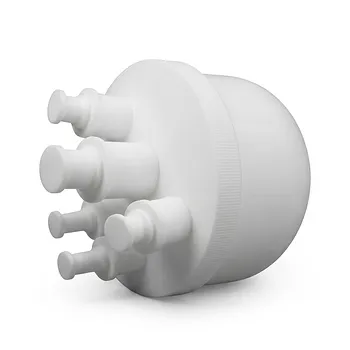
- Custom Multi Neck PTFE Flask for Chemical Engineering and High Purity Laboratory Synthesis Applications
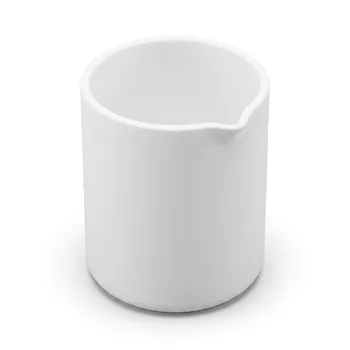
- Custom Thickened PTFE Beaker 3000ml Hotplate Heating High Temperature Deformation Resistant Fluoropolymer Labware
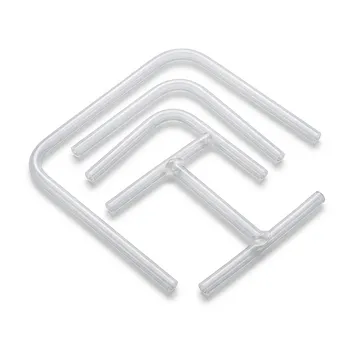
- High Purity PFA Coiled Tubing Custom PTFE Machining PFA Welding and Precision Bending Solutions
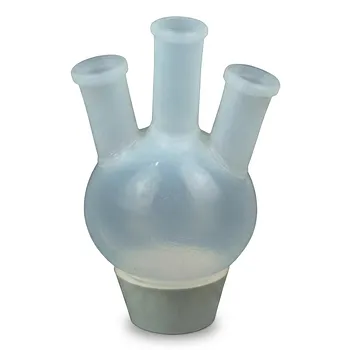
- Custom Corrosion Resistant PFA PTFE Multi Neck Laboratory Reaction Flask GL Standard Mouth Fluoropolymer Flasks
- High Purity PFA Chromatography Column with Collection Bottle Corrosion Resistant Fluoropolymer Filtration System for Trace Analysis
People Also Ask
- How does the molecular structure of fluorinated polymers contribute to the extreme thermal stability and chemical resistance required for high-performance laboratory reaction vessels and digestion containers? Discover the science behind PTFE and PFA for your lab.
- How do PTFE fluoropolymer laboratory vessels and tubing handle exposure to different types of organic solvents? Discover key insights for optimal solvent compatibility.
- How does hardware selection optimize research? Enhance Workflows with Custom Reaction Vessels
- How do pyrolysis temperature and steam diluent ratios influence tetrafluoroethylene (TFE) conversion and yield in fluoropolymer monomer reaction apparatus? Optimize TFE yield with temperature and steam control
- How is Teflon classified in terms of plastic types? A Guide to Thermoplastic Fluoropolymers